Hamad Airport partners with Atos and Royal Schiphol Group to implement digital passenger assistance kiosks

DIGITAL TRANSFORMATION | ON THE GROUND | WAYFINDING & PASSENGER SERVICES // SEP 2023

Hamad International Airport, in partnership with Atos and Royal Schiphol Group, has introduced Passenger Digital Assistance Kiosks as part of “overarching digital strategy to transform passenger experiences”.

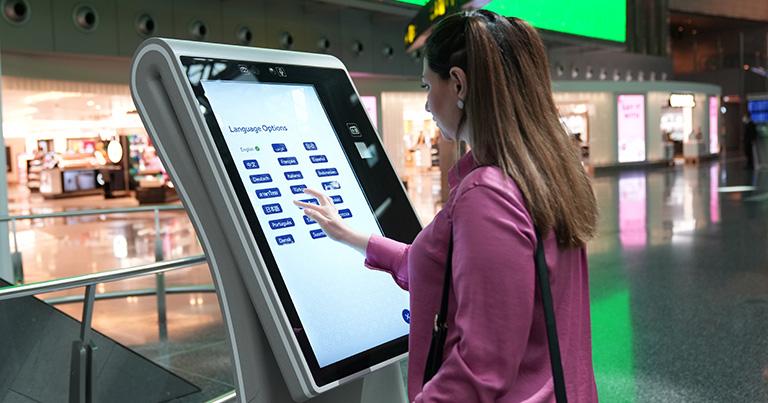
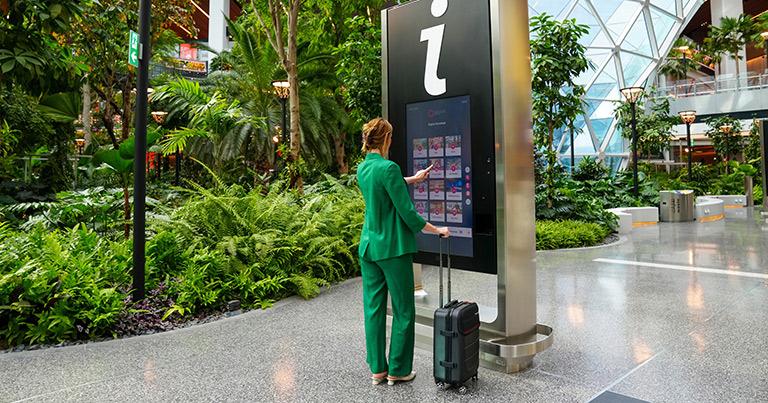
Hamad International Airport, in partnership with Atos and Royal Schiphol Group, has introduced Passenger Digital Assistance Kiosks to enable seamless journeys for travellers. The kiosks provide easy access to information, assist in navigation and help passengers through live video calls to customer service agents.

“The new Passenger Digital Assistance Kiosks are part of our overarching digital strategy to transform passenger experiences,” said Suhail Kadri, Senior Vice President of Technology and Innovation, Hamad International Airport. “We are committed to investing in the latest technology and innovative solutions; to create the most seamless airport experience for all passengers traveling from and to Hamad International Airport, we are working with industry innovation leaders such as Atos and Royal Schiphol Group.”

The kiosks are multilingual with 20 language options. With the airport map for wayfinding, tey provide information related to flights, airport services, retail and F&B outlets and passenger events at the airport.

“Together with our strategic partner Schiphol, we are proud to have successfully delivered this solution at Hamad International Airport to improve the digital passenger experience, and to manage passenger flow more effectively especially during the airport’s critical peak periods,” said Marc Veelenturf, CEO of Middle East and Turkey, Atos.

Hear more from Hamad International Airport at FTE Global, Los Angeles, 19-21 September 2023. Suhail Kadri, Senior Vice President of Technology and Innovation, Hamad International Airport is speaking in the Future Airports conference track in ‘The Airport Technology Leaders Conversation’.

source : https://www.futuretravelexperience.com/2023/09/hamad-airport-partners-with-atos-and-royal-schiphol-group-to-implement-digital-passenger-assistance-kiosks/

Sustainable Journey: Navigating the Future of Aviation

The demand for sustainable mobility is growing rapidly while at the same time, the fight against climate change and atmospheric pollution has emerged as one of the paramount challenges for the European transportation sector. According to the EU Sustainable & Smart Mobility Strategy, the gradual change and modernization of European transportation should give way to a fundamental transformation. The scenarios presented in the EC’s strategy, aligned with those supporting the 2030 climate target plan, suggest that—with the right level of ambition—the combination of policy measures detailed in this strategy can achieve a 90% reduction in transport sector emissions by 2050. Air transport is increasingly perceived as one of the key carbon-intensive sectors. It’s often labelled a hard-to-abate industry, primarily because of technological limitations that make it difficult to directly reduce carbon emissions. The recently adopted EU policy measures and regulations, intended to make transport more sustainable, have established a stringent framework for the aviation value chain. In the absence of revolutionary net-zero aviation fuel and propulsion technologies, the aviation sector faces a monumental task to achieve the carbon dioxide emission targets set by the European Green Deal, among other EU strategies and policies. Currently, the largest infrastructure project in Europe is being built in Poland – Centralny Port Komunikacyjny. CPK is a planned multi-modal transport and interchange hub that will integrate air, rail and road transport in the region. As part of the project, a new airport and a major rail hub will be built in the centre of Poland, connecting CPK with the rest of the country and other European countries via newly constructed high-speed railway lines. In its commitment to combating climate change and fostering a shared green future, CPK has embedded sustainability into its investment programme from the very beginning. The aim is to transform the mobility industry in Poland and Central and Eastern Europe. Highly ambitious climate mitigation and pollution reduction targets have been set during the planning and design phases, positioning CPK to become the first “Net-Zero Ready” airport in the region upon its inauguration. This undertaking aims to set new standards for green airports globally. This unique sustainable strategy will be showcased by CPK in collaboration with LOT Polish Airlines at the event titled “Sustainable Journey: Navigating the Future of Aviation”. The presentation, which will bring together representatives from the European Commission, CPK (the new Polish airport investor and its future operator), LOT (the Polish national air carrier), IATA (The International Air Transport Association), and industry experts, will culminate in a panel discussion. This debate will focus on ensuring European aviation’s sustainability without undermining its global competitiveness and will also contemplate potential solutions, opportunities, and recent proofs of concept. Organised by: CPK Media Partner: Euractiv

This Airport Is About to Go Passport Free

Soon you’ll only need your face to travel through Singapore’s Changi Airport.

Green plant–filled interior of Rain Vortex in Singapore’s Changi Airport

Singapore’s Changi Airport is switching to biometric technology, which should speed up the security process, giving travelers more time to explore the airport. 

Courtesy of Jewel Changi Airport.

With the world’s tallest indoor waterfall, a terraced tropical garden with more than 900 trees and 60,000 shrubs, and a walking path dotted with life-size dinosaur sculptures, Singapore’s Changi Airport is consistently ranked the best in the world. And soon, it’ll also be one of the most high-tech.

Starting sometime in the first half of 2024, you won’t need to show your passport if you’re traveling through Singapore. All you’ll need to pass through security and immigration is your face—the airport is switching to biometric technology and facial recognition technology instead of having agents physically check travel documents to move travelers through the airport more quickly.

“Biometrics will be used to create a single token of authentication that will be employed at various automated touchpoints, from bag-drop to immigration and boarding,” the country’s communications minister, Josephine Teo, said in a speech to Singapore’s parliament on September 18. “This will reduce the need for passengers to repeatedly present their travel documents at these touchpoints, allowing for more seamless and convenient processing.”

In just August 2023, more than 5.15 million passengers transited through Changi, which is still shy of the nearly 6 million passengers the airport saw in the same month in 2019. As the tourism industry continues to recover from the effects of the pandemic, that number is expected to rise, especially after the completion of Changi’s Terminal 5 (slated for around the mid-2030s).

“Our immigration systems must be able to manage this high and growing volume of travelers efficiently and provide a positive clearance experience while ensuring our security,” Teo said.

Already, Changi uses the technology for automated lanes at immigration. And while you won’t need to flash your passport in the Singapore airport once the new tech goes into effect, you will need to bring it on your travels, as it will still be necessary when you land in another country and upon returning home from abroad. (And it’s a good idea to keep on hand in case customs officers need to double-check your documents.)

Singapore isn’t the only airport that is increasing its reliance on biometric technology and facial recognition. Those flying Emirates through Dubai (specifically those using the Terminal 3) can board their aircraft with just facial recognition by the end of the year.

Europe is working on a new tech-driven Entry/Exit System (EES) that will keep track of visitors as they cross borders. And in the United States, biometric face scanners are already in use at Global Entry kiosks, and some airlines (like United, American, Delta, and JetBlue) are testing facial recognition technology for check-in, bag drops, and boarding at select gates.

source : https://www.afar.com/magazine/singapores-changi-airport-will-soon-go-passport-free

New technology at Detroit Metro Airport aims to speed up the travel process

If you’ve traveled lately at Metro Airport, you might have seen a display that takes you into a parallel universe

You’ll notice it right after you go through security at the McNamara Terminal at Metro Airport. It’s a big-screen offering something called parallel reality to help passengers figure out where to go. If you’ve traveled lately at Metro Airport, you might have seen a display that almost looks like it might take you into a parallel universe. Okay, not quite.

DETROIT – If you’ve traveled lately at Metro Airport, you might have seen a display that almost looks like it might take you into a parallel universe.

Okay, not quite.

It’s a brand new technology to help you get your travel itinerary personalized—no need to scan that big board trying to find your flight amongst the hundreds of others. Delta has customized the big board just for you.

“Ohhh, that’s so cool,” said one passenger. “Oh my God! That is awesome.”

The big arch and information desk just past TSA is getting all kinds of reactions for passengers traveling through Metro Airport.

Passengers like the Aadhi family had never seen it before and wondered what it was.

“I was kind of surprised,” said passenger Harshita Aadhi. “I didn’t know exactly what I was looking for because they didn’t tell us what we were looking for and when I saw my name, I thought can everybody see my information? And then I realized my sister could only see hers.”

“My first name is up there, and it says what medallion status I have, which gate, how many minutes I have to walk there,” said passenger Sangeetha Aeisekaran.

With each Delta passenger walking through, the board displays only their travel itinerary.

“I see that there’s nothing on the screen,” said passenger Virgil Flowers.

“But what do you see for you,” said a Delta information agent.

“I see that there’s ‘hello Virgil,’” Flowers said. “Thank you for flying Delta. Gate 30a. Three-minute walk.”

“The display fundamentally can direct different contents towards each person that looks at it,” said Albert Ng, CEO of Misapplied Sciences, the company that created the technology. “Above us is a motion sensor that detects moving objects as they’re moving around, and when one of these moving objects scans their boarding pass, that’s how the display knows to direct that flight information towards that moving object as they’re walking around.”

The display can show personalized flight information for up to 100 travelers at one time.

How it all works is pretty simple.

All you have to do is walk up to the desk, scan your boarding pass, and your boarding information is displayed on the big screen only for you to see. The technology behind it is what makes it all possible.

“It’s in the pixels of the display itself,” said Ng. “Each pixel is capable of controlling the color of light that it projects in many different directions. But right now, I’m only seeing a blank airplane because I didn’t opt-in or scan my boarding pass.”

“You don’t see anything on the screen?”

“Nope,” Ng said. “So if the camera can pan back behind my head, you can see that I’m truly not seeing anything.”

“The digital ID technology was first tested at Delta here in Detroit among the employees,” said Delta’s Hussein Berry.

The parallel reality experience has been a few years in the making through a partnership between Delta and Misapplied Sciences. It was just unveiled for public use for Delta travelers on June 28, and Metro Airport is the first airport in the world to use.

“Well, it’s helpful,” Flowers said. “Just because I’m thinking, where do I go from here? So absolutely, it’s definitely helpful.”

The goal is to eventually spread this technology to other airports across the country and the world. Another cool thing to note is that the board will also display in whatever language you prefer as well.

More details : http://tinyurl.com/34v55d7r

Generative AI, the good, the bad, and the risky

by Gustavo Pina Director of SITA Lab

Gus Pina is the Director of SITA Lab, the company’s strategic research and development arm. Created in 2008, SITA Lab explores new technology. It drives innovations for the air transport community, working independently and in partnership with others on pilot projects in robotics, big data, AI, wearable technology, and many others.

With 25 years in the IT industry, Gus has always been passionate about transforming business processes with emerging technologies. Prior to SITA, Gus spearheaded key roles in digital transformations across FedEx, Delta Air Lines, and Macy’s. We spoke to him to determine what drives SITA’s innovation roadmap.

The evolution of AI in chatbots

The last year has seen significant announcements and global public attention towards emerging Artificial Intelligence (AI) and Large Language Model (LLM) platforms like ChatGPT. Capturing both the public’s imagination and sparking fears around the rapid evolution of these transformative technologies, many industries are now speculating over the future of their products and services in a shifting technological landscape.

Chatbots and virtual assistants are among the most common use cases of customer-facing generative AI in the air transport industry. The rise of chatbots and virtual assistants expanded in the 2010s with the likes of Siri and Alexa. Like many other customer-facing industries, the air transport industry started leveraging the trend for AI-driven chatbot customer services.  

Before the availability of generative AI technology, chatbots were relatively limited in capability and required significant investment in development, training and tuning. Generative AI, and in particular LLMs such as ChatGPT, can make the user experience much richer without the resource of expensive machine learning training. They also provide a much broader knowledge base to work from.

Back in 2017, a small percentage of airlines and airports used AI-driven chatbots. We predicted that by 2020 68% of airlines and 42% of airports would have plans to adopt AI-driven chatbot services offering customer support. 

Our latest Air Transport IT Insights finds that the adoption of AI will continue to increase: airlines (76%) and airports (68%) are planning major programs, or R&D, for AI by 2025. 

Some of these programs today are directly customer-facing. For example, Etihad plans to use AI to enable passengers to book flights: Etihad Becomes The Latest Airline To Embrace AI Chatbots (simpleflying.com).

Clearly, while AI, and generative AI, are still relatively new, they have the potential to transform travel. 

Harnessing AI in the air transport industry today

As a global IT and communications provider for the travel and transport industry, we continuously explore and leverage emerging technologies to transform business models and processes – to help the industry reduce costs, overcome operational hurdles, and improve the passenger experience.

Starting with our SITA Lab innovation team and expanding across our product portfolios, we thrive on solving the industry challenges of today and tomorrow. SITA Lab explores new technology and drives innovations for the air transport community, working independently and in partnership with others on pilot projects in robotics, big data, AI, wearable technology, and many others.

While there are risks, generative AI’s opportunities for the air transport industry are immense. As part of our continuing work around AI, we are exploring numerous use cases to streamline processes, drive new operational insights and improve collaboration between airlines, airports, governments, and other stakeholders.

For instance, much process interaction between these stakeholders is through text-based document exchange (for legacy reasons). LLMs make it possible to extract meaning and intent from these human-readable documents into machine-readable and interpretable information. This bridge from human-readable text to digital computer interfaces will enhance greater collaboration and knowledge sharing, speeding up processes and enhancing industry efficiencies.

Today, we use AI, including machine learning, for data analytics, in several ways. See a few examples outlined below: 

(1) We offer SITA OptiClimb® as part of our SITA OptiFlight® suite of solutions, the industry’s only machine-learning solutions that analyze aircraft data and weather to optimize fuel and flight paths. The SITA OptiClimb® solution, aimed at airlines, delivers fuel savings of 5% for each flight while reducing annual CO2 emissions by thousands of tons and operational costs by millions of dollars.

(2) Our SITA WorldTracer® Lost and Found Property leverages machine learning and several other emerging technologies to solve the global multi-million lost property problem by handling lost and found issues promptly and accurately, reuniting passengers with their lost property, and ensuring GDPR compliance. 

The technology behind the solution searches a global database of images and descriptions to match the found item to a missing item report. The solution uses image recognition to identify details such as the missing item’s brand, material, and color. It also recognizes similar words in the description to make a definitive match. 

Lost and Found Property cuts the cost of repatriating lost items by 90%. Airline employees can register a found item, create a missing item report, and validate a match in under two minutes. The solution also dramatically speeds up the time taken to find and return found items, with 60% of these items returned within the first 48 hours.

(3) Our border technologies are leveraging AI too. For example, we use it in our biometric identification technologies that support more modern border control procedures to increase security, improve border agencies’ operational efficiency, and generally provide a more pleasurable immigration experience for the traveler. 

We use AI to rapidly improve the performance of face recognition software to a point where they meet and even exceed the performance of other biometric modalities, such as iris and fingerprint, while being more convenient. A combination of more powerful edge processors with machine learning models is enabling face recognition on devices like mobile phones and smart security cameras.

(4) In our SITA Lab, we are developing next-generation digital assistants that leverage LLMs to create much richer chatbot-type interfaces than the first-generation chatbots. These bots have access to a combination of airport manuals, passenger points of interest, and real-time operational data. These assistants can be deployed at the airport to augment existing information service desks or within airline and airport apps.

We are also developing digital assistants to assist with airport operations systems. The assistant can provide advice on routine operational decisions, freeing up time for the airport staff to deal with more complex scenarios.

(5) AI is being used to help us resolve our airport customers’ technical issues, enhance communications, and increase customer self-service through virtual agents.

Here at SITA, we see great potential for generative AI across the entire travel and transport industry and we will leverage more of it to improve the effectiveness of our solutions and services to support the industry.

Assessing the risks of AI

There are many opportunities that we are exploring with AI. Of course, AI has several potential risks, from privacy violations to discrimination.

In addition to the traditional machine-learning risks, generative AI brings a new category of risk. The most commonly known is when ChatGPT ‘hallucinates’ and provides answers that sound convincing but are wrong or just invented. In the case of LLMs, careful use of Prompt Engineering and limiting the LLM to a specific data source (such as an airport’s operations manual) can prevent this from happening.

Until trust in these systems is established, it is important to have a human in the decision-making process and to build guardrails to autonomous systems.

source : https://tinyurl.com/49j6d3wk

Hamad Airport launches new navigation and digital customer service solution for “seamless and enhanced airport journey”

Hamad International Airport is elevating its passenger experience with innovative digital wayfinding. QR codes are leveraged to provide an easy to use wayfinding solution through different digital touchpoints.

Hamad International Airport is elevating its passengers’ airport experience with the introduction of innovative digital wayfinding. QR codes are leveraged to provide an easy to use wayfinding solution through different digital touchpoints located across the terminal.

Whether trying to navigate from ORCHARD to LampBear, wanting to try one of the many dining or retail experiences at the airport, or finding a departure gate, the aim is that passengers will experience frictionless wayfinding.

The QR Codes are available across the airport through Flight Information Display Screens, Passenger Digital Assistance Kiosks and other key touchpoints. The new digital solution is compatible with all mobile devices and passengers can seamlessly connect to Hamad International Airport’s next-generation Wi-Fi to use the service.

“We are constantly reviewing and evaluating our multiple digital touchpoints for passengers to ensure we meet their requirements,” said Suhail Kadri, Senior Vice President of Technology and Innovation, Hamad International Airport. “By investing and utilising the latest innovative technological solutions and listening to global passenger requirements at our airport, we will continue to set and exceed industry standards.”

Digital Concierges located at ORCHARD include information about retail and F&B offerings, flight information, relaxation and rejuvenation options, and attractions at the airport. Travellers can scan the QR code to navigate to their chosen point of interest on their mobile.

The airport has also introduced the Passenger Digital Assistance Kiosks, which are located at the North Plaza and around the iconic LampBear to further enhance the passenger experience.

As part of its digital transformation strategy, Hamad International Airport is constantly investing in the latest technology and innovative solutions designed to “optimise operations and provide a seamless and enhanced airport journey for passengers”.

source : https://www.futuretravelexperience.com/2023/08/hamad-airport-launches-new-navigation-and-digital-customer-service-solution-for-seamless-and-enhanced-airport-journey/

The New Sustainable Travel Journey

Jeremy Aniere, Vice President of Operations, Singapore & General Manager, Pan Pacific Singapore, Pan Pacific Hotels Group; Jason Loe, Founder, Tribe; Gerald Ng, Vice President, Environment & Sustainability, Changi Airport Group, discuss how they are cultivating more sustainable travel experiences and contributing to a greener and more inclusive future. (Source: Bloomberg)

https://www.bloomberg.com/media-manifest/embed/iframe?id=f1cacf2c-8f6a-4849-934e-ad05dfe0bc58