

The New Sustainable Travel Journey
Jeremy Aniere, Vice President of Operations, Singapore & General Manager, Pan Pacific Singapore, Pan Pacific Hotels Group; Jason Loe, Founder, Tribe; Gerald Ng, Vice President, Environment & Sustainability, Changi Airport Group, discuss how they are cultivating more sustainable travel experiences and contributing to a greener and more inclusive future. (Source: Bloomberg)
https://www.bloomberg.com/media-manifest/embed/iframe?id=f1cacf2c-8f6a-4849-934e-ad05dfe0bc58
Hamburg Airport on The Way to Becoming a Hydrogen Hub: EU Funds The “Baltic Sea Region Project”
Hamburg Airport on the way to becoming a hydrogen hub: EU funds the “Baltic Sea Region Project”.
Hamburg Airport is taking the next big step towards becoming a hydrogen hub in the general aviation sector. As part of the EU’s Interreg Baltic Sea Programme, the “Baltic Sea Region Project” initiated by Hamburg Airport will receive support in the “Green Mobility” funding category.
The project aims to better connect rural Baltic Sea regions to existing aviation hubs with hydrogen-powered small aircraft. The project “BSR Hydrogen Air Transport – Preparation of Baltic Sea Region Airports for Green Hydrogen” is expected to start in November 2023. The project is scheduled to last about three years and involves 16 project partners and 24 associated organisations in addition to Hamburg Airport.
The project budget is up to 4.8 million euros, of which about 1.1 million euros will be allocated to Hamburg Airport. The project partners expect EU funding of around 80 percent.
Important contents of the “Baltic Sea Region Project” are the development of the supply chain for green, gaseous hydrogen from production to the fuelling of aircraft or airport ground equipment, as well as test operations. Almost all major airport operators around the Baltic Sea are part of the partnership, e.g. Finavia, Swedavia, Lithuanian Airports, Riga Airport, Tallinn Airport.
The project development and application was initiated by Hamburg Airport, the lead partner of the partnership. As the project aims, among other things, at revitalising regional air traffic, several smaller airports and regional airlines are also involved in the partnership. Relevant technology providers, universities and authorities are also partners or associated organisations.
In Germany, Sylt Airport, Sylt Air, Lübeck Air and Lübeck Airport are project partners. In addition, there are the following associated organisations: Ministry of Economics, Transport, Labour Technology and Tourism of the State of Schleswig-Holstein (MWVATT), Hamburg Aviation e.V., ZAL Zentrum für Angewandte Luftfahrtforschung, Hamburg Authority for Economics and Innovation (BWI).
Especially for smaller aircraft: Hydrogen as the engine of the future
Michael Eggenschwiler, Chairman of the Executive Board at Hamburg Airport:
These are exciting days for the future of aviation.
“We recently announced our cooperation with Rotterdam The Hague Airport on a flight connection for hydrogen-based aircraft, and now we are getting the green light for the Baltic Sea Region Project. It is no coincidence that Hamburg Airport is one of the drivers of innovation: as an airport, we have set ourselves the goal of reducing our CO2 emissions to zero by 2035 and completely foregoing compensation.”
“So it is only logical that we also make a concrete commitment to an environmentally compatible future for aviation. As a hydrogen hub, we can contribute to this development very well.”
Jan Eike Hardegen, Head of Environment at Hamburg Airport:
Hydrogen offers great potential for climate-neutral flights on short-haul routes.
“General aviation with smaller, future hydrogen-powered aircraft is particularly suitable here. Gaseous hydrogen is the propulsion of the future, especially for smaller general aviation aircraft, such as turboprops with 20-30 seats.” These aircraft can also be used to connect more rural regions of the Baltic Sea countries according to demand. Therefore, the primary goal of the initiated “Baltic Sea Region Project” is to power hydrogen-based air transport in the Baltic Sea region.
Real H2 demonstration flight from Hamburg planned
The project aims to clarify the prerequisites for an airport infrastructure that is geared towards H2-powered aircraft. At the end of the project, all airports should be prepared to invest and implement their infrastructure projects on their own.
At the end of the project period, a real demonstration flight with a hydrogen-powered aircraft is planned from Hamburg Airport. With this project, Hamburg Airport wants to work out the possibilities of general aviation in H2 technology. In addition to this development aspect, a completely new network of flight connections is also to be opened up.
Net Zero 2035: Hamburg Airport supports climate-friendly flying
With its climate strategy “Net Zero 2035 – Now. For the Future”, Hamburg Airport aims to reduce the airport city’s greenhouse gas emissions to zero by 2035 – as the first major airport in Germany to do so. In addition, Hamburg Airport supports air traffic on its way to a CO2-free future.
The goals of Net Zero 2035 include active support for research and development: the “Baltic Sea Region Project” is an example of how alternative propulsion options can further advance aviation in the field of climate-friendly flying.
read full article here : https://hydrogen-central.com/hamburg-airport-way-becoming-hydrogen-hub-eu-funds-baltic-sea-region-project/
How is Tallinn Airport aiming to be net zero by 2030?
Riivo Tuvike, CEO at Tallinn Airport, is back writing for IAR’s Cleaner, Greener Airports Series and details the work going into achieving the airport’s aims to be carbon neutral by 2025 and to become a net zero hub of air travel by 2030.
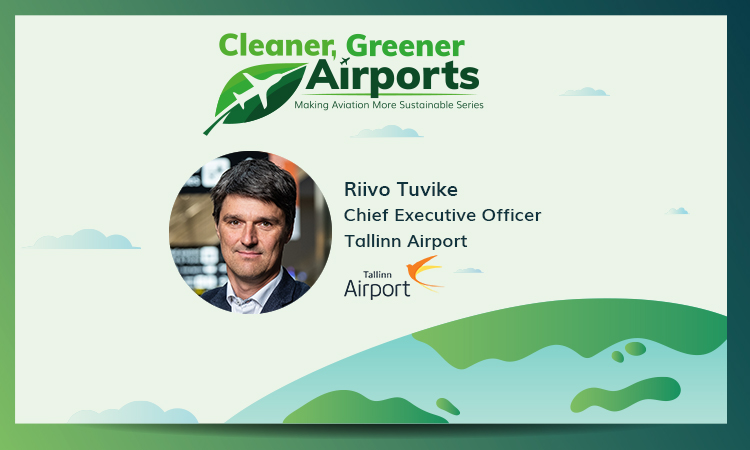
How is Tallinn Airport aiming to be net zero by 2030?
Riivo Tuvike, CEO at Tallinn Airport, is back writing for IAR’s Cleaner, Greener Airports Series and details the work going into achieving the airport’s aims to be carbon neutral by 2025 and to become a net zero hub of air travel by 2030.
Tallinn Airport will never be the biggest airport in the world, but it is the world’s cosiest, and people have a lot of love for it. It is, after all, just 5km from the city centre (a rarity for a capital city), bordered by forest and on the shores of Lake Ülemiste. This certainly makes for pretty landings, and it gives arriving passengers a true sense of what Estonia’s like. But at the same time, it presents a major challenge, since the impact of our operations is felt, and is visible, immediately over the fence line.
Tallinn Airport has invested almost €80 million in sustainability since 2012. This has resulted in a significant reduction in our carbon footprint – 25% between 2018 and 2022 alone. Achieving these sorts of transformations is never easy, but with determination to mitigate environmental impact and set an example to others, it can be done.
How did Tallinn Airport bring about such a substantial reduction in its CO2 emissions?
We pinpointed our biggest sources of carbon emissions and set about lessening them. Green issues have been in greater focus at the airport over the last two or three years, in which time we’ve made several initiatives and achieved our most significant reductions.
As for the sources of emissions and how much we’ve been able to limit them, the fact that we operate 24/7, like so many airports around the world, means our buildings and runway have to be constantly lit and our facilities heated and fully functional. As such, electricity, heating and our fleet of vehicles account for the majority of our CO2 emissions.
To reduce emissions (and costs) from the use of electricity, we started constructing solar farms in our airports all over Estonia in 2020. This meant we also started using green energy, which has helped us cut emissions in 2022 from electricity by 11% compared to 2019. A total of 15 solar farms around the country, with total peak power capacity of 6.5MW, now power our airports. Last year we covered 14% of our electricity needs from our solar farms, while this year we predict that the farms will generate up to 40% of the energy we require. In May alone, parks produced 54% of our electricity consumption. In sunny weather, the farms at our regional airports produce more electricity than the facilities there can use. In addition to reducing carbon emissions, the solar farms have helped us cut costs and make gainful use of land that would otherwise have stood empty.
To take further steps forward from here, we’ve decided to buy in and use only renewables-based electricity from 01 January 2024. This means that by next year our carbon emissions from electricity will have been reduced to a minimum.

CEO of Tallinn Airport, Riivo Tuvike
Our airport may be small, but it still covers a lot of ground, and inevitably we have to use vehicles to get around. Here, too, we have to take a smart approach. Estonia’s situated in a climate with four distinct seasons. This means we get both sleet and snow, as well as heatwaves and dry spells. Such varying conditions are a challenge for the technology we use and for us in trying to make it all as green as possible. Our view is that ‘green’ doesn’t necessarily mean ‘new’ – rather that you have to be inventive in maximising your efforts to make your existing equipment more sustainable and replacing it gradually, making smart choices along the way.
Make what you’re already using greener!
It’s important to us to get the most out of the technology we use, not just to replace something so that it would run on electricity. After a successful test period, we stopped buying in diesel made from fossil fuels in June, and by the end of the year at the latest we’ll be solely using Neste MY paraffin fuel produced from renewable sources within the airport boundaries
This new fuel will have to be used by all of the airport vehicles that operate outside of the airport grounds as well, starting from next year. This will help us reduce our annual carbon emissions from fuel by 90% or more, which is to say by 1,200 tonnes in total, or 3.3 tonnes of CO2 per day.
We’ll also be using this sustainable fuel in our generators.
In everything new we buy, we go for the greenest options
Wherever possible, we’ve already adopted or will shortly be adopting green technology. For example, at the start of the year we introduced electric cars for our ground staff to use for servicing aircrafts. These replaced the small cars we previously used, which consumed around 2,500 litres of fuel per car per year. This has reduced our annual carbon emissions into the air by more than 17,000kg. Also zooming through airport grounds now are electric scooters, which have been a big hit among staff and passengers alike. They’re helping to limit our use of four-wheeled vehicles, further reducing our CO2 emissions. Quite a few passengers have posted photos and videos of our workers zipping around on scooters on social media, adding that it’s something you’ll only see at the world’s cosiest airport. We also use green tech in servicing aircraft, whether it’s battery-powered ground power units (GPUs) or electric push-back.
To promote and simplify the electrification of technology, we’ve started building a charging network at the airport, with the charging points for the use of both staff and passengers. We’ve set ourselves the goal of there being no airport vehicles running on fossil fuels by January 2028.
The total area of the buildings at the airport is 93,563m², and it unavoidably takes a lot of energy to heat them all. But keeping rooms warm doesn’t have to come at the cost of the environment. Up until November last year we used gas to heat our buildings, but the geopolitical situation and our wish to reduce the impact of our operations on nature drove us to look for more sustainable and dependable solutions. As such, we decided to switch from gas to district heating – two thirds of which is produced from renewable sources, including wood chippings. This transition will help us reduce our CO2 footprint from heating by almost 20%. To amplify the positive impact of district heating, our end goal is for the heating energy we use to be entirely generated from renewables. We’ll never eliminate the environmental impact of heating altogether, but it’s important to us to minimise it.
A net zero airport by 2030
Looking after the environment and operating sustainably have become integral parts of our everyday activities, and the realisation that we need to act now has forced us to reassess our actions and objectives. In early summer we cast a critical eye over our goals, making changes to them which now see us aiming to achieve a net zero airport five years earlier than originally planned. We’re delighted to announce that Tallinn Airport will be carbon neutral by 2025 and a net zero hub of air travel by 2030.
This will take a lot of work and smart decisions on our part and require the cooperation and involvement of our employees and partners. Our goal is to get our partners involved in both the planning and implementation phases, to which end we’ve already started mapping out our Scope 3 partners – the airport and its partners form a whole, and every member of staff and every company we work with shares our principles and values. It’s important that everyone at the airport, staff and passengers alike, does what they can to mitigate their own personal impact on the environment. For this it’s important that we raise awareness, too, which is why we’ve already established a platform we call ‘Green Mornings’ to share knowledge and best practice with our partners and to work with them to map out the areas in which the airport and they themselves can take steps for the benefit of the environment.
We get our partners involved from the very beginning of the procurement process – we consider it important that the products we’re supplied with and the services we’re offered have as limited of an impact on nature as possible. That’s why we are implementing environmental requirements as an inseparable part of procurements.
Tallinn Airport has repeatedly been named one of the best airports in the world not only for being so cosy and so quick to get around, but also for offering such good service. However, clients’ expectations are changing, with sustainability becoming increasingly important to them. If we want to remain competitive, continue to develop and maintain our reputation as an attractive employer with a worthy mission, we too must change – and that’s exactly what the airport is doing. These changes start in each and every one of our staff and passengers, the role of the airport being to offer them the kind of knowledge and infrastructure that supports the green transition.
Tallinn Airport’s goal is to ensure the sustainable and responsible operation of the airports belonging to the group and the provision of high-quality services, while preserving the natural environment and reducing emissions.
Read more at source : https://www.internationalairportreview.com/article/187921/how-is-tallinn-airport-aiming-to-be-net-zero-by-2030
How Lidar improves airport operations
Digital Mortar CEO Gary Angel highlights the increasing role of Lidar in people measurement and why it’s particularly important in airports.

Moving people is what airports are all about. Yet, paradoxically, non-aeronautics airport operations managers often have huge gaps in their knowledge about what passengers do – gaps that stem from the difficulties inherent in measuring people, not things.
Knowing how long passengers had to wait in line, how much traffic passes-by retail and concession locations, what the conversion rate is for each of those locations, whether curbside pickup areas are jammed, when there weren’t enough taxis, and how long the passenger journey took from parking to gate; these are fundamental facts that influence operations and passenger experience.

While this kind of measurement isn’t easy, it’s become much more practical with the advent of new technologies that can measure how people navigate physical spaces.
The technologies to do this are called ‘people measurement’ sensors. They map customer behaviour within a physical space. They do so in great detail, and they do it anonymously.
Light Detection and Ranging (Lidar), in particular, has emerged as a great tool for ‘people measurement’ in very large spaces. Lidar sensors provide great overall tracking, more reliable measurement of people, more precise tracking of their movement, and better privacy protection than previous technologies.
How Lidar Works
Lidar sensors are like radar, but with light. They shoot out invisible beams of light (infrared) and then measure how long it takes for the beam to reflect back. This lets them create a 3-dimensional map of an area (called a point cloud) and identify objects (including people) in the location.
By repeatedly sweeping an area and tracking whether and how objects move, a lidar sensor can track individual objects over time and map their entire path throughout even large and complex spaces.
Since lidar is just creating a radar image, it can’t be used to identify someone. This makes lidar nearly perfect from a privacy perspective. Even if a lidar sensor is hacked by a malicious actor, it can’t be used to identify a specific person.
Because lidar generates its own light, it isn’t dependent on good lighting. It can work indoors and out. And it can work in all but the very worst weather conditions. What’s more, because lidar beams carry a very long distance, lidar isn’t dependent on having ceilings of a specific height or even being ceiling mounted at all.
The combination of privacy, coverage and environmental flexibility make lidar especially appropriate for airports where every one of those capabilities is fully exercised.
Lidar is an extraordinary tool for ‘people measurement’. It provides highly reliable people identification (better than 98%), precise positioning (down to single square feet), and it tracks an object’s movement 10 times a second, meaning that it will literally measure every step a passenger takes.
It’s also worth calling out that while this section is titled ‘people measurement’, the capabilities of lidar detection are not limited to people. Lidar can track any kind of moving object in its field of view. That means lidar can be used to monitor curbside areas, taxi lines, valet areas, and parking lots, helping you monitor and count special use cases and passenger needs.
What Does it Take to Use Lidar?
Installing lidar sensors is the first step. These are typically smaller than cameras but are similar from an installation perspective. Unlike cameras, Lidar can be mounted in almost any location. They are typically mounted well over the scene so that you minimize people blocking people, but they can work with a variety of angles and mounting heights.
Because lidar sensors have a large area of coverage, line-of-sight considerations are frequently paramount in planning implementation. Knowing how many sensors to deploy to get good measurements can be tricky. Fortunately, there are simulation tools available that make the job far more scientific and far less error-prone.
Each lidar sensor requires a direct cable connection to a local network, to which a processor running the software that translates the raw output of the lidar sensor (Perception Software) into real information is also connected. Typically, a single processor can handle the output from 5-12 lidar sensors.
The processor running the Perception Software pipes data to a ‘people measurement’ system that can be running on-premises or in the cloud.
Look Ma, No Wires!
Because terminals are so large, cable runs are expensive, since installers will charge by the length of the run. Fortunately, there’s a way around this.
By adding a small, node processor that is directly connected to the sensor at the sensor location and then transferring processed data to a central server (via Wi-Fi) that then fuses the data from multiple sensors, you can implement large networks of lidar sensors without any wiring:
A sensor is a sensor is a sensor. If you buy a lidar sensor, you get a mechanical device. Every 10th of a second, it will produce and send a point cloud. To get usable data, you need two additional software pieces – both of which have a dramatic impact on the final quality and usability of your data.
The data produced by a sensor must be analysed by Perception Software. Real-world performance in terms of object identification and tracking is always a combination of hardware and software. Even with a highly detailed point cloud, poor Perception Software may impair the quality of tracking.
With Perception Software, however, you’re just getting a stream of timestamps and object positions. This data is filled with line-of-sight breakages and has no spatial contextualization.
So, output from the Perception Software is typically fed into a People Measurement Platform. The People Measurement Platform will clean the data, stitch tracks across line-of-sight breaks, contextualise the data to the space and supply a range of analytic functions like heat-mapping and pathing.
source for more details : https://www.airport-technology.com/comment/how-lidar-improves-airport-operations/
Hamad International Airport Wins Most Innovative Airport Initiative Award For Its Digital Twin Technology
Hamad International Airport (DOH) has once again demonstrated its commitment to innovation and excellence by adding another accolade to its name, winning the ‘Most Innovative Airport Initiative Award’ at the Future Travel Experience (FTE) Innovate Awards event. The award recognizes the groundbreaking Digital Twin platform that was introduced by Hamad International Airport and highlights its transformative impact on airport management. The award ceremony took place in Dublin, Ireland.
Implemented by Hamad International Airport and its industry partner SITA, the Digital Twin platform is revolutionizing the way airports are managed, tackling long-standing challenges and optimizing decision-making processes. Through the seamless integration of machine learning and Artificial Intelligence, the platform simplifies complex data analysis, enabling efficient and informed decision-making and ushering in a new era of operational efficiency.
The FTE Innovate Awards, presented at the co-located FTE EMEA and FTE Ancillary and Retailing event, are regarded as the industry’s definitive innovation platform. These landmark awards shine a spotlight on the latest innovation efforts of airlines and airports, allowing them to compete head-to-head and showcase their groundbreaking initiatives. Each of the shortlisted entrants were invited to present their initiatives on-stage in Dublin, where Hamad International Airport emerged as the winner among esteemed competitors.
On the airport winning the Most Innovative Airport Initiative award, Senior Vice President of Technology and Innovation at Hamad International Airport, Suhail Kamil Kadri, said: “We are delighted to have received yet another award, as we continue to invest in innovative solutions to maintain our operational excellence. Hamad International Airport is actively shaping the future of the airport industry by being at the forefront of digital twin development. This breakthrough technology will transform how operational teams consume information and make decisions – benefiting passengers, airline partners and all airport stakeholders.”
The Digital Twin platform goes beyond traditional approaches by incorporating data from ground handlers and airlines, facilitating collaboration among various aviation stakeholders. This breakthrough in cooperation will yield significant benefits for all parties involved, driving innovation and enhancing overall airport operations. The platform provides a real-time, intuitive 3D interface that offers a comprehensive view of the entire airport. By leveraging advanced analytics and integrating information from multiple airport systems, the Digital Twin delivers powerful insights and recommendations to optimize operations. It effectively manages aircraft stand conflicts, responds swiftly to alerts and monitors the health of critical airport assets. Furthermore, the platform optimizes resource utilization by providing the right data at the right time, reducing asset downtime and maximizing efficiency.
In 2022, Hamad International Airport’s Digital Twin platform received the ‘Smart Solution of the Year’ award at the Qatar IT Business Awards – underscoring the airport’s commitment to embracing cutting-edge technology and its ability to shape the future of the industry.
Voted as the world’s second-best airport at the Skytrax World Airport awards 2023, Hamad International Airport continues to invest in cutting-edge technology to maintain its status as the favored destination for millions of travelers worldwide. Its commitment to becoming the world’s leading digital air hub has solidified its position as a key leader of technology in the region.