
Hamburg Airport, cars now park themselves
Say goodbye to looking for a parking spot – at Hamburg Airport, cars now park themselves
Using a unique technology, the Volkswagen Group is currently testing autonomous parking at Hamburg Airport. Using only sensors and visual markers, Volkswagen, Audi and Porsche brand vehicles independently find their way to their parking spots.
Dubai Airports moves workforce to Box
Dubai Airports, the operator of the city’s two airports, has moved its workforce to Box,
a cloud content management company.
In 2016, the company selected Box to manage its cloud content and has now moved nearly 2,000 employees to this system.
Dubai Airport BT Infrastructure and Operations vice-president Abdulrahman Al Hosani said: “Nearly 88.2 million passengers travelled through Dubai Airports in 2017, and we are continually looking to implement new technology to create a smoother experience for those customers.
With Box, we spend less time servicing file servers and support desk tickets, and can focus on what we specialise in: providing premiere passenger experience, baggage processing, and airfield management.”
Following its deployment in 2016, Dubai Airports has leveraged various Box solutions to fulfil its requirements.
Box Governance and Box KeySafe solutions were used to classify and securely control all forms of content, while Box Zones was deployed to manage and store content in European data centres.
Box solutions were also used to collaborate with external service partners and consultants, integrate with Microsoft Office 365 and Okta as well as to centralise internal project management, digital assets and business-critical records.
Box global operations senior vice-president and general manager Tom Addis said: “Dubai Airports is a leading airport authority, consis
ently raising the bar for aviation infrastructure and technology.
“We are excited to power the future of work at Dubai Airports by providing integral, digital-first solutions to their employees and partners.”
Besides Dubai Airports, various other transportation companies, including Eurostar, Gatwick Airport and Hamburg Airport have moved to Box.
source : https://tinyurl.com/yb7d5oqd
Reckless drone users prompt detection radar trial at Auckland Airport
A drone detection radar will be positioned at the end of Auckland Airport’s runway to prevent near-misses between planes and unmanned aircrafts.
It follows two near-misses at the international airport last month including an incident where an Air New Zealand flight from Japan was approaching the runway when a drone flew so close to the passenger plane the pilot thought it was sucked into an engine.
The move by Airways New Zealand, the air traffic control organisation, comes amid calls within the aviation industry to register drones, consider a licensing system and strengthen penalties for reckless operators.
Air NZ chief operations and integrity standards officer Captain David Morgan said the pilot of NZ92 from Tokyo could not take evasive action on March 25 because the plane with 278 passengers on board was already midway through its landing descent.
“The drone was sighted at 1400ft, about five miles from the end of the runway on the approach path and went straight past the aeroplane, not far from the captain’s window.”
Drones are not supposed to be flown higher than 400ft (120 metres), within restricted airspace, over private property, at night and must be in sight of the operator.
Currently a drone sighting at an airport temporarily shuts down the airspace forcing planes to be diverted and delayed.
But an Airways trial of a drone detection radar, set to begin in about four weeks, is aimed at spotting drones up to 9km away and 1700ft (518m) in the air.
Morgan said Air NZ was very supportive of the technology.
“That will allow the guys in the [traffic control] tower to detect a drone, and then warn the pilots that it’s there.”
source : https://tinyurl.com/y7osbwef
Sigfox and Louis Vuitton partner for innovative luggage tracker
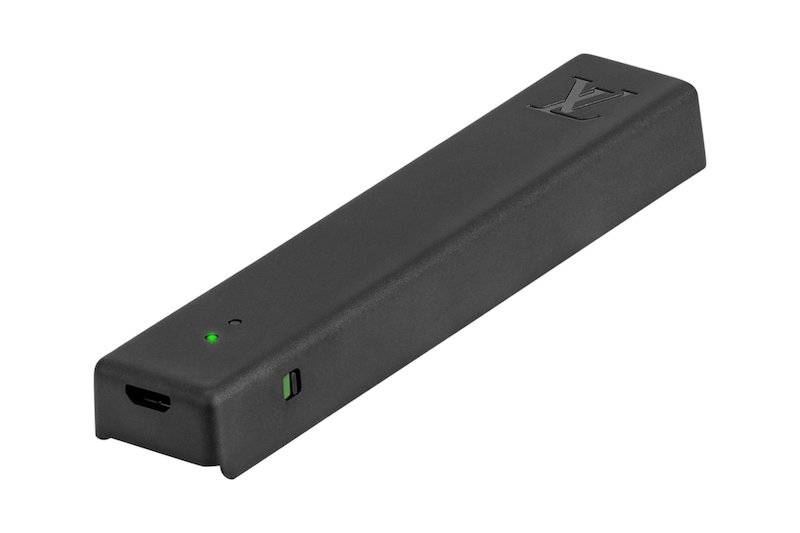
Sigfox, the leading IoT service provider, and Louis Vuitton,
the most iconic luxury brand in the world, have announced the release of a luggage tracker that uses Sigfox technology. Exclusively available with the Louis Vuitton Horizon luggage range, it allows passengers to track their checked luggage in major airports, even while travelling between different countries
The tracking device is the first to include Sigfox’s Monarch service. Unveiled at the World IoT Expo in September 2017, Monarch is a new service that enables devices to run seamlessly in all parts of the world, by automatically recognising and adapting to the local radiofrequency’s standards. As global operations are split into three geographical zones, the use of Monarch unlocks endless applications in logistics and supply chain, the consumer market, and automated maintenance for the shipping, aircraft and railway industries.
Asset tracking is the most important vertical in the massive IoT industry and Monarch represents a major breakthrough. This project is the first commercialized application of many millions that will be developed in the coming years. Sigfox’s unique value proposition is currently the only one allowing this kind of use case: a global network combined with a simple technology based on cost efficiency and low-energy consumption.
The luggage tracker is available as an additional accessory for the Horizon 50, 55 and 70 models and can easily be clipped into a pocket within the suitcase. Extremely easy to use, its low energy comsuption ensures a battery life of up to six months.
For additional information about the list of airports where the Monarch service is available, please check: https://www.louisvuitton.com/Horizon70/Airports
source : https://tinyurl.com/yczaoxgj
Is it a bird? Is it a plane? No, it’s Southampton’s new airport drone!
EAGLE-EYED bird spotters passing through Southampton Airport
recently may have noticed a species they couldn’t quite place.
Although it looks just like a falcon to the casual observer, the new arrival, named Robird®, is actually an ornithopter – a type of drone designed and flown to mimic the actions of a bird of prey, and used to deter real birds from the airport.
This innovative drone has been thoroughly trialled at Southampton Airport in partnership with NATS and the developers, Clear Flight Solutions. The successful trial means similar robot bird systems could take flight at other airports in the future.
Whilst airports employ a wide range of methods to reduce the risk, if a bird does collide with an aircraft during landing or take off – known as a bird strike – this can create a threat to flight safety.
Traditional bird scaring methods lose their impact over time and need to be backed up with lethal deterrents. The benefit of Robird® is that all types of birds see the drone as a predator and change their behaviour to keep well away. No harm comes to any bird through this method of bird control.
Dan Townsend, Southampton Airport’s airside operations and safety manager, said: “At Southampton Airport, we invest every effort to make sure our airfield is as safe as possible. Robird® is an innovative idea that we’ve found to be an effective and durable way to reduce bird strikes — so you could say this idea really has wings.”
Nico Nijenhuis, CEO, Clear Flight Solutions, said: “It has been a pleasure to be working with Ferrovial and Southampton International Airport. The professional approach to integrating Robird® into airside operations has led to a European first, with fantastic effects on bird problems and bird strikes. We are looking forward to continuing our cooperation with both parties.”
Watch video from source : https://tinyurl.com/y8v82q5j
Skyteam adds airport maps to mobile app
Skyteam adds airport maps to mobile app – Business Traveller –
The leading magazine for frequent flyers
Skyteam has launched a series of digital airport maps available through its mobile app. The maps cover all 39 of the alliance’s main hubs, including seven locations where Skyteam has branded lounges (Beijing, Dubai, Hong Kong, Istanbul, London Heathrow, Sydney and Vancouver). Skyteam said that the maps provide customers “with a clear and detailed view of their surroundings”… “from check-in and departure right through to baggage collection”.
The new maps add to existing feature of the Skyteam app.
New York’s JFK Booted Out of World’s Top 20 Busiest Airports
New York’s John F. Kennedy International Airport is no longer ranked among the 20 busiest in the world, thanks to the rush in Asia.
Among those pushing out JFK was New Delhi’s Indira Gandhi International Airport, which made its debut on the table last year at No. 16, according to Airports Council International rankings released Monday. The Indian airfield was also the fastest-growing on the list, with passenger traffic rising 14 percent, followed by 10 percent at China’s Guangzhou, which climbed two notches to No. 13.
The center of gravity for world aviation is continuing its eastward shift, with China and India poised to feature among the world’s top three air-travel markets by 2020 as rising incomes make fares more affordable, Montreal-based ACI said. The Asia Pacific region is likely to have 3.5 billion passengers by 2036, adding more than double the forecast for North America and Europe combined, according to estimates by the International Air Transport Association.
To cater to that explosion in demand, about half of the $1 trillion budgeted for airport expansions and upgrades around the world are expected to be spent in Asia, Sydney-based CAPA Centre for Aviation estimates.
Efforts by Chinese airlines to add more direct flights to the U.S. and Europe stoked passenger traffic at second- and third-tier airports last year, ACI said. Travel demand in China is expected to add 3 billion more passengers by 2040, representing 21 percent of the projected global passenger traffic growth, it said.
JFK, as in some other big cities, has other airports nearby. The combined traffic at the New York metropolitan area’s three large airports is typically twice that of JFK’s alone.
source : https://tinyurl.com/ya22uhgm
These three technology trends will define the future of travel

Automation will change how services are delivered, (Image credit: PhonlamaiPhoto/iStock-Getty Images)
Awareness and cognitive capacity for machines suggest a huge range of opportunities for those serving the travel space to completely rethink when and what to sell, how to staff and operate their businesses and how to anticipate and exceed their own customers’ needs.
2. Authenticity
“Authenticity” has emerged as a buzzword across culture and is being peddled as the cure-all for everything from politics to tacos, states the report. In a digital world trust is in low supply, so authenticity and authentic experiences are more valuable than ever. At the same time, businesses increasingly need to rely on technology and digitisation to interact with their customers at scale.
In the travel industry, for example, leisure travellers are seeking destinations and brands able to provide authentic experiences such as reliving a 1960s peace protest or providing whole-grain, organic, gluten-free, non-GMO foods for the morning breakfast buffet.

A guaranteed seat on a flight – an authentic experience for business travellers (Image credit: opolja/iStock-Getty Images)
Similarly, business travellers are seeking brands that are authentic in providing dependability and consistency in what they promise — whether that’s a guaranteed seat on a flight or a mid-sized rental car ready and waiting for an on-time pickup
In this section the report “examines and unpack “complex issues such as whether technology is in tension with authenticity, or if digital is the enemy of the real.
3. Blockchain
“2017 was the year blockchain exploded into public consciousness, led by the crypto-millionaires and billionaires riding an early wave of cryptocurrency investment; the conversation was around how to get a piece of the market and how high it might go,” Sabre says as it explores this technology.
The huge volatility in the price of cryptocurrencies has been dominating headlines but serve to overshadow the value in the underlying blockchain technology. Separating crypto hype from the actual potential of distributed ledger technology – which enable secure, “trustless” transactions to take place – can be hard to do.

Blockchain could be implemented across every industry. (Image credit: Zapp2Photo/iStock-Getty Images)
“Beyond cryptocurrencies, we’ll see a lot of real world implementations of blockchain across virtually every industry as companies and individuals experiment with how this new technology can add security and efficiency to real world problems,” the technology company points out.
It also sees “significant promise for blockchain as it relates to travel”, envisaging a future when travellers head off on a round-the-world trip without having to bring a passport or wallet.
Philip Likens, director of Sabre Labs, notes that increasingly people are starting to understand that the travel business is really a technology business.
“Even the simplest journey generates huge amounts of data. Collecting, indexing and understanding that data – and how we apply that understanding to improve every traveller’s experience – is what will drive real innovation across the entire travel ecosystem.
“Whether it is AI and machine learning to automate and optimise tasks, the counter-intuitive ability to deliver authentic experiences digitally or using new protocols (such as distributed ledgers) so a traveller can head to the airport and leave their wallet and ID at home – on purpose – tech is going to reshape the travel experience.”
• Featured image credit: bowie15/iStock-Getty Images
source : https://tinyurl.com/yaon27mb