Travellers departing Dubai can use the gates by scanning passports but arriving passengers must continue to go through immigration
Smart gates at Dubai International Airport’s Terminal 3 are operational for departing travellers.
Passengers flying out of Dubai can use the smart gates by scanning their passport, confirmed the General Directorate of Residency and Foreigners Affairs in Dubai.
Previously, passengers could operate the smart gates using a passport or Emirates ID, e-gate card or a QR bar code generated via the GDRFA smartphone app.
“The restart of the smart gates helps facilitates and simplifies the travel procedures, as the smart gates are considered the safest way to travel in light of the current conditions”, said Mohammed Al Marri, director general of the GDRFA.
No prior registration is required to use the smart gates at the airport and users do not need to be Dubai residents. The electronic gates help travellers pass through immigration more quickly.
For all travellers flying into Dubai International Airport, or those departing from terminals other than T3, the smart gates are currently not functional.
All UAE residents travelling to Dubai still need to obtain permission from the GDRFA before they can fly back to the country. Find out more about what you need to know before flying to, through or from Dubai.
In recent weeks, Dubai airports have witnessed an increase in the number of people returning to air travel, said Al Marri. The emirate reopened to tourists in July, having been closed to international flights since March in an effort to slow the spread of the coronavirus.
KLM Royal Dutch Airlines is not only one of the world’s oldest airlines; it is also one of the most forward-thinking. Today, despite the global uncertainty created by the ongoing COVID-19 pandemic and widespread cost-cutting initiatives across the industry, innovation remains as important as ever to the carrier.
Within the Transformation Office sits the Radical Innovation Team, which is responsible for orchestrating the KLM innovation ecosystem, co-creating innovation strategy, and accelerating innovation projects that focus on the most strategically important topics for the business.
“You don’t do innovation at the head office, on the eighth floor, behind your laptop; you do it where the operation is and with the people who are working there,” KLM’s Arlette van der Veer, Project Manager Radical Innovation, explains to FTE. “We have a lot of innovative colleagues throughout the company – they are scattered throughout all the different divisions and departments.”
Innovation ecosystem methodology
Much of the innovation that is happening within the airline is driven by three methods – agile lean, design thinking and scrum – but the innovation ecosystem itself helps to ensure that innovation is not carried out in siloes, under the radar of other teams or departments. “Innovation ecosystem methodology is really the glue to make a coherent visualisation of all the innovation present, of all the technologies and skills available, and then you can orchestrate it and a lot of good things happen from it. If you’re good at knowledge sharing the chances of making the right product and the right innovation becomes much larger… An innovation ecosystem shows you where the technology is, where the innovation hubs are, and it shows where you can work together.”
One example of how the development of an organisation-wide innovation ecosystem is delivering valuable results can be found in the field of additive manufacturing. Van der Veer explains: “Within engineering and maintenance, additive manufacturing started within Engine Services. However, it also started in Component Services, but these people didn’t cooperate with each other and they weren’t aware of the fact that they were working with the same technology. So, an innovation ecosystem shows the synergies possible between colleagues, between departments, on topics and innovation projects.”
When the Radical Innovation Team realised that there was no additive manufacturing vision in place across Engineering & Maintenance, action was quickly taken. They hosted additive manufacturing vision workshops per department, which created a lot of data and a long wish list. This information was then consolidated and the team organised a workshop for the key management in Engineering & Maintenance. As the management already knew the wishes of each of the departments, within just three hours they agreed upon an additive manufacturing vision for the whole of KLM Engineering & Maintenance. In addition, they identified that they needed to prioritise one thing above all else; building 3D design capability within the business.
Since then, a series of projects have been successfully completed, perhaps most notably the implementation of a circular additive manufacturing process which uses recycled plastic bottles from KLM flights to ultimately create and print tools for aircraft maintenance. This is just one example but similar success stories exist across various departments.
The Radical Innovation Team has also developed the Innovation Ecosystem SharePoint, which will be launched in mid-September. This online one-stop-shop provides the KLM workforce with information on which themes and technologies are currently being explored, tested and implemented. Ranging from robotic process automation to drones, the “knowledge base”, as van der Veer describes it, is wide ranging. As well as searching for information and inspiration, colleagues can post questions and find co-workers who may be able to offer expertise on a specific topic.
Combining strategy and innovation
The Radical Innovation Team is able to help deliver truly meaningful innovation thanks in part to the structure that it sits within. The Strategy Office is also within the Transformation Office. “The nice thing is they are my direct colleagues,” says van der Veer. “On paper we are two separate teams, but we work a lot together, because you see that some strategy questions or choices you make are fuelled by technological breakthroughs or innovations that you want to implement… We make sure that our innovations are aligned with the strategy team.”
Not all airlines – nor airports, for that matter – see the holistic value of innovation in the way that KLM does. In fact, some have reduced their innovation budgets as part of recent cost-cutting measures. In van der Veer’s opinion, there is far more to innovation than spending money on seemingly futuristic projects.
“I think there is only one solution and that’s really focusing on knowledge sharing,” she tells FTE. “People think that to be able to invest in innovation you need money. Of course, you need money if you need technology developments, but when times get tough that’s not the only option you have… knowledge is also very, very valuable.”
Alongside the design thinking innovation programme with the University of Technology of Delft, KLM is partnering with the Technical University of Twente to address a shortage of data scientists within the organisation. “We are going to kick-off a programme in October with key cargo colleagues looking to co-create a minimum viable product on a data algorithm we’re looking at for cargo customers,” van der Veer explains. “We have all the industry knowledge, the only thing we lack is the actual data scientists who will build the algorithm and that’s why we’re cooperating with universities. They have students who are lacking in international experience who cannot currently do any internships, who cannot graduate at companies, and so this is what we’re doing right now.”
Overcoming legacy systems and mindsets
Of course, the global backdrop does look bleaker than anyone expected at the start of the year, but van der Veer hopes the industry can take some valuable lessons from the COVID-19 crisis. Increased diversity – covering everything from the gender balance and new ways of thinking, to ethnicity and the number of universities closely aligned with the sector – is on her own wish list, as is a desire to see the industry embrace much-needed change.
“I think that with all crises, it really lays bare the weak points of a company or an industry,” she says. “The weak points in our industry are the legacy systems and legacy mindsets that are hampering innovation. The industry has a very clear purpose – we are here to take people and cargo safely from A to B. Everything else is secondary. If it’s not safe then we can just stop.
“However, most of these rules and mindsets were created 50 years ago. Then we didn’t have the technological advancements that we have now, we didn’t have the computer programmes or quantum computing that we have now, we didn’t have forecasting models or 3D programmes that allow us to test ideas virtually first, but we’re still dealing with the mindset that was created 50 years ago. I hope that because of the crisis, we are going to change our mindset. However, what is never going to change is that it continuously has to be completely safe – that is always the number one thing. In 2020, we can test and we can experiment with new technologies while being safe and that is the big difference. I hope that we, as an industry, become more agile in testing and experimenting in the transformation that this industry really wants.”
While the overall state of the air transport sector in one, two or five years’ time cannot be accurately predicted today, one thing that is certain is that KLM will continue to place its faith in innovation as it continues to search for new ways to optimise efficiency and deliver improvements across the business.
Airport management, aircraft maintenance personnel and ground service providers are increasing disinfection protocols to increase safety and restore the public’s confidence.Jennifer WilberschiedJosh SmithJoe Petrie Aug 13th, 2020
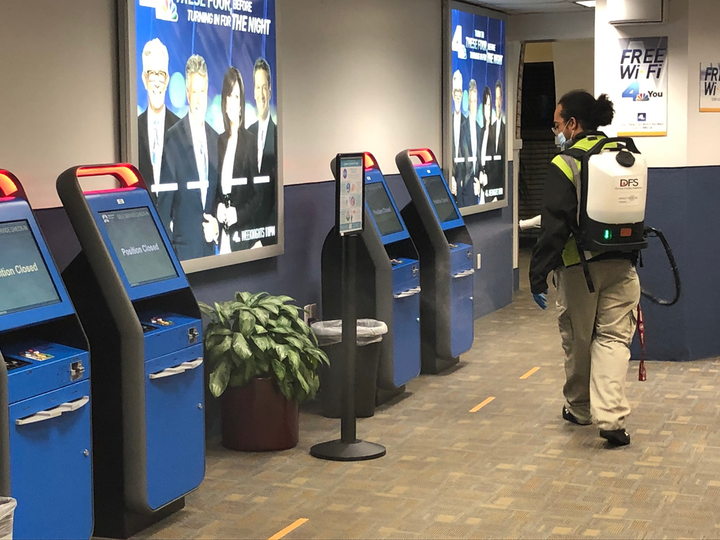
Cleaning crews at Hollywood Burbank Airport wipe down areas during the daytime hours and deploy a sprayer at night to add a an additional level of disinfection. Jerson Ramirez, DFS site director for Burbank Airport
The COVID-19 pandemic created a host of new challenges for the aviation industry. As airlines struggle to get back on their feet and airports examine their operations, a massive sea change is taking place.
One of the biggest permanent changes we’ll see is a fundamental shift in cleaning services inside the terminal.
Jeffrey Holaly, key account director for ISS, said cleaning programs traditionally focused on aesthetics, but not the science of disinfection. The pandemic created a need for change that’s likely to persist.
“A lot of airports and airlines wanted the perception that everything was clean, but they didn’t want to necessarily see people cleaning,” he said. “Now we’ve seen a shift to airports and airlines wanting those cleaning folks to be visible at all times and for people to actually see them doing the cleaning work.”
Thomas O’Rourke, director of aviation, North America for ISS, said airport terminal cleaning programs are likely going to evolve into cleaning/disinfecting programs after the pandemic is over. They will implement technology and techniques to not just clean the facilities but kill viruses.
O’Rourke said making cleaning and disinfecting efforts visible will be key in gaining back the public trust in travel. They want to know they’re being protected in the terminal and on the plane.
“Optics is absolutely crucial at this moment,” he said.
Cleaners at Hollywood Burbank Airport (BUR) are using electrostatic sprayers to provide a deep clean to the terminal.
Allen Dishman, senior director of operations for Diverse Facility Solutions (DFS), which handles cleaning at BUR, said the sprayer allows efficient disinfecting of areas within the terminal by spraying a positively charged 3M C. diff material onto surfaces.
A supplier brought the equipment to the company’s attention, so DFS made the quick decision to add it into service.
“We wanted to bring this equipment on board because now it gives us the ability to spray all touchpoint surfaces that are public facing,” he said. “We want the passenger experience to be a hygienic one.”
A specially trained cleaner is deployed with the sprayer on a nightly basis. They work from the point of entry of the terminal, spray ticking areas, TSA checkpoints, tubs, stanchions and other surfaces where passengers may touch through to the boarding area.
Traditional disinfecting methods still take place during the day.
“It’s for passenger ease,” Dishman said. “If we’re spraying and we’re wiping, we’re leaving a surface that’s dry. I can’t necessarily go through and spray kiosks during the day and now they’re wet.”
The sprayers can also help in the event of an immediate COVID-19 infection at the airport. If an employee or a passenger is diagnosed with the virus, the unit can be deployed for immediate disinfection.
“Because the micron is small enough, I’m also able to spray keyboards, gate agent stands and electronics,” Dishman said. “Before it’s a little more of a challenge to disinfect electronics and get the proper dwell time.”
Holaly said airlines are increasing cleaning and disinfecting efforts after every flight. Their employees are also getting more involved in the process and make it part of their culture.
ISS started a program with Delta Air Lines in January at Detroit Metropolitan Wayne County Airport (DTW) to disinfect areas of the airport. Detroit is one of the airline’s hubs to Asia, so ISS would clean and disinfect any areas following flights from Asia to the U.S. Customs and Border Protection.
“It wasn’t really accepted at first to see people walking around in the Tyvek suits, but now it’s quite the opposite,” O’Rourke said.
The new requirements will change the way staff cleans. O’Rourke said there’s extensive training that goes along with utilizing new techniques and technology, so front-line cleaners will need more skills to meet new standards.
“The big challenge is education,” he said. “We have to make sure staff is educated on proper procedures and PPE safety around the whole evolution of cleaning/disinfection.
“The challenge is the mindset, the paradigm shift that it’s not just spraying window cleaner on a widow and wiping it down. There’ a difference between being clean and being disinfected.”
Holaly said electrostatic spraying of disinfectant will likely become the new standard inside all areas of the airport. He also expects airports and airlines to ask for more frequency of disinfection in their contracts.
Expect major change in airport technology as well. O’Rourke said he sees airports implementing more touchless technology and air handling systems bringing in more outside air instead of recycling from inside the terminal. He also expects more UV lighting placed inside air handling ducts to kill bacteria.
“They will have to use a heck of a lot more outside air and a lot less return air,” he said. “It will cost a lot more money to condition the air correctly.”
Holaly said airports need to tell their story about what they’re doing to protect the public. Anything to reduce the number of touchpoints or cleaning will convey the safety being taken to protect the public.
“A lot of it is going to be increasing the frequency of cleaning and communicating that to the public,” he said.
Cincinnati goes automated
Cincinnati/Northern Kentucky International Airport (CVG) implemented autonomous robots in April to aid in terminal cleaning. The Avidbots Neo robot was deployed to autonomously clean floors throughout the terminal on a continuous basis to ensure a high-quality, healthy experience for travelers.
Neo is an autonomous floor scrubbing robot. It uses artificial intelligence, cameras and 3D sensors to adapt to its environment and automatically update its route to avoid obstacles. Neo avoids people, suitcases, furniture, displays and other items.
Neo can operate six hours on a single charge. The airport started a pilot program with the robot in November. It cleaned about 200,000 square feet of flooring per week during the pilot.
Faizan Sheikh, CEO and co-founder of Avidbots, said the robot use 3D cameras and lidar to perceive its environment. The company first walks the robot through the facility, then creates cleaning plans for the facility. The operator can choose one of the plans each deployment and the robot will run the course in the least amount of time possible.
One of the robots can clean 80,000 to 120,000 square feet on one charge, depending on the layout of the obstacles present in the facility.
“We can show you down to 5 centimeters what got cleaned and what got missed and why it got missed down to a very granular level,” he said. “What were the cleaning settings, what was the floor type and you can audit all of that. If you want to make changes it will do that too.”
The robot is also used at Paris Charles de Gaulle Airport (CDG), Singapore Changi Airport (SIN), Tokyo Narita International Airport (NRT), Tokyo Haneda Airport (HND), Kansai International Airport (KIX), Montréal-Pierre Elliott Trudeau International Airport (YUL), Ben Gurion Airport (TLC) and Sydney Airport (SYD).
Cobb said he first saw the Neo while on a leadership exchange trip to Changi in July. It was on the heels of a failed attempt at another cleaning robot and knowing Changi’s reputation for quality, it made the unit worth exploring for CVG.
“The impression I saw not only from keeping it clean, but also the customer engagement,” he said. “I saw kids walking close to it and I also saw adults trying to play with it by jumping in front of it.”
CVG got interested in autonomous cleaning units as driverless vehicles grow in different areas. They wanted a unit that would perform while also meeting employee needs. The Neo was appealing to CVG because it’s self-learning and can adjust its route based on changes inside the layout of the terminal.
Running the units in the middle of the day also includes the optics inside the facility, by showing passengers they’re on top of cleaning issues during a time of an international health crisis.
“The cool thing about this is it can work all day long and it’s constantly learning the environment,” Cobb said. “Very few of them learn on the fly.”
Cobb said CVG has one unit in operation now, but leaders would like to have three, so they would be operating inside all major facilities if money is available in the future. Travelers are engaging with the current unit and shows the public Cincinnati is serious about being a forward-looking airport.
“In the current situation with COVID-19, the world is waking up to the idea that you just have to clean more and more frequently and you can’t do that with people,” Sheikh said. “But the robot you can. It doesn’t get tired.”
The robots allow Cincinnati to reallocate floor team staff to other areas of critical importance while tackling the COVID-19 health crisis. The airport originally reexamined the housekeeper role at a time when all airports are seeing a labor shortage for what was a low skill job and changing it into a higher skill position. Now it allows them to examine if they can have robots clean and disinfect areas that pose a health risk for humans.
“It’s a simple clean, drop, ingest and dispose of. It keeps the system very simple while at the same time we can have a much higher degree of comfort level that we’re disinfecting to the appropriate amount without jeopardizing the health of workers or the consumer,” he said.
Cobb suggested airports should push a pilot test when picking such a unit. It would allow for a low entry point and will give the vendor a chance to prove the machine will do what is promised.
Keeping hangars spic-n-span
The first step to ensure a safe and healthy environment for your maintenance crews is to keep your hangar or other maintenance facility as clean as possible. Cleaning is simply the process of removing soils from a surface, opposed to disinfecting, which will destroy and kill microbes such as bacteria and viruses. Regular floor cleaning with an automatic scrubber is a key component to an overall cleaning program.
“While disinfecting highly-touched areas, such as door knobs, cabinet handles, shared tools, faucets and similar is critical, other surfaces, such as floors, may just need to be cleaned well,” explained Bryan Smith, Sr. Marketing Manager, Americas, Tennant Company. “It is critical to remember you can clean without disinfecting, but you can’t disinfect without cleaning first.”
Keep in mind that generally, it is not recommended to disinfect floors outside of critical areas such as food preparation areas or where bodily fluids may contact the floor. So, a simple sweep and scrub will do the trick when taking care of a maintenance site.
Two industrial cleaning machines that can aid in the cleanliness of floors are sweepers and scrubbers, which help to really scrub deep and keep floors clean. Sweepers remove dry, lose soils and debris, while scrubbers use water and detergent to clean and dry the floor.
“Sweepers work with a combination of spinning brushes that lift the soil and debris along with a vacuum that pulls the debris into a hopper,” mentioned Smith. “Scrubbers use water with optional floor cleaning chemicals to remove dirt, liquids, grease and other soils. A scrubber sprays a solution on the floor, scrubs with a brush, and then automatically recovers the solution with a trailing vacuum and squeegee leaving the floor nearly dry.”
Both scrubbers and sweepers come in sizes ranging from small walk-behind machines to large riding machines and can be battery or engine powered, depending on the application needs.
Last year, Tennant launched the T7AMR, the company’s first autonomous floor scrubber. “This technology can provide tremendous productivity to your cleaning teams as they are asked to spend more time on disinfecting highly-touched surfaces or other additional tasks,” said Smith.
The frequency of use depends greatly on the types of soil, the amount and type of traffic and the expectations of the facility manager. Tennant recommends facilities to always sweep before scrubbing to ensure that larger debris is removed before scrubbing. Tennant provides equipment that combines these functions into one process known as Sweeper/Scrubbers
Tennant Company has been serving the aviation industry for decades, supplying both civilian and military facilities. Aviation has always been a core market for Tennant equipment and continues to do so during a time when cleanliness is high priority. “We have received many questions about how our products can help prevent the transfer of COVID-19,” explained Smith. “While there is a protocol Tennant has published for disinfecting floors with our equipment, the floor is not always going to be the priority for disinfection. The best way Tennant equipment can help is by enabling cleaning teams to keep the floors clean as efficiently as possible so they have the time to do extra detail work disinfecting the highly-touched surfaces that are more critical to preventing disease transfer.”
Clean aircraft and ground handling facilities
Before the airline industry can recover to pre-pandemic levels, passengers will need to begin booking commercial flights again.
So as travel restrictions around the world are lifted, it will become more important for the flying public to see the industry taking cleaning and disinfecting aircraft seriously. Much of that responsibility falls on the ground service providers carrying out these cleaning duties.
“They can see that we are putting a lot of emphasis on cleaning and we’re taking the whole coronavirus very seriously,” said Brian Giacona, VP of operations at AccuFleet International.
In addition to remain overnight (RON) deep cleans, AccuFleet is applying ultra-low volume (ULV) disinfectant, commonly known as a fogging application, and made plans to acquire electro-static spraying equipment.
“We have started a fogging process for a domestic carrier,” Giacona said. “The chemical, based on the manufacturer’s information, says that it kills all viruses for a 10-day period. It was used during Ebola and in other areas where we’ve had viruses and outbreaks in the past.”
Both the fogging method and electro-static spray are effective disinfecting measures, Giacona explained. The key difference is the fogging method is more labor-intensive as personnel must ensure the mist is applied to all areas of the aircraft.
The electro-static spray, meanwhile, is electrically charged and adheres itself to all the aircraft’s surfaces.
“So you can virtually just walk down the airplane and spray this stuff in the middle, and it will attach to the walls, the seats, under the seats – any surface that has an area for it to attach to,” Giacona noted, adding this equipment is in high-demand.
The disinfection process can be daily or spread out over a period of days, depending on how long the chemical lasts on the surfaces.
“We’re also recommending more thorough deep, or heavy, cleans,” Giacona said. “A heavy clean is a very labor-intensive clean on an aircraft. It’s not just walking on, wiping down a tray table and vacuuming the floors.
“We’re currently doing heavy cleans on a nightly basis for a domestic carrier, where we’re doing them every single night in all of their locations that they have AccuFleet in,” he continued. “That clean basically entails scrubbing the airplane down from top-to-bottom. We’re using disinfection chemicals. We’re cleaning every crack and crevice, to the point where we even remove the seat tracks off the floor and clean underneath them.”
A deep clean on a 737 takes approximately 40 man-hours to accomplish, Giacona said. So, for AccuFleet to accomplish this, a group of 6-8 people clean an aircraft continuously for 5-6 hours.
While many cleaning agents can be utilized to disinfect aircraft, Giacona urges ground handlers to be mindful of an airline’s approved-chemical list.
Beyond cleaning services, at WinMar Engineering Technologies, officials are utilizing technology developed by Far-UV Sterilray to disinfect the air.
“We know the SARS-2 Coronavirus, similar to SARS-1, spreads in the air when people are just exhaling,” said Ed Neister, chief scientist at Far-UV and inventor of Excimer Wave Technology. “The virus, before any symptoms show, are going to be exhaled in little, tiny, 1-micron aerosol droplets that the human body normally makes.
“We consider air disinfection very important.”
Marty Craig, managing director with WinMar Engineering Technologies, also works for ADSI – an FAA Part 145 repair station. Years ago, ADSI applied the Sterilray program to aircraft in order to keep cabin air systems clean.
“That subsequently led to many other long-term interactions and planning,” Craig said. “We started WinMar Engineering to do some of the engineering for the ground services segment – not only cabin air inflight operations, but also ground handling and ground-related items.”
Sterilray manufacturers lamps that project a specific type of ultra-violet light that targets the proteins and peptide bonds of bacteria and viruses.
“Coronavirus turns out to be very, very susceptible to the Far-UV Light,” Neister said. “It targets the capsid in the virus, and that’s why it kills the virus so well.”
With limited modification, the system can be used elsewhere.
“On the ground side of it, it’s particularly focused on operational centers, air cargo container areas, gateways, jetways, any enclosed area that supports the commercial operations of aircraft – including FBOs and things like that as well,” Craig said.
The lamp can be made as small as a magic marker or as much larger fixtures.
“We have a wand that we can move over the surface that we want to disinfect – at 1 foot per second to 2 feet per second and get 100-percent disinfection,” Neister said. “We also have, what we call Luminaires, which are lamps in a fixture that sits in the top of a hung ceiling.”
The Airport Health Accreditation programme assesses new health measures and procedures that have been introduced as a result of COVID-19.
ACI World and EUROPE have announced Istanbul Airport as the first airport to be accredited through the new Airport Health Accreditation programme.
ACI’s Airport Health Accreditation programme assists airports by assessing new health measures and procedures introduced as a result of the COVID-19 pandemic in accordance with ICAO Council Aviation Restart Task Force recommendations and in alignment with the joint EASA and ECDC Aviation Health Safety Protocol and ACI EUROPE’s Guidelines for a Healthy Passenger Experience at Airports.
This includes cleaning and disinfection, physical distancing (where feasible and practical), staff protection, physical layout, passenger communications and passenger facilities.
ACI World Director General, Luis Felipe de Oliveira, said: “We congratulate Istanbul for being the first airport to be accredited through our new Airport Health Accreditation programme, which demonstrates that it is focused on the health and welfare of travellers, staff and the public. This will be crucial as our industry begins to restart, providing passengers and employees high globally-recognised standards on health and hygiene, which will help to restore public confidence in air travel.”
Kadri Samsunlu, Chief Executive Officer at İGA Airport Operation, said: “Aviation is an important industry that is bound to international rules and committed to continuous improvement aimed at maximised passenger experience. We continue our efforts to offer our passengers ‘safe travel at maximum hygiene’ in the new normal. The certificate has been awarded by Airports Council International and is really important to make sure that the aviation industry is in the finest possible position to support strong recovery in the near future. Aviation is a very resilient industry and we need to take measures to endure COVID-19 through implementing strict health and safety standards at our facilities and operations.
“The Airport Health Accreditation certificate should definitely be considered by all airport operators as proof to demonstrate greater readiness to build passenger confidence and trust. I must place special emphasis that we will never ever compromise on the hygiene standards we have achieved at Istanbul Airport.”
Olivier Jankovec, Director General of ACI EUROPE, commented: “Recovery from this unprecedented crisis has called for swift and thorough implementation across the entire aviation system of the global standards developed jointly by competent authorities. ACI has worked hand in hand with ICAO, EASA and ECDC to help deliver a blueprint for safe airport operations amid the ongoing COVID-19 pandemic. This blueprint, which has served as the basis for ACI EUROPE’s Guidelines for a Healthy Passenger Experience at Airports, is now complemented by a new Airport Health Accreditation programme. It is with great pride we note that the first airport to become accredited is European – reflecting the eager adoption of the new focus on the health-concerned passenger among airports across our region.”
Karen Ann Monsykaren@khaleejtimes.com Filed on August 12, 2020 | Last updated on August 12, 2020 at 12.06 pm
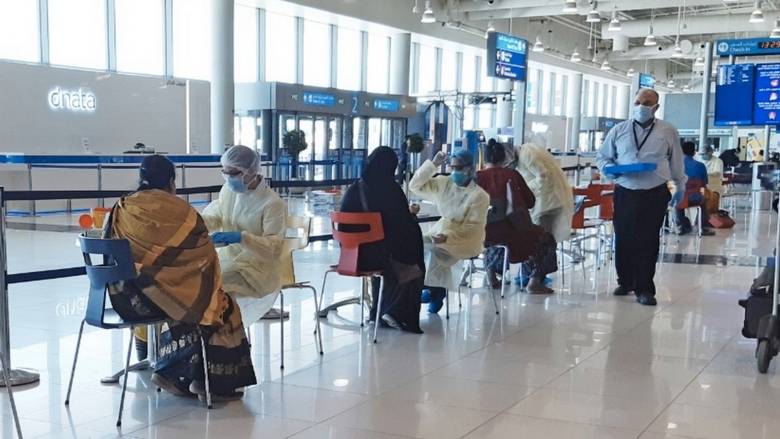
(Photo by Juidin Bernarrd/Khaleej Times)
Covid-19 rapid test stations will no longer be available at Dubai airport departure terminals, according to an announcement by Dubai Airports.
Starting August 16, the stations will instead be relocated to a site outside the airport at the Shabab Al Ahli Football Club, near Al Mullah Plaza, on Al Nahda Street.
Passengers can avail of the service every day between 8am and 1pm, including Fridays and Saturdays.
They must present proof of holding a valid ticket or reservation in order to be eligible for the test, which is complimentary and valid for 96 hours from travel.
A ‘Fit to Travel’ sticker will be affixed to the passports of those passengers who test negative for antigens.
Travellers are advised not to remove this sticker until they reach their final destination, as the sticker replaces the need for a report.
Karen Ann Monsy
A ‘Dubai child’, Karen has been writing for magazines for close to a decade. She covers trends, community, social issues and human interest features. Whether it’s overcoming disability, breaking stereotypes or simply relating the triumphs of everyday lives, she seeks out those stories that can uplift, encourage and inspire. You can find her favourite work at www.clippings.me/karenannmonsy
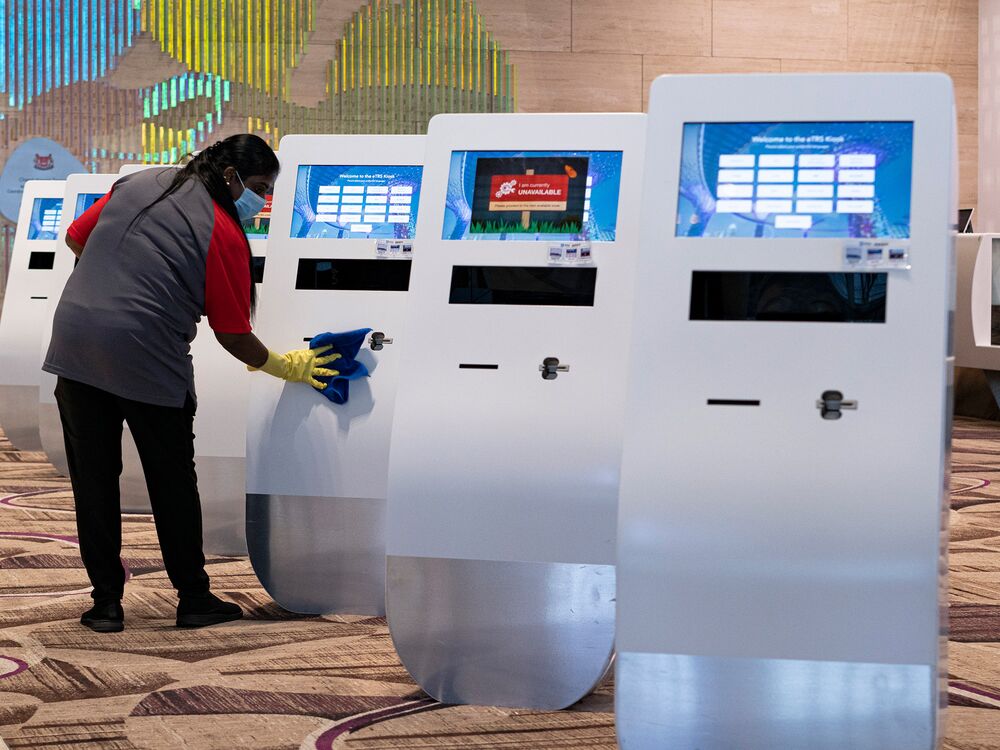
An employee wearing a face mask cleans a kiosk at the departure hall of Singapore Changi Airport. Photographer: Ore Huiying/Getty Images AsiaPac
Navigating the Roman circus of obstacles known as an international airport is likely the one thing travelers aren’t missing during the Covid-19 crisis. Now that forecasts predict tourism won’t fully recover until 2023, these transit centers are getting a rare, low-traffic chance to make many of the changes flyers have long wanted—along with upgrades they never imagined.
Among them: disinfection booths, biometric security scans, automated customs and border patrol screenings, and enhanced self-check-in stations. Together, they represent the most significant overhaul of the airport experience since Sept. 11.
“The traditional way we design airports has long been hamstrung in two directions,” says Matthew Johnson, who helped spearhead the ongoing $14 billion renovation of LAX in Los Angeles as an aviation principal for architecture firm Gensler. The de facto airport floor plan funnels traffic through an “X” shape, with passengers coming from various entries and converging at one congested portal—TSA—before dispersing to find their gate. This design was largely put into place after the 2001 terror attacks, when extensive security scans became emblems of personal safety.
If long lines were once the price of safety, they’re downright dangerous now. “Covid-19 is going to herald a complete reversal,” says Johnson, who proposes eliminating the X all together. Airports could become like casinos, he says, coupling eye-in-the-sky surveillance with state-of-the-art sensors—as in the “smart tunnel” at Dubai International that verifies your identity by scanning your iris as you walk through it. Add advanced X-ray technology, and airports may be able to identify threats without requiring anyone to line up, divest, or even put luggage in a tray.
The most radical changes have the potential to turn airports from hotbeds of frustration into beacons of innovation. Here’s a look at what’s being installed around the world, and a few ideas yet to come.
Checking In
Illustration: Jaci Kessler Lubliner
Without having to rush to get through a snaking TSA line, passengers will be able to enjoy their time anywhere in the airport—including presecurity areas. Free of human gridlock, these spaces will be landscaped and outfitted with seating, where it will be possible to get food dropped off from Uber Eats or Grubhub if traffic is light and you’re a little early. Such deliveries are being tested at Toronto Pearson.
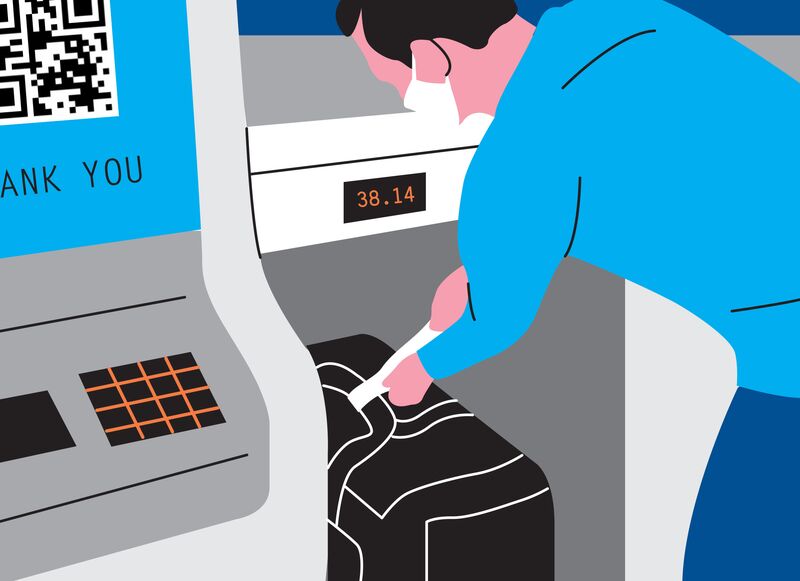
Airline apps will also mitigate the need to touch screens; in May, United Airlines Inc. announced plans for touchless kiosks that print baggage tags when you scan your phone. Coupled with QR code boarding passes and self-drop luggage stations, the check-in process will be fully digitized. From here, walking to the gate is a choose-your-own-adventure, done on your own time.
Going Through Security
Illustration: Jaci Kessler Lubliner
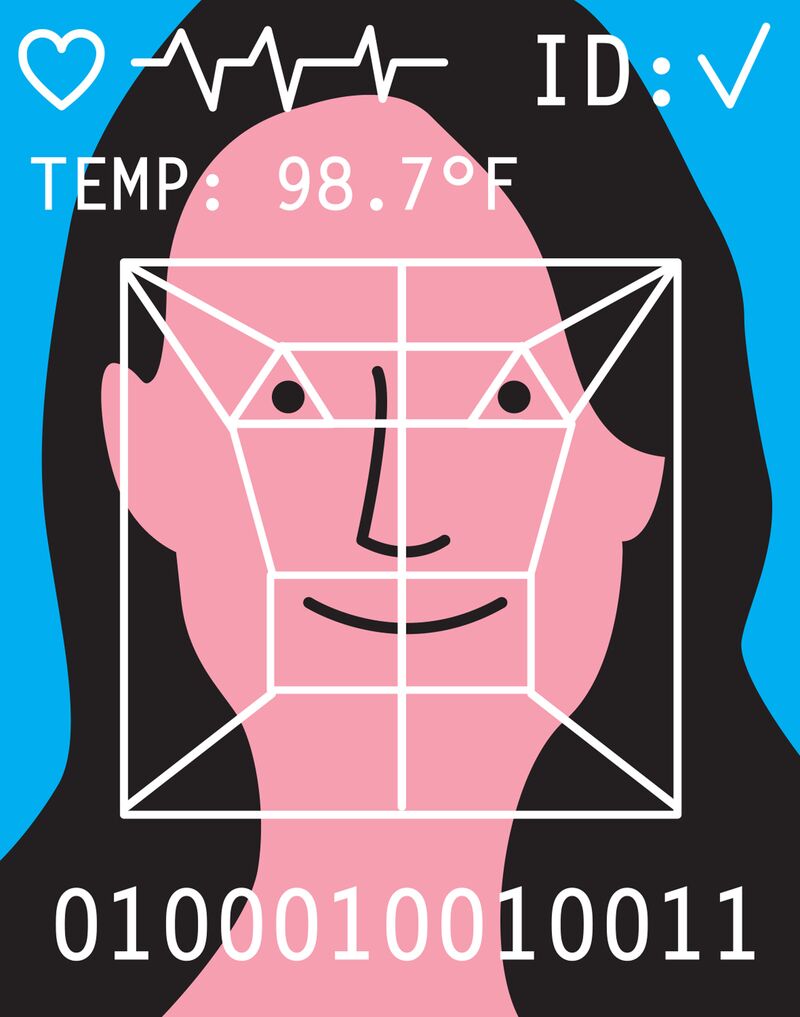
Some airports already provide security without requiring human interaction. At Hong Kong International, passengers tap passports to unlock security barriers, scan their boarding pass, and have their photo snapped for identity verification at an electronic terminal. Munich and Singapore Changi have similar systems. Then there’s new technology that’s being fast-tracked for deployment: Remotely operated X-ray machines can check carry-ons for explosives, and millimeter-wave imaging systems can examine your shoes for traces of contraband while they’re on your feet.
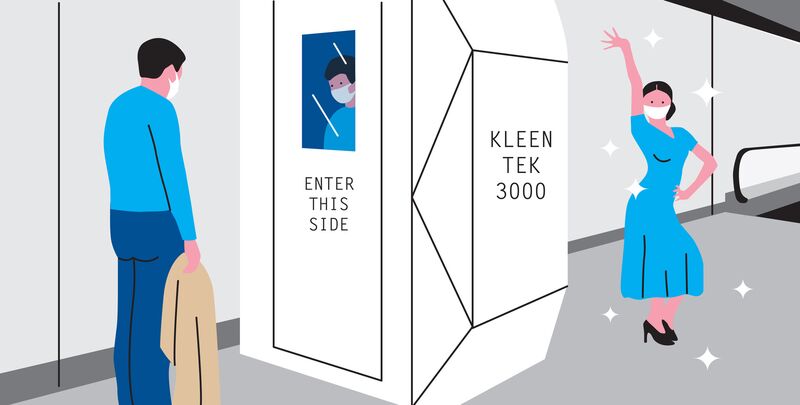
In response to the current pandemic, thermal cameras—common in Asian airports following the 2003 SARS outbreak—will become a ubiquitous way to detect feverish travelers. Trailblazing Hong Kong International is one-upping that, with full-body disinfecting stalls that look like walk-in tanning booths. They take your temperature and blast you with an antimicrobial spray, all in 40 seconds. Except for these stalls, all the technology operates in the background, without your even knowing it (though it may alarm those concerned about privacy).
Navigating the Terminal
Illustration: Jaci Kessler Lubliner
In places such as Seoul Incheon and Guangzhou, a new type of employee can be spotted throughout terminals: robots. Some of them sterilize common high-touch surfaces such as bathrooms, hallways, bag trolleys, and elevator buttons with UV lights; others flag authorities when they detect an unmasked face.
At JFK an artificial intelligence platform called SafeDistance is using cameras to monitor for congestion, so employees can easily identify overcrowded areas and open up other avenues of access in response. A similar software tool called Zensor uses CCTV footage to bring real-time crowd estimates for places such as gate-side bathrooms, coffee shops, or retail outlets right to a traveler’s phone; Pittsburgh International is piloting it.
Boarding
Illustration: Jaci Kessler Lubliner
A touchless departure is the last step. Cathay Pacific Ltd. is working in collaboration with U.S. Customs and Border Protection to bring automated boarding gates to LAX and San Francisco International, joining a similar effort at JFK. They’ll scan your face and biometrically verify your identity, allowing you to get on the plane without handing over your ticket and passport.
James Groark, who handles landside innovations for the carrier as its vice president for airports, says that “eventually this will be mandatory for all airlines—the writing is on the wall.”
From monitoring temperature and sanitising spaces to enabling video conferencing with doctors, these robots by Indian startups are helping minimise human intervention and paving the way for the use of technology in our fight against COVID-19. By Trisha Medhi
Healthcare professionals, researchers, and governments from across the world are struggling to contain the spread of the coronavirus, which has infected 18,486,295 people globally, and claimed more than 698,396 lives so far, according to Worldometer . While healthcare workers are at high risk of contracting COVID-19 due to their proximity to the patients, humanoid robots are replacing human beings across the world to ensure social distancing. Invento C-Astra. Credit: Invento Robotics
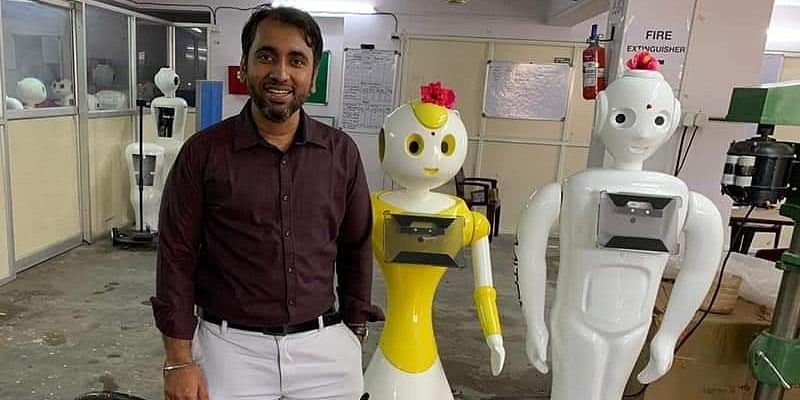
Invento C-Astra. Credit: Invento Robotics
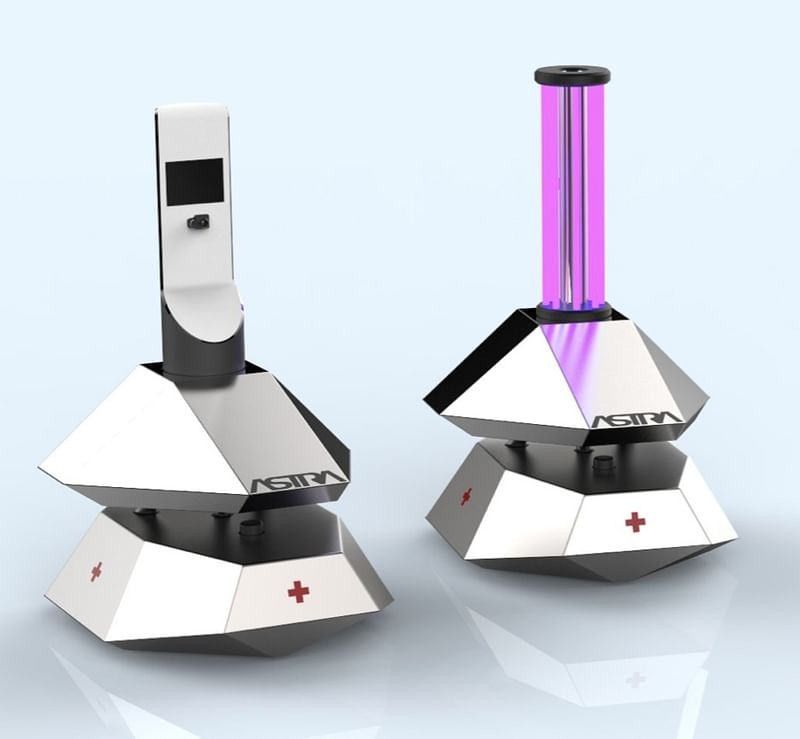
In India too, robotics startups have risen to the occasion to help deploy robots in places like hospitals, thereby minimising human intervention and paving the way for the use of machine to carry out tasks such as sanitising hospitals and to deliver food and medicines to the infected patients. From disinfecting floors and carrying out temperature checks, to arranging video call with doctors in case of an emergency, robots are being deployed to minimise the risk for healthcare workers. YourStory lists few such humanoid robots invented by Indian startups that are battling COVID-19. C-Astra, Mitra, and RoboDoc by Invento Robotics Bengaluru-based Invento Robotics, founded by Balaji Vishwanathan, Mahalakshmi Radhakrushnan, and Bharath Kumar in 2016, is a full-stack robotics startup that helps automate customer engagement in banks, airports, restaurants, and other places. The startup has now turned its business focus to help fight the coronavirus pandemic. In April this year, the startup launched Invento C-Astra, a robot which helps screen patients and to disinfect common areas. The autonomous mobile unit can move around lobbies, hallways, and can sanitise rooms. According to the startup, the robot makes use of disinfecting UV-C lamps to disinfect a room completely in just three to four minutes. The robot is currently being used in hotels to disinfect rooms, and is also being used at Apollo Hospitals, etc.
Balaji Vishwanathan, Co-founder, Invento Robotics
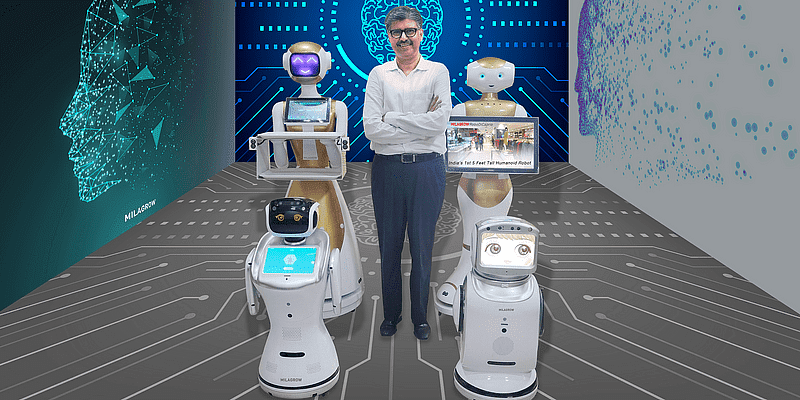
Its flagship robot, Mitra, which was designed for customer engagement, alerts host about the arrival of visitors. With the current COVID-19 crisis, it has been modified with the following features – scans temperatures of patients, collects necessary details of patients like their name, phone number, and picture, and even sets up a video call with the doctor for further diagnosis. “This robot takes pictures of visitors and records their body temperature. It asks them for details such as name and phone number, and validates their identity. It provides these details to the organisation the person is visiting. If the visitor fails the screening test, the robot immediately connects the visitor with telemedicine support. Doctors can talk to them directly through the robot and advise accordingly,” Balaji says. To reduce the risk for doctors from contracting the virus, Invento Robotics has come up with another robot called RoboDoc. This can move around the hospital autonomously, and it takes doctors inside COVID wards virtually, reducing their physical movement. It also scans temperature and other vitals of patients, and collects and feeds the data (their temperature, diet, etc.,) to the computer. Apart from this, the robot can also carry load of up to two kilograms. While C-Astra and Mitra can be used in various sectors including shopping malls, metros, warehouses, etc., RoboDoc is specially designed for the healthcare sector. RoboDiCaprio, RoboJulia, RoboNano, and RoboElf by Milagrow Milagrow HumanTech, founded by Rajeev Karwal in 2007, recently launched four new humanoid robots – RoboDiCaprio, RoboJulia, RoboNano, and RoboElf. Specially designed to cater to hotels, hospitals, restaurants, and corporate offices, these humanoids can interact with customers, perform tasks, and navigate independently.
Rajeev Karwal, Founder and Chairman, Milagrow
The guest relations robot RoboDiCaprio can be used for business consulting, greeting, reservations, advertising, and patrolling. The humanoid claims to have face recognition capabilities with 98 percent accuracy, and can scan a distance of 25 m with an accuracy of 2 mm. The Serving Robot – RoboJulia is designed to deliver meals to guests, explain the menu, give restaurant information, etc. It can work universally, take fast turns, and has an emergency stop. Similarly, RoboElf is a service assistant, which can be deployed in various locations such as metros, banks, and shopping malls. It has a business management system, which is built on a Cloud terminal that enables users to give orders or push new files to their RoboElf robots distributed around the world. RoboNano acts like a personal companion, and is equipped with Amazon’s Alexa Voice Service, smart home control, and remote surveillance capabilities. It has over 50 sensors to avoid objects in its way, recognise voices, and know when someone enters the room. Additionally, it can order pizza, request a car, track fitness stats, control the TV, and play music as well.
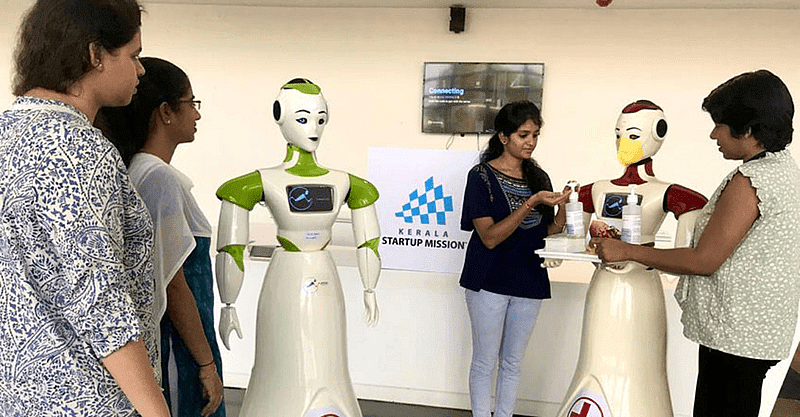
Earlier in April, the Delhi-based startup developed Milagrow iMap 9 and Humanoid ELF, which were being deployed by the All India Institute of Medical Sciences (AIIMS) for its COVID-19 wards. Asimov Robotics Kochi-based Asimov Robotics, under the Kerala Startup Mission, developed two humanoid robots in March this year. These robots were the first in the country to raise awareness about the spread of coronavirus among people in Kerala. The robots currently distribute masks, sanitisers, and napkins in the startup complex in Kochi. In addition to this, the robots also stream videos and brief people about social distancing and other steps to be taken to prevent the spread of the virus.
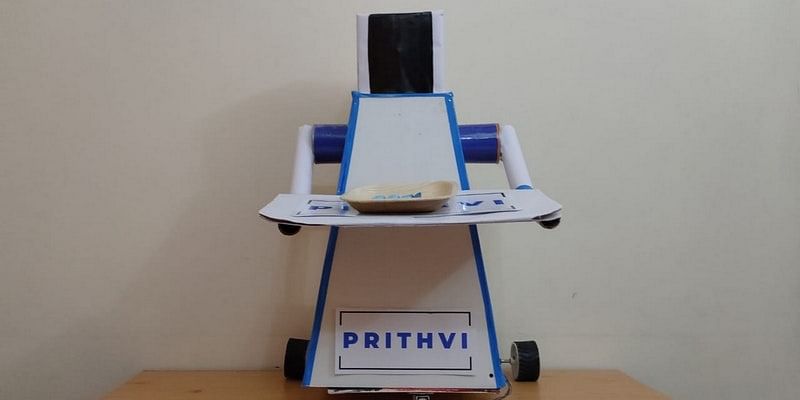
In an earlier conversation with YourStory, Jayakrishnan T, Founder and CEO of Asimov Robotics, said the idea was patented during the Nipah Virus outbreak that affected the state. The thermal camera sensors will also analyse people’s body temperatures and advise those with a high temperature to consult with the health department. Prithvi by Delhi teenagers A group of teenagers from Delhi has built a robot called Prithvi to protect healthcare workers by reducing their contact with COVID-19 patients. Nishant Chandna (15), Saurav Maheshkar (16), and Aditya Dubey (17) devised the idea and put it into action after Prime Minister Narendra Modi declared a nationwide lockdown in March.
Prithvi (Image: ThePrint)
The robot allows a smart tablet to be linked to it in order to enable video conferencing between doctors and patients. The team also plans to add a temperature gun feature to the robot to further minimise contact with the patients. “About 50 to 52 cases of coronavirus in India are of doctors who were infected while treating patients. We wanted to design something that would help protect those at the frontline battling this illness. So, we put our ideas together and designed this robot,” Chandna said during a media interaction. CO-BOT and NIGA-BOT by ITI Cuttack In April, the government-run Industrial Training Institute (ITI) in Cuttack developed two low-cost robots – CO-BOT and NIGA-BOT, which can protect health workers from the coronavirus and reduce the need for personal protective equipment (PPE). In the wake of the pandemic, the institute had constituted an innovation team that developed the robots in its laboratory, in association with SAK Robotics Lab, a startup. The service robot CO-BOT can move on wheels and has a humanoid structure. Its hand-like structure can hold a tray and carry a load of up to 20 kg. It can be used in COVID-19 hospitals for carrying food, water, and medicines to and from patients. The second one, named NIGA-BOT, is a telepresence robot, which can be used for surveillance and teleconsultation by doctors who can interact with patients remotely through live video streaming. NIGA-BOT can be used to monitor the health of patients. “This will protect doctors and nurses from contracting the virus. All these innovations will lead to reduced need for PPE kits, and could be a saviour for health workers,” said Hrushikesh Mohanty, Principal, ITI-Cuttack. (Edited by Megha Reddy) Want to make your startup journey smooth? YS Education brings a comprehensive Funding Course, where you also get a chance to pitch your business plan to top investors. Click here to know more.