

Brussels airport equipped with a robot to help passengers
Can not find the way to your gate?
Or do you want to know in advance how hot it is at your destination? From now on, you can ask at Brussels Airport for a smart robot: Bruce-Pepper.
Brussels Airport wants to make people who leave during the summer months as pleasant as possible. The airport has also made a number of changes, especially for parents with children. Thus, a special family lane will be on the security so families need to wait a little longer. In addition, a large maze was painted on the ground in one of the rooms.
https://nieuws.vtm.be/vtm-nieuws/binnenland/deze-robot-helpt-je-op-de-luchthaven
RunWay Status Lights (RWSL) implementation in Paris-CDG, a first in Europe
Discover RWSL use in daily operations at Paris-CDG airport.
RWSL is a fully automatic, autonomous and safety advisory
high-technology system designed to prevent aircrews and vehicle drivers from runway incursions, or to reduce their severity. These visual aids come as a complement to the compulsory ATC clearances for runway penetration, and other existing means on the platform (wig wags, “RWY AHEAD” markings, stop bars in LVP conditions).
This film was made by Groupe ADP and the DSNA with the participation of Air France . RWSL at Paris-CDG has been co-financed by the European Union (Connecting Europe
Facility).
Hologarde Integrated Drone Defense Solution
Hologarde is a unique, globally available, integrated solution
combining three proven technologies to detect, identify and track small drones at 5 kilometers range.
French article here :
Si les drones n’ont jamais été à l’origine d’un accident aérien, ils ont déjà provoqué de belles frayeurs aux compagnies aériennes et aux aéroports. Le groupe ADP a décidé de prendre ce problème naissant à bras-le-corps : en partenariat avec DSNA Services, le gestionnaire de Roissy et Orly travaille sur une solution de détection de drones à longue distance.
ADP travaille sur une solution de détection de drones à longue distance pour proteger l’espace aérien des aéroports
Le Groupe ADP et DSNA Services, filiale fondée par la DGAC (Direction Générale de l’Aviation Civile), ont décidé, dans le cadre d’un partenariat, de collaborer ensemble sur le projet Hologarde qui vise à co-développer une solution de détection de drone adaptable à tous les sites sensibles.
“Dans le cadre de son programme Innovation Hub, le Groupe ADP était déjà à la pointe de l’utilisation et l’expérimentation de drones en milieu complexe comme celui des aéroports. Hologarde nous positionne à l’avant-garde de l’innovation mondiale en matière de dronautique, en combinant l’expertise métier du Groupe ADP et de l’aviation civile française avec l’agilité des start-ups partenaires, dans un secteur estimé à plusieurs milliards d’euros”, souligne Edward Arkwright, Directeur Général exécutif du Groupe ADP.
Intégrant 3 technologies (radar, radiofréquence et vidéo HD) au sein d’un centre de commande unique, Hologarde, installé à titre expérimental sur l’aéroport Paris-Le Bourget durant le SIAE, permet de détecter tous les types de drones à plus de 5 kilomètres. Les deux partenaires expliquent dans leur communiqué “L’avantage d’une distance de détection importante est d’anticiper et d’apporter une réaction proportionnée à la nature de l’intrusion. Une fois détecté, le drone est suivi en temps réel par caméra grâce à un centre de commande disponible sur PC ou tablettes mobiles”.
Cette première étape va permettre de valider la fiabilité de la solution. Les partenaires étudient également ses modalités d’industrialisation ainsi que les possibilités de développer des moyens de contre-mesure compatibles avec l’environnement aéroportuaire.
Par ailleurs, la solution Holograde sera aussi expérimentée pendant plusieurs mois sur Paris-Charles de Gaulle à partir du mois de juillet.
Le boom des drones, et plus particulièrement ceux de loisir, posent des problèmes de sécurité et sûreté aux aéroports. En 2016, selon l’Agence Européenne de la Sécurité Aérienne (AESA), ils ont occasionné plus de 1 400 incidents contre seulement 606 entre 2011 et 2015. Les compagnies aériennes ont connu quelques frayeurs ces dernières années à cause de ces machines volantes, par exemple aux abords de Roissy, Heathrow, Munich ou encore Los Angeles.
Use your translator for reading in your language.
source :http://www.deplacementspros.com/ADP-part-en-guerre-contre-les-drones_a43806.html?TOKEN_RETURN
Artificial intelligence to make travel smarter
Artificial intelligence to make travel smarter
International | 24 June 2017, 09:00am
Christopher Elliott
Washington – New artificial intelligence (AI) technologies promise to make travel a little smarter. The latest entrant is Aeromexico’s new AI-based customer-service bot, billed as a “smart brain” capable of machine learning. It launched earlier this year in Spanish on Facebook, and an English version is being rolled out now.
But do they really live up to the billing? It depends. There’s little doubt that AI is improving the bottom line for airlines, hotels and car-rental companies, which are aggressively integrating this technology into their operations. But for consumers, there are only a few AI-enabled apps and sites that offer a meaningful improvement, if any.
Nearly 85 percent of travel and hospitality professionals are using AI within their businesses, according to a recent survey by Tata Consultancy Services, which is based in India. So far, the use is largely limited to their information-technology departments, with 46 percent of companies saying they use it for functions such as processing bookings and credit-card transactions. But within four years, 60 percent of companies surveyed said that AI would expand to their marketing efforts – persuading you to book their products.
Nearly 85 percent of travel and hospitality professionals are using AI within their businesses, according to a recent survey by Tata Consultancy Services, which is based in India. So far, the use is largely limited to their information-technology departments, with 46 percent of companies saying they use it for functions such as processing bookings and credit-card transactions. But within four years, 60 percent of companies surveyed said that AI would expand to their marketing efforts – persuading you to book their products.
Read also: Google eyes driverless ride sharing
Indeed, most of the AI firepower is reserved for the back-end systems designed to squeeze more profit out of an airline seat or hotel room, or to improve the efficiency of airport operations. For example, flight disruptions cost airlines billions each year, so airports are deploying AI systems to quickly deal with irregular operations. A company called SITA is working with airports to create an algorithm to forecast airline delays.
“This is a huge cost for the industry,” says Jim Peters, SITA’s chief technology officer. “There is a strong desire to remove as much uncertainty as possible.”
For customer-facing AI systems for travellers, there are several standouts. One of the most prominent examples of AI is Hopper, which uses a variety of artificial intelligence to power its site and booking engine.
That includes machine learning to analyze pricing data and suggest the best times to book a trip to a destination, a system that alerts you when ticket prices drop, and a “conversational chatbot” that understands written queries and generates relevant results. Another site, Hipmunk, also has a well-known conversational chatbot capable of understanding queries and offering relevant search results.
“The idea here is to leverage AI strategically at the right moment in the customer journey,” says Étienne Mérineau, the co-founder and head of conversation design at Heyday.ai, a chatbot developer based in Montreal.
At Kayak, when you access its price forecast tool, you’re using an intelligent system that’s more than a simple search. Not only does it offer a more accurate price prediction, says Giorgos Zacharia, the chief technology officer for Kayak, “artificial intelligence also allows us to combine flights from different carriers for more savings for our users.”
And while the sites that offer it are popular, the technology can be a little glitchy. Take the Aeromexico AI, called Aerobot. Like the Terminator’s mythical Skynet, it goes far beyond offering scripted answers, learning as it goes by scanning and analyzing previous customer service transcripts.
The system, currently only available in Spanish, is still primitive. I accessed the AI through its Facebook page and asked it for help with a reservation. The response? “Let me transfer you to a human agent.” Its developers said Aerobot can answer simple questions, such as “What is your pet fee?” and “I have to change a flight,” but is still learning the rest. Who said customer service would be easy?
Certainly not Nina McGouldrick, a medical writer from Richardson, Texas. She recently used Hopper to book a flight on American Airlines, with frustrating results. When she called the airline to check on the status of her flight, American claimed she had cancelled her ticket and that its records indicated that someone using her number had called.
“All we could see on our side is that it was cancelled by the airline at the flier’s request,” says Brianna Schneider, a Hopper spokeswoman. “It pains us to hear, though, that this traveller didn’t intend to cancel her trip and we will reach out to her to get more details.”
But McGouldrick may be in the minority. Artificial intelligence is increasingly palatable to a majority of travellers. A new PricewaterhouseCoopers survey of consumer and business attitudes toward the technology suggests that in the next five years, 56 percent of respondents would be willing to embrace an artificial travel agent.
To which human agents say: Nonsense
“Would you trust the Terminator to tell you where to see the best sunset on the Amalfi Coast?” asks Erika Richter, a spokeswoman for the American Society of Travel Agents. “I don’t think so.”
For now, the dream of an AI making travel better seems closer to becoming a reality for a company’s back-end systems, where intelligent applications can improve efficiency and cut costs. But when it comes to the systems travellers use, there’s a long road ahead – at least before you can call a machine to book your next vacation.
source : https://tinyurl.com/ybw4dcbc
Airport Advisor the new app for airports and their customer’s feedback
Have you heard about Airport Advisor ?
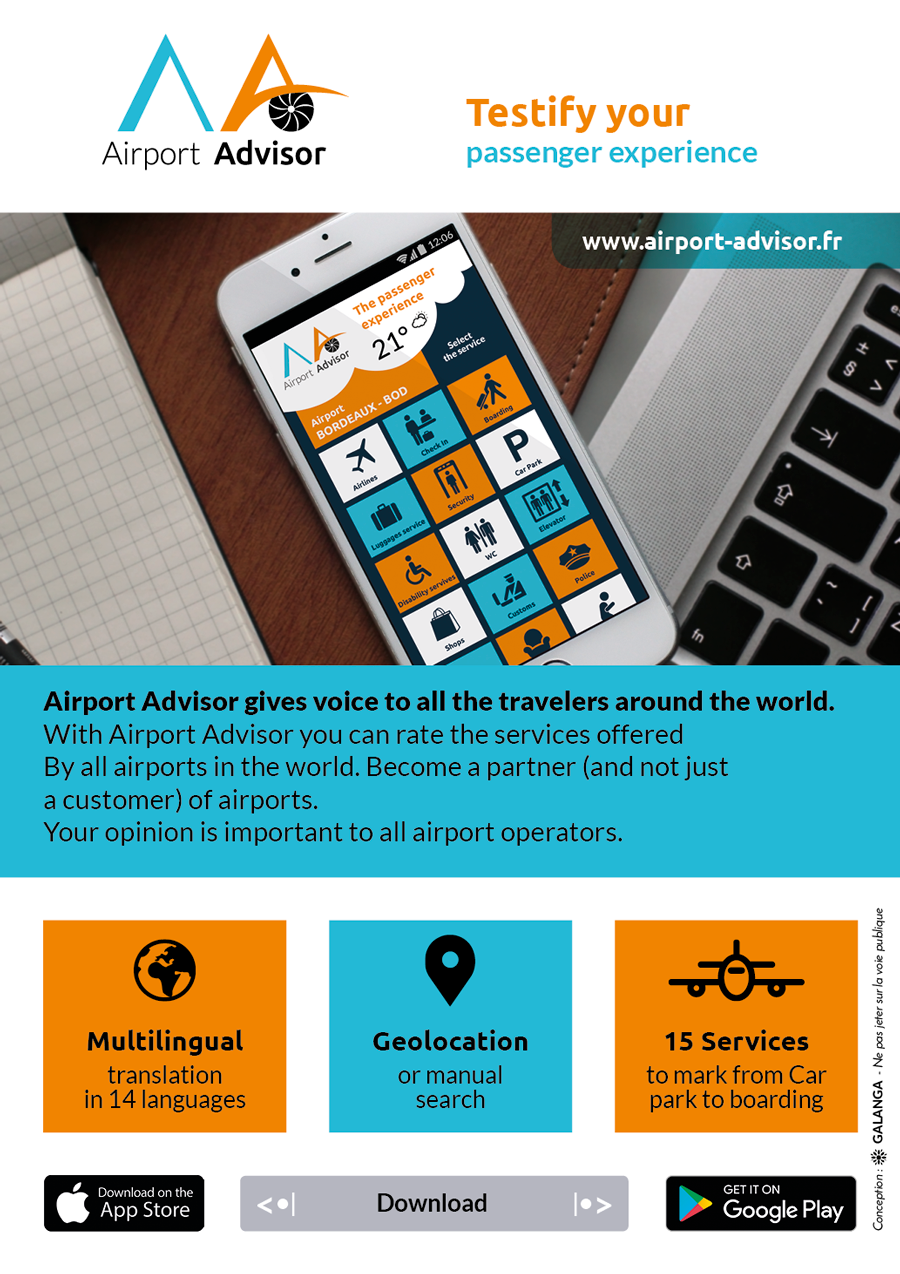
The new app that allow your passenger to leave quotes about your Airport ? ( availbale for Android and Ios in 14 languages) ?
After 2 months on line, already 143 advices left on the app
98% are very good opinion of travelers.
Picture also are left on the app to give an idea of the post.
The passenger who give more post on the month, become an Ambassador of the app and recieve his goodies.

Airports can become members of Airport Advisor and recieve their monthly quotes, marks.
contact@airport-advisor.com
Airport Advisor enhance the #paxex for sure.
No need for your Airport to spend a fortune on Survey. And make your e-reputation on the Top.
Your Pax is now your partner
http://www.applepies.nl/en/interview-app-founder-karima-kouidri/

Don’t miss this opportunity.
http://www.airport-advisor.fr
Houston Airports to Be First Airports in the World to Debut Cutting
Houston Airports to Be First Airports in the World to Debut Cutting-Edge Wayfinding Technology .
HOUSTON, June 25, 2017 /PRNewswire-USNewswire/ — Finding your way around Houston’s airports will be as simple as checking your smart phone when a new way-finding application is launched on the Houston Airport System’s award-winning fly2houston.com website this month.
Working with San Francisco-based company LocusLabs, George Bush Intercontinental Airport (IAH) and William P. Hobby Airport (HOU) will be the first airports in the world with the turn-by-turn wayfinding technology that doesn’t require downloading a separate app to smart devices.
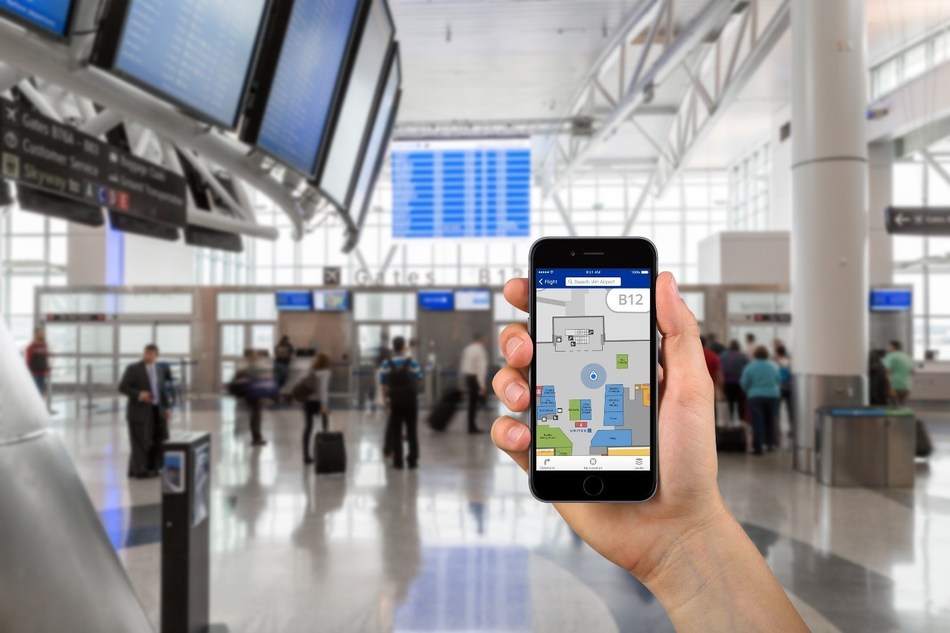
Once in place, passengers can easily access the interactive map technology from any device or browser, whether the device is mobile, desktop or tablet. The easy navigation tool provides “transit path” directions that will take the user from their originating point to their destination with the most direct and efficient path possible. LocusLabs has named this product “Maps Online.”
Both graphic and text directions are provided and each step of the path has turn-by-turn points listed, as well the estimated time it will take to walk to the destination. As important, it offers searchable navigation, with location information and search terms for points of interest including gates, ground transportation, ticket kiosks, shops, restaurants, security checkpoints, and more.
“For the Houston Airport System, the accessibility of this new technology is as exciting as being chosen as pilot airports for its launch,” said Kathleen Boyd, Head of Marketing for the Houston Airport System. “The fact that there is no app necessary — that travelers at our airports can use it simply by going to fly2houston.com on their smart device — offers another powerful and valuable tool to our customers, who already use our passenger journey-focused award-winning website to find a wide variety of information and services on a daily basis. It is another step towards meeting our strategic objective to “Make Our Passengers Happy.”
The fly2houston.com website has earned accolades from industry leaders and customers since its re-imagined makeover a year ago. This new technology enhances its passenger journey-focused approach with faster and easier feed updates, providing users with more real-time updates on airport services and amenities as well as up-to-the-minute updates on the airport footprint and points of interest information.
Airport maps are some of the most-visited pages on the fly2houston.com website, and with the new technology providing precise navigation throughout both airports — as well as a search engine that can provide information on shopping, dining, gate location and more, this ground-breaking technology advances the Houston Airport System’s goal of providing the most complete and useful information possible to passengers at both airports.
Launched in 2015, LocusLabs is a San Francisco-based company that provides the platform and tools that enable devices to be location-aware on a micro level. LocusLabs is going a level deeper than existing mapping solutions by not only mapping places, but also people, products, and things, using technology that scales. LocusLabs’ mission is to provide global venues, enterprises and brands a digital platform to communicate, share and manage everything about their physical space.
“We are proud to partner with Houston Airport System, whose innovative thinking is bringing IAH and HOU passengers the optimal digital travel experience in whatever channel or app they may be using,” says Campbell Kennedy, Co-Founder and CEO, LocusLabs.
To view the original version on PR Newswire, visit:http://www.prnewswire.com/news-releases/houston-airports-to-be-first-airports-in-the-world-to-debut-cutting-edge-wayfinding-technology-300479262.html
SOURCE Houston Airport System
Related Links
Airports and airlines need to work together to unlock value
DUBAI — Airports and airlines need to work together and exploit synergies wherever possible,
according to a recent study by global management consulting firm Strategy& (formerly Booz & Company), part of the PwC network. These partners need to join forces in order to boost revenues, lower costs, improve efficiencies, and enhance the customer experience.
Commenting on the need for airports and airlines to make unlocking synergies a priority, Alessandro Borgogna, Partner with Strategy& who leads the aviation practice in the Middle East, said: “Airports and airlines have a long and successful history of collaborating to transport millions of customers safely from place to place. However, this is no longer sufficient for business success. With a far more dynamic geopolitical and economic environment, increasing global competition and need for lower costs, these two natural partners need to make every effort to unlock synergies.”
According to the study by Strategy&, there are four areas where airports and airlines could work jointly to unlock value:
1) Integrate sales channels to boost customer purchases – Airports and airlines should solve the basic problem that prevents them from selling more products to their millions of passengers. To give passengers more time to shop, and make it more convenient, airports and airlines could integrate their sales channels for retail goods. These following options could be put to use at the same time: airplane to gate, airplane to airplane and home to gate.
Hong Kong International Airport for example has introduced the i-Gate facility, which allows travelers to order goods directly on tablets at the departure gates and have the goods delivered to them within 10 minutes.
London Heathrow Airport also offers an online travel store, Heathrow Boutique, which provides a ‘Reserve & Collect’ service where passengers can reserve products online, then pay and collect the goods as the shop.
2) Drive sales with joint loyalty programs – Although most airlines offer loyalty programs, these programs are much less common among airports. In a recent study of international airports, Strategy& found that only a quarter offered loyalty programs which were predominately large airports with over 40 million passengers per year. With a joint sales channel, a joint loyalty program can generate incremental revenues and profits for both airports and airlines at relatively low costs.
Airports and airlines also stand to gain in the following ways: More passenger spend as loyalty-program members increase their purchases to obtain loyalty points, enter higher reward tiers, and earn vouchers; lower costs thanks to shared costs, such as a joint technology platform and call centers; economies of scale as the joint program grows and increases its negotiating power with suppliers; better customer knowledge that digital analytics can exploit to tailor offerings and improve customer relationships. However, designing a business model with the right profit-sharing mechanism and the right technology will be critical.
3) Improve customer experience and efficiencies with joint digitization – Digitization is shaping the travellers’ entire experience, which Strategy& identified in five stages: pre-journey, pre-flight, in-flight, post-flight, and post-journey. Today, airline-related digitization focuses on the pre-journey, in-flight, and post-journey stages, while airport digitization focuses on pre-flight and post-flight.
By integrating their digitization efforts, hub airlines and airports could offer a single application for an integrated, seamless travel experience across all five travel stages with all manner of services, information, and guidance. The hub airlines and airports could also realize additional revenue and/or reduce costs in three key ways: Optimized operations; targeted marketing and cross-selling; improved decision making. The key challenge with this will be to define the right technology architecture and operating model for the joint digital platform.
Emirates airlines for example has started a “Together” program in collaboration with Dubai customs, police, immigration and airport authorities to use technology and improve travelers experience and make processes such as checking in or baggage drop-off and collection simpler.
4) Joint real estate development and hub operations – There are many opportunities to better coordinate real estate development and operational activities to save money and maximize the use of property. On the development front, airports and hub airlines could develop terminals and airport facilities through joint ventures or concessions to ensure optimal use. They could also coordinate the development of real estate around the airport.
For example, the Al Maktoum International Airport has already put this strategy into action. It helped created Dubai World Central, which has dedication aviation logistics and staff accommodation clusters.
On the operations front, airports and hub airlines could set up a joint slot-coordination team to maximize the use of airport infrastructure and improve airlines’ operational efficiency. They could also set up joint airport operations centers that serve both airports and airlines, lowering costs by eliminating redundancies and repetition of functions such as gate control, ground coordination, emergency centers, and call centers.
Marwan Bejjani, Principal with Startegy& and a member of the engineered products and services practice said: “These four key areas could play a significant role in boosting revenues, lowering costs and enhancing customer experience. The first three areas can help airports and airlines work together more smoothly to improve the customer experience and boost airport commercial sales by 10 to 20 percent and airline commercial sales by more than 50 percent, with relatively little incremental investment.
The fourth area concentrates on how hub airlines and airports can coordinate to improve efficiencies, lower costs, and foster economically dynamic aviation clusters — populated with their ecosystem stakeholders — to compete better in the global travel market of the future. In all of these joint activities, the challenge will be designing a business model with the right profit- and cost-sharing mechanisms and with the right technologies.”
Tarek Khalifa, Manager at Strategy& and member of engineered products and services practice in the Middle East, concluded: “We believe that priority synergies are in sales-channel integration, joint loyalty programs, joint digitization, and collaboration in real estate development and hub operations. By taking their partnership to the next level, airports and airlines can thrive and grow together in the global travel market of the future.” — SG
source : https://tinyurl.com/y95o4a29