Hamburg Airport is promising a new shopping experience for passengers when the redesigned retail area beyound security comes onboard in the next few months.
Hamburg-based company Gebr Heinemann is opening a handful of new shops in the airside passenger pier during March and April, which the airport reveals will bring a host of new brands and a fresh, modern design.
“At Hamburg Airport, we never sit still in our commitment to provide passengers with an optimal travel experience and a maximum of comfort and this, of course, includes a colourful range of shopping options,,” enthuses Lutz Deubel, head of center management at Hamburg Airport.
“We have been in partnership with Gebr Heinemann for many years, and the company has a great deal of experience and awareness of customer needs. We are thrilled about the fresh new design that the shops will soon be presenting — along with even more products and offers for customers to discover.”
New brands, Hamburg souvenirs and a modern atmosphere
Gebr. Heinemann’s Destination Hamburg concept store is moving from Gate B53 into the Airport Plaza at Hamburg Airport, offering typical Hamburg souvenir articles such as from St. Pauli, HSV and Gin Sul.
The relocation, says the airport, places the shop in an even more prominent location, easily accessible for passengers directly after the central security checkpoint in the Airport Plaza.
The duty free operator is also opening Heinemann Duty Free in the Airport Plaza, with premium sunglasses from numerous designer brands.
In the third shop, currently being remodelled adjacent to Gate A18, Heinemann will be launching its innovative “FAWJ” concept: Fashion, Accessories, Watches and Jewellery.
The new shop concepts offer customers the price benefit of Heinemann’s duty-free pricing.
“My team and I are very excited about the new shops,” says Thomas Brock, managing director of Gebr Heinemann Hamburg Airport.
“The Destination Hamburg Store is so well established, you could almost call it a classic. With the trendy new design, it will be even more attractive to the young target market.
“And with the sunglasses and FAWJ shops, we are finally able to demonstrate our competence in these areas at Hamburg Airport again.We have an extensive product range for every passenger under the Heinemann Duty Free umbrella.”
Destination Hamburg is scheduled to open mid-March 2019, followed by Heinemann Duty Free Sunglasses and FAWJ at the start of April 2019.
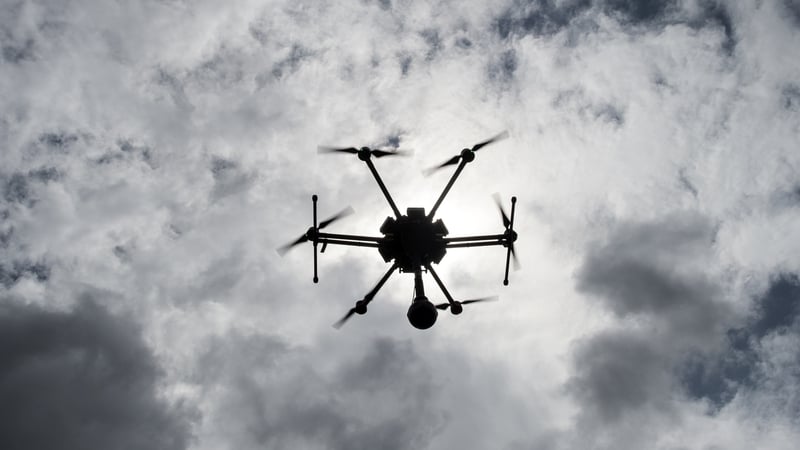
In December 2018, the world watched on as Gatwick Airport in the UK battled with a repeated drone incursion that grounded all flights and stranded tens of thousands of travellers. This incident once again highlighted the need for new security systems in an era of ubiquitous drone availability. So what solutions exist today for stopping malicious drone operations, and what solutions are expected to appear soon?
From the perspective of security, drones can be classified under two categories: fully assembled off-the-shelf drones made by drone manufacturers and DIY drones assembled from different components. With the former, the best option for ensuring lawful drone use is to work with the manufacturers to include compulsory security mechanisms into the drones being sold.
From RTÉ Six One News, a report on how drone risk assessment will be carried out at Irish airports
This could include built-in airspace maps which prevent the drone from flying in protected airspace, radio beacons which transmit drone information to nearby authorities during flight and backdoor security access that could allow members of law enforcement to take over and land unlawful drones. Airspace geofencing is already implemented in many of the popular drone brands and safety features like radio beacons are expected to become industry standard very shortly.
DIY drones pose a bigger security concern as a knowledgeable drone operator can assemble a device which lacks the security features discussed above. To deal with this class of drone, active defence systems need to be developed and deployed in high-risk areas.
From RTÉ Radio 1’s Drivetime, Captain Evan Cullen, president of the Irish Air Line Pilots Association, on pilots’ concerns around the use of drones in Irish airspace
Another option for tracking the drone is by listening to its radio transmissions. If a drone is not flying autonomously, it is using a radio link to communicate with its operator on the ground. If this radio signal can be identified then not only can the drone itself be tracked, but so can its operator. The difficulty with this option is that drone radio signals typically use the Wifi spectrum for communication, which means that the radio signal will be hidden among other Wifi device signals. New, more intelligent types of radios are needed to be able to identify the correct signal and track the source.
Other types of tracking are also possible, based on drone emissions such as thermal output or noise. We expect a combination of the above technologies to be used for defending airspace, to maximise effectiveness and reduce the chances of false positives.
Once a drone has been identified, it needs to be stopped. There are numerous options for how to do this, which can be roughly grouped into three categories: stopping the drone operator, interfering with drone communications and physically stopping the drone. To stop the operator, you require law enforcement to quickly locate his or her location. This can be achieved by listening for the remote control signal (see above) or tracking the drone to see where it goes. Police drones equipped with cameras can also be sent out to search for the guilty party.
From RTÉ 1’s Prime Time, Travel Extra editor Eoghan Corry on how well prepared is Irish air space for a drone attack
Interfering with drone communications means jamming radio signals by transmitting a signal on the same frequency with so much power that the target device can’t receive its own signal. This jamming can be applied to the drone-operator radio signal (if the drone isn’t flying autonomously) or the GPS signal which the drone uses to know where it is. The downside of jamming is the collateral damage it causes. Jamming the Wifi frequencies can cause other Wifi devices in the area to be affected, while jamming the GPS signal can be outright dangerous depending on who is using GPS nearby. In the case of Gatwick airport, it is possible that other aircraft flying above could be negatively affected if GPS jamming was used.
Physically stopping the drone is exactly what it sounds like, this can be achieved by shooting the drone with a big gun (for example, ) or cooking it with a high-power laser. A cheaper (and possibly safer) alternative is to use other drones to catch the intruder. These could be drones carrying nets or even cheap drones designed to crash into the target drone at full speed and ram it out of the sky.
Drone technology is developing in leaps and bounds, and anti-drone technology must keep up to ensure public safety. As comical as it may seem today, the next time a drone incursion happens at a major international airport could see a fully-fledged air battle between several remote-controlled aircraft not much bigger than children’s toys.
By combining 4K camera and Artificial Intelligence, NATS and Searidge Technologies are working to cut delays created by low visibility at Heathrow Airport. Andy Taylor, NATS Chief Solutions Officer, explains how. Find out more at https://www.nats.aero/services/airpor…
For some, the idea of a digital tower means recreating what you already have in a remote location. But the reality can be so much more. NATS and Searidge Technologies are working with airports to combine the latest 4K camera and machine learning technology with airfield and ATM data to solve some universal challenges – from low visibility to stand management.
The result is a genuine digital airport, where disparate systems come together to help people make the best possible decisions, improving safety, operational resilience and the passenger experience. Find out more https://www.nats.aero/services/airpor…
There is a lot happening in the world of flying taxis, but for all the renders, working prototypes and design sketches, how exactly they will land, collect passengers and take off again is something of an unknown. Startup Volocopter will now seek to explore the possibilities around this through a newly announced partnership with Frankfurt Airport.
Through a new partnership with Fraport AG, operator of Frankfurt Airport in Germany, it will now explore this with respect to airports. The two companies have begun developing concepts for so-called Volocopter Ports, which would be integrated into existing airport infrastructure and provide connections to local forms of urban transport.
“Autonomous flying will fundamentally change aviation in the years to come,” says Anke Giesen, Fraport AG COO. “We want to be the first airport in Europe to harness the potential of electric air taxis in partnership with pioneer Volocopter – for the benefit of our passengers and the Frankfurt/Rhine-Main region. This partnership underscores Fraport AG’s role as a key driver of innovation in diverse fields.”
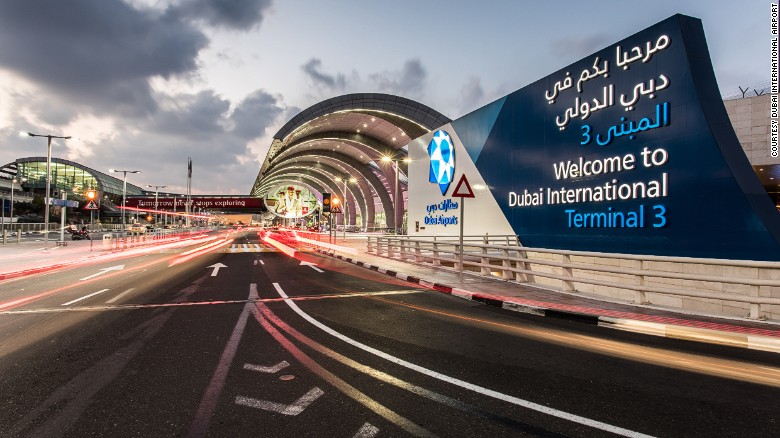
Dubai’s International Airport is seen in this file photo.
(CNN)Departing flights from Dubai International Airport, one of the world’s busiest travel hubs, were temporarily suspended on Friday due to “unauthorized drone activity” near a runway, according the Ali Zaigham, the airport’s press relations manager.The pause lasted about a 30 minutes, Zaigham said. He could not tell CNN where the drone originated from. Dubai’s International Airport is the third-busiest in the world measured by total volume of traffic, according to Airports Council International. It welcomed some 88 million passengers in 2017, trailing only Atlanta’s Hartsfield-Jackson International Airport and Beijing Capital International Airport, which hosted 104 million and 96 million passengers respectively. Major airports have been on alert for drones near runways since hundreds of flights were canceled at Gatwick Airport — London’s second busiest airport — just days before Christmas following a reported drone sighting.
Paid Content
How Older Men Get Tighter Looking Skin [do this daily] The Modern Man Today
Digital transformation has fundamentally changed passenger expectations about air travel.
An overwhelming majority of travellers today want access to digital services to improve their journey. Airports are meeting passenger demands with varying degrees of success. For most, the biggest barrier is their infrastructure.
This paper examines what changes airports can make to upgrade their cable and IT infrastructure to enable delivery of the self-service, on-demand, digital travel experience modern passengers expect.
A 24/7 security operation center at Ben Gurion international airport handles cybersecurity threats
Israeli firms and the Ministry of Economy are setting up a consortium to deal with aviation cyber-threats (Shoshanna Solomon/Times of Israel)
Israel’s Airports Authority, in charge of the nation’s international and domestic airports and its land border crossings, has to block three million attempts to breach its systems a day, mostly by bots, the head of cyber and information security at the authority, Roee Laufer, said.
In an interview with The Times of Israel and other reporters at the sidelines of a cybersecurity conference in Tel Aviv last month, Laufer said these “external threats” try to breach the “virtual fence” of cybersecurity protections the airports authority has built to protect the workings of the airports and border crossings it operates.
“We have our challenge cut out for us,” was all he said when asked how successful the authority has been in thwarting the attacks.
The Airports Authority set up a cybersecurity division four years ago, and, after that, a security operation center (SOC) at the country’s main airport, Ben Gurion international airport, which handles cybersecurity threats 24/7/365, he said.
Roee Laufer, head of cyber and information security at the Israel Airports Authority; speaking to reporters on Jan. 29, 2019 at CyberTech in Tel Aviv (Shoshanna Solomon/Times of Israel)
The center “detects and responds to potential cyber events,” he said.
The SOC makes Ben Gurion Airport possibly one of the only major international airports in the world that has such a center on its premises, he added. The authority is in charge of the airports and the border crossings, he emphasized, but not of securing the airlines themselves, which remains their own responsibility.
Surge in global travel brings increased digitalization at airports
The Airports Council International, an umbrella organization of airport authorities, predicts that by 2040 there will be 20.9 billion global passengers, up from 8.2 billion in 2017.
Airports thus must digitalize their processes to be able to handle this huge amount of traffic, said Laufer, from the check-in process to how airports interact with aircraft and how they vet passengers as they board.
“IT is at the core of the airport business,” he said. But this, in turn, increases the “attack surface” for cyber incidents at airports.
As the world undergoes digitalization and more institutions and objects become connected to the internet, the risks of a cyberattack surge. The global cybersecurity market is expected to grow from $153 billion in 2018 to $248 billion by 2023, data research firm MarketsandMarkets says in a report. Israel punches above its weight in the cybersecurity field, with the nation receiving 20% of the global share of private cybersecurity investments, second only to the US.
The airline industry is one of the most vulnerable and unprotected markets today, Prime Minister Benjamin Netanyahu warned at a cybersecurity conference in Tel Aviv in January.
“Our airlines can be attacked one hundred ways,” he said. “They can be attacked by ground control interference, they can be attacked by the systems within the plane and the communications. It is in many ways right now the most vulnerable system that we have, but as you know everything today is vulnerable and everything is under attack. Civil aviation is the one area that requires the most immediate cyber defense solution but it is one of hundreds.”
In September, Bristol airport staff in the UK had to go back to working with whiteboards after all of its flight information screens were blacked out over a weekend in a ransomware attack. Hartsfield-Jackson Atlanta International Airport, one of the busiest in the world, shut off its internal Wi-Fi network as a security measure in March last year, as the city of Atlanta’s government network underwent a ransomware attack.
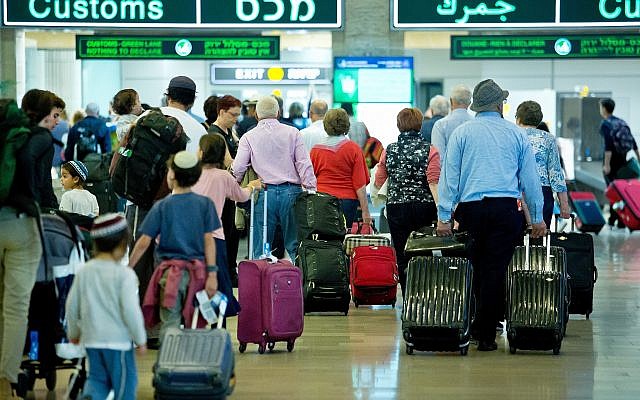
Illustrative image of travelers seen at the arrival hall of Ben Gurion International Airport, near Tel Aviv, on April 11, 2018. (Moshe Shai/FLASH90)
However, introducing new processes and technologies to an industry that has very rigid practices already in place is very hard, explained Israel Airports Authority’s Laufer. “One thing that makes airport and civil aviation safe is strict enforcement of safety and security,” he said. But that also makes it more difficult to innovate, he said.
The airline sector is also unique because there are a variety of parties involved in the business — airports, airlines and aviation industry suppliers — all of whom need to work very closely with one another to make the industry tick. “It is a very interconnected sector,” Laufer said.
To raise the level of cybersecurity in civil aviation as a sector, the effort needs to be sector-wide, he said.
“The chain is only as strong as its weakest link,” Laufer said. Thus, while some parts of the industry may have high levels of cybersecurity measures, if others don’t raise their standards as well, the sector as a whole is vulnerable.
“It has to be a sectorial effort, and currently I’m afraid it’s not,” he said. The matter must be dealt with at a national, government level using the expertise of the civil aviation agencies, he urged.
In November, a group of Israeli cybersecurity firms, along with the Economy and Industry Ministry, set up a new cyber consortium to offer comprehensive, end-to-end cybersecurity solutions for the commercial aviation industry — airports, airlines and aircraft.
The consortium includes Israel Aerospace Industries (IAI), CyberArk, Check Point Software Technologies Ltd., El Al’s Cockpit Innovation hub, Karamba Security and ClearSky — a combination of veteran cybersecurity and aerospace firms that already offer “a broad range of aviation, security, intelligence and cyber solutions for the global market” alongside “young startups with cutting edge cyber products and technologies,” the consortium said in a statement at the time.
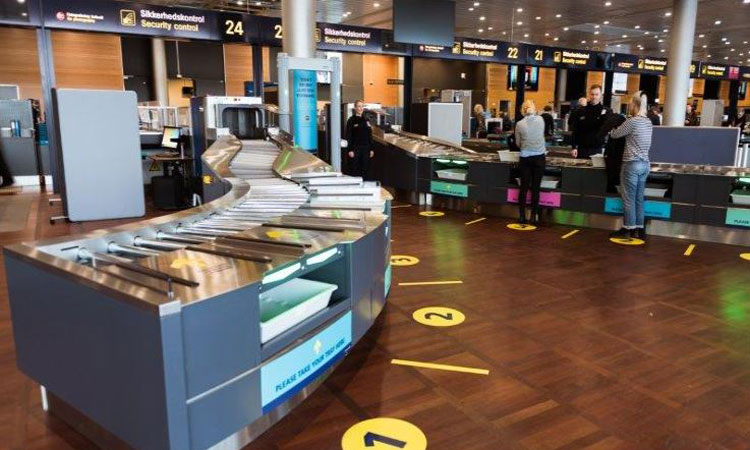
Passengers at Copenhagen Airport will be trialling new security features to ensure the longevity of the new technology, which will enable passengers to leave liquids in hand luggage.
Credit: Copenhagen Airport
Copenhagen Airport (CPH) has announced the beginning of the development planned for the current security protocols at the airport. These developments will improve the passenger experience by eventually ensuring that passengers can go through security without having to remove computers and liquids from their hand luggage. Until then, travellers and employees will test the new security equipment to help find the best solution for a new and future-proof security system.
The new security system will be developed over the next couple of years using two dedicated lanes (23 and 24), where the airport initially will test two new lane designs. These lanes will in the first instance be longer and have more packing stations to increase the number of passengers that can prepare for the screening process. New technology along with new equipment for baggage screening will also be introduced on the two lanes in the spring. The new equipment consists of C3 scanners, which can display advanced 3D images and allow passengers to leave electronics and liquids in the hand luggage during the screening process.
Johnnie Müller, Head of Security at Copenhagen Airport, said: “An increase in passengers and demands on security obviously places a high demand on airport security. We are constantly working to optimise the security process and improve the customer experience throughout the airport. It is therefore crucial that the new lanes and equipment are tested in operation, so that our employees and travellers can experience them in real situations. In this way, we can develop the best possible solution for the future.”
To further optimise security, Copenhagen Airport will test a number of different screening equipment, including C3 scanners from various suppliers. In addition, the airport will test new body scanners. As a result of this, security will be tailor-made for the requirements of Copenhagen Airport, its airport employees and passengers.
Müller continued: “We want new security protocol to be modern, efficient and high-tech, but first and foremost, good security means we need to find the solution that best suits our airport. Not only does the solution have to suit our area, but it also has to assist our employees in providing the best service possible, as well as also being the best solution for the many different needs of our passengers. Unlike other airports, we will also test the new equipment and the new lanes in close cooperation with both employees and passengers, instead of creating a closed test environment that has difficulty in reflecting reality.”
New equipment and more efficient processes will improve the security control for passengers and employees. The new equipment and lane design will improve the ways that employees can assist passengers, which in turn will improve the airport passenger experience, something that usually begins at security.
Müller concluded: “Even though this new security system is a change for the better, we know that any change can be difficult. That’s why we are doing everything we can to advise the passengers using lanes 23 and 24 of the changes and how best to participate. Our employees have been thoroughly trained and signs have been placed throughout the area to ease the process.”