Pepper Robot at Munich Airport , Germany Lufthansa and Munich Airport have started testing of a humanoid robot in Terminal 2 of the airport. The robot, given the name “Josie Pepper,” is there to provide information and answer questions for passengers in Terminal 2. Spencer KLM Humanoid Robot After more than three years of construction and programming, Spencer the robot completed various tests at Schiphol this month. -LG Robot at Seoul Aiprot, South Korea SITA – Leo Robot many more -Robots assist passengers, clean floors at South Korean airport -These Robots Could Be Coming To An Airport Near You Munich Airport Has a Humanoid Robot Talking to Passengers https://thepointsguy.com/2018/02/muni… -KLM’s Robot Spencer –https://www.youtube.com/watch?v=ir_Ku…. Schlaue Helferin: Roboterdame Josie Pepper unterstützt Flughafen Münche https://www.youtube.com/watch?v=dNe9u… -airport freakout LG at CES 2017 – Robots https://www.youtube.com/watch?v=e1J28… Tour of the $68.6M Gulfstream GS650ER jet | Business Jet https://www.youtube.com/edit?o=U&vide… Singapore Airshow 2018 : Full Tour | Air Baltic’s BRAND NEW Bombardier CS30 https://www.youtube.com/edit?o=U&vide… Singapore Airshow 2018 | First A350-1000 Tour https://www.youtube.com/edit?o=U&vide… Singapore Airshow 2018 | Aerobatic Flying Display, RTAF, TNI , ROKAF https://www.youtube.com/edit?o=U&vide… Top 10 World’s Safest Airlines for 2018. https://www.youtube.com/edit?o=U&vide… How much does it cost buy a Boeing Plane : 2018 https://www.youtube.com/edit?o=U&vide… 10 things about Indigo Airline, India : 2018 https://www.youtube.com/edit?o=U&vide… Top 15 Longest Flights in the World 2017-18 https://www.youtube.com/edit?o=U&vide… 13 Airlines who operate worlds biggest passengers aircraft airbus A380 – New HD – 2017- prt 1 https://www.youtube.com/edit?o=U&vide… 10 new planes you may fly soon in 2018-19 https://www.youtube.com/edit?o=U&vide… How it’s made .? Airbus 380 for Etihad https://www.youtube.com/edit?o=U&vide… Design by : Daval Presented by : www.Jetlinemarvel.net
He’s 243 years old, and is here to clear the air on all the conspiracies at DEN.
Turns out this gargoyle is wiser than we thought, and is sharing more than we planned. Along with giving travelers his two cents, he’s surprising them with smiles and plenty of laughs.
We believe interactions at DEN should not only be helpful, but fun too. That’s the art of airporting.
Navigating through an airport and getting safely on and off a flight is quite the task for anyone. The OCS system at Dublin Airport caters for people with disabilities, who need that extra bit of help through the hustle and bustle of the airport. We join a young boy and his mother and see how their airport journey was improved by using the OCS system.
Plus there are plenty more stories straight from Dublin Airport. All over the world, airports are abuzz with people; with arrivals and departures, and crying and smiling, Dublin Airport is no different.
We follow the stories of the passengers and the staff at Dublin and see just how an airport operates from day-to-day.
by Shany Seawright | Feb 27, 2019 | At The Airport, Recent News |
Global passenger traffic is expected to reach and
potentially exceed 20 billion by 2039, according to the Airports Council International (ACI) World data. This projected growth, with a 4.1 percent Compounded Annual Growth Rate (CAGR)
globally, has grabbed the attention of airports in nearly every geographic
area. How will they modernize infrastructure to keep up with passenger demands
and accommodate their needs?
“Catering to the changing needs of passengers will be pivotal to
airports’ success in an increasingly globalized and competitive environment,”
according to ACI World Director General Angela Gittens.
The first step to staying competitive is investment into
current airport infrastructure to keep up with high levels of service that
passengers have come to expect of their travel experience.
“Investing in new and improved infrastructure, as well as making the
most of existing infrastructure, is the bedrock on which smooth airport
operations and improved passenger experience is built,” Gittens continued.
No longer can airports run simply as points of
departures and arrivals. Modern airports are complex travel centers that offer
a wide range of services. From 5G wireless connectivity to biometric screening
and baggage drop solutions, technologies are rapidly evolving to help create a
more seamless travel experience for passengers.
Yet where is the investment in this infrastructure coming from?
According to Gittens, airport privatization has proven to be an
important investment vehicle globally, specifically in Europe, China, and
India, to help support the development to infrastructure and accommodate air
service demand.
into every aspect of airport management Duration: 45 minutes
Presented by:
Ray Cleary, BI Manager, Dublin Airport
Mikkel Oldenburg, TARGIT Senior Sales Manager
Airports need to answer critical questions every minute of every day: How many passengers should you expect at any given moment? What’s the average wait time? How many security lanes should you open?
Of course, there’s a good place to turn for answers: your data. But how do you combine data from different systems into one streamlined plan that helps employees learn in a data-driven way?
Join Ray Cleary, as he highlights how TARGIT helped world-class Dublin Airport. You’ll get their full data story, including:
Implementation of data & analytics process and business areas
Methodology and why they’re moving to an agile approach
BI champion models which create competence centers in each business area like car parks, security and airport operations
Learn why TARGIT is tailor-made for the needs and regulations of the airport industry in this exclusive on-demand webinar.
Most travelers face the check-in and security processes at airports with a feeling that typically fluctuates somewhere between resignation and dread. There are the long, snaking lines to shuffle through one agonizing step at a time. There is the struggle to balance briefcase, wallet and ID without letting anything important drop to the floor. And despite its importance, there is frustration associated with the need to prove one’s identity at multiple checkpoints.
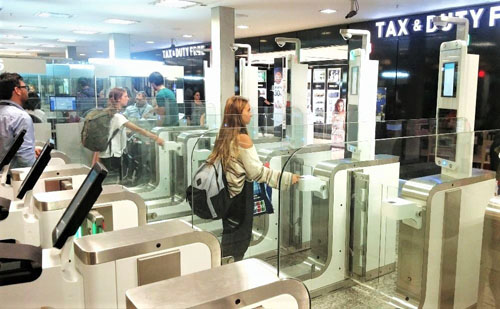
Biometric technology – in particular, facial recognition solutions – hold the promise to change all that for the benefit of travelers, airlines, and airports alike. Multiple airlines, including British Airways, Delta, JetBlue, and Lufthansa – as well as airports worldwide – are testing biometric authentication as a means to streamline the passenger experience. With facial recognition biometrics, passengers have their photo taken at the airport. That photo is then compared with stored valid ID images. If there is a match, the passenger is approved to move forward through the process. Check-in and security are transformed from a “necessary evil” into a seamless, frictionless process.
The rewards of successful biometric solutions are many, but some of the most notable ones include:
Passengers spend less time in lines and have less hassle, improving customer satisfaction
Airport vendors benefit from the extra time passengers have to shop and eat in the airport terminal.
Airports have the opportunity to automate check-in and security to a greater degree, enabling the optimization of staffing, capacity and resources.
Airlines are able to avoid needless and costly delays waiting for passengers.
Airports and airlines boost security by analyzing facial images for known terrorists.
Immigration and border control organizations can verify the status of individuals seeking entry to a country in real-time.
Given that the International Air Transport Association (IATA) expects 7.8 billion passengers to travel by the year 2036 – almost double the current volume of air travelers – the need for streamlined check-in and security clearance processes is critical. IATA itself is promoting the use of biometric technology in their introduction of One ID. According to IATA:
“One ID seeks to introduce a collaborative identity management solution that spans all process steps and stakeholders in the end-to-end journey from booking to arrival at destination and back, putting the passenger in the center. The concept relies on early validation of the passengers’ identity, and controlled access to this information by the various public and private stakeholders on an authorized-to-know basis, so that the passenger can be recognized and attended to in the most efficient way in subsequent process steps. The concept involves the use of a trusted, digital identity, biometric recognition technology and a collaborative identity management platform.”
Breaking that down, the use of biometrics at the airport involves biometric-capturing technology, reliable algorithms for producing identity matches, an identity management platform, and end-to-end security. All these components must work together in real-time for any integrated solution to deliver against its promised benefits.
Of these components, security is potentially the greatest sticking point to the success of utilizing biometrics at the airport. The fact is, while almost three quarters of consumers indicate that they are either very comfortable or somewhat comfortable with biometrics, a full 86 percent of consumers state that they are very concerned or somewhat concerned about the misuse of their personal information, according to a report by the Center for Identity at the University of Texas at Austin. Therefore, airports, airlines and security organizations need to demonstrate that they can protect the privacy and confidentiality of consumer biometric and personal data. Otherwise, they will likely face objections or protests against the expansion of biometric technology.
To promote digital trust with consumers, security must be fully integrated into any biometric airport solution. It should offer multichannel and multifactor authentication, auditability, real-time monitoring, advanced analytics and protection against both external and internal threats. For example, solutions exist on the market today that leverage identity-driven microsegmentation and strong encryption to dynamically secure communities of interest – separating trusted systems, users, and data from the untrusted. It enables organizations to further reduces the attack surface by concealing endpoints, rendering them undetectable in any public or private network.
What it comes down to is this: airline passengers are more than willing to smile at the camera – as long as they know that their smile will be protected.
Dheeraj Kohli is Vice President and the Global Head of Travel and Transportation and Hemalatha Asundi is Airport Solutions and Product Manager for Blue Bell-based Unisys Corporation. They can be reached at Dheeraj.kohli@unisys.com and Hemalatha.Asundi@in.unisys.com.
Airline passengers are using automated technology for passport checks at double the rate recorded in 2017, according to the latest aviation IT report.
Indeed, passengers are happier when technology smooths their way through passport checks and other aspects of their airport journey, reveals SITA’s 2019 Passenger IT Insights report.
The report, released today, reveals that 44% of passengers sailed through automated passport control, a jump from 21% in 2017.
Other key findings include:
• At passport control, passengers were 3.85% more satisfied when using self-scanned gates to verify their ID
• At automated boarding gates, passengers were 2.2% more satisfied when scanning their own documents to board
• At every point in the passenger journey where technology was utilised, the rate of satisfaction was higher
In general, technology users had a satisfaction rate of 8.36 out of 10.
Matthys Serfontein, SITA’s president of air travel solutions, said: “One of the standout findings of our report this year is that at every point in the journey, where passengers use technology, the rate of satisfaction is higher.
“Airlines and airports can see the benefit of their technology investments in making it easy for passengers, every step of the way. Over the years, booking, check-in and bag drop have increasingly become automated and passengers like it.
“Interestingly, this year the report shows how introducing automated passport controls, in collaboration with government and border agencies, also increases passenger satisfaction.”
Automated gates used at boarding are another success for the industry and its passengers, according to SITA.
It claims that not only do they speed up the processing of passengers but they support more efficient operations and faster turnarounds, the end result being 2.2% higher satisfaction levels for travellers opting for the self-service options.
“Today, we have our Smart Path solution at airports around the world, from Australia to the Americas, which uses biometrics to automate the journey,” notes Serfontein.
“Across the board we have found that passengers are keen to use the biometric self-service process, when given a choice, over 90% of travellers typically opt in. Actions speak louder than words, and it’s becoming very clear from our implementations that people like using biometrics for easy travel.”
It seems that when it comes to verifying their identity, passengers are ready to use technology even more and in a variety of ways. SITA reports that 59% are ‘very willing’ to use their mobiles for ID verification along the journey, with a further 33% open to the idea.
While proving your identity using your mobile deviceis not an option widely available today, with nine out of ten passengers potentially welcoming this service, airlines and airports can be confident when moving to mobile services for ID identification.
Passengers, SITA insists, are looking to make their journey as easy as possible and mobile is top of the technologies they want to use.
The key findings of SITA’s report are based on a survey of passengers from 20 countries across the Americas, Asia, Europe, Middle East and Africa, representing over 70% of global passenger traffic.
This year’s report was co-sponsored by Air Transport World.
Expansion of domestic and regional routes in the aviation market, a strong economic growth, and rising air passenger traffic increase the demand for airport services.The major drivers of this industry are reviving airline and tourism sector and increasing penetration of low cost carriers in the developing countries.
GlobalAirport Service Market Report Investigates and Presents Gigantic Information and Reasonable Data of the Overall Industry with rising CAGR(compound annual growth rate) of xx% during 2019-2025.
Airport Service Industry research report is a meticulous investigation of current scenario of the market, which covers several market dynamics. Airport Service Market Research Report provides an in-depth analysis of the major Airport Service industry leading players along with the company profiles and strategies adopted by them.
Top merchant analysis is one of the key component and is exceptionally helpful for each player to comprehend focused scene in the market. Major companies present in Airport Service market report are:
Aeroports de Paris,BBA Aviation,Fraport AG Frankfurt Airport Srvc Wrldwd,Japan Airport Terminal,Sats,
Request a Sample of Airport Service Market research report from
Market segment by Type, the product can be split into
International Domestic
The report provides actionable insights to improve source-to-contract cycle performance in the Global Airport Service Market. It helps sourcing professionals formulate better category strategies, enhance savings, understand supplier and market challenges, and implement sourcing best practices.
Further in the Airport Service Market research reports, following points are included along with in-depth study of each point:
Production Analysis – Production of the Airport Service is analysed with respect to different regions, types and applications. Here, price analysis of various Airport Service Market key players is also covered.
Sales and Revenue Analysis – Both, sales and revenue are studied for the different regions of the Airport Service Market. Another major aspect, price, which plays important part in the revenue generation, is also assessed in this section for the various regions.
Supply and Consumption – In continuation with sales, this section studies supply and consumption for the Airport Service Market. This part also sheds light on the gap between supple and consumption. Import and export figures are also given in this part.
Competitors – In this section, various Airport Service industry leading players are studied with respect to their company profile, product portfolio, capacity, price, cost and revenue.
Other analyses – Apart from the aforementioned information, trade and distribution analysis for the Airport Service Market, contact information of major manufacturers, suppliers and key consumers is also given. Also, SWOT analysis for new projects and feasibility analysis for new investment are included.
Market Effect Factors Analysis
Market driver • Increasing market penetration of digital technologies. • For a full, detailed list, view our report
Market challenge • Stringent regulatory challenges in Airport Service applications. • For a full, detailed list, view our report
Market trend • Rising demand for Airport Service in market. • For a full, detailed list, view our report
Place a Purchase Order for Single User License ($3900) at:
Key questions answered in this report What will the market size be in 2025 and what will the growth rate be? What are the key market trends? What is driving this market? What are the challenges to market growth? Who are the key vendors in this market space? What are the market opportunities and threats faced by the key vendors?
BIAL to implement Digi Yatra – the passenger’s face will become the single biometric token – there will be no more inconvenience of showing an eTicket/ boarding pass/ identity card at various locations.
Hari Marar, MD & CEO, BIAL
Hari Marar, MD & CEO, BIAL is leveraging the technological innovations at the Kempegowda International Airport, Bengaluru (KIAB) to offer a seamless travel experience for passengers and is creating a future-ready airport. Bangalore International Airport Limited is the third largest and busiest airport in India.
Bangalore International Airport is embarking on a transformational journey and is leveraging IoT, AI, and ML for quick reactions to the provision of passenger facilities across the airport and enhance Airside performance, enabling on-time departures of flights. A robust IT infrastructure to support future technologies, with the use of BI, AI, and deep-learning algorithms will facilitate transformation as the Terminal at BLR Airport evolves, always ensuring that data security is central to all processes.
Biometric and paperless boarding
BIAL is currently planning the implementation of the Digi Yatra biometric boarding system at KIAB. From entry into the Airport campus till boarding the aircraft, every point in the passenger’s travel through the Airport will be touched by various aspects of technology.
With the implementation of Digi Yatra – subject to MoCA and GoI developing the platform – the passenger’s face will become the single biometric token – there will be no more inconvenience of showing an eTicket/ boarding pass/ identity card at various locations.
Marar explains, “To use this technology, the passenger must create a DigiYatra ID with a one-time validation of his/ her Aadhaar or any other Government-approved ID, followed by one-time facial recognition at the Airport kiosk.”
The rollout will be phased and will start with one domestic airline and scale up systematically over the next few months.
Frictionless check-in and check-out
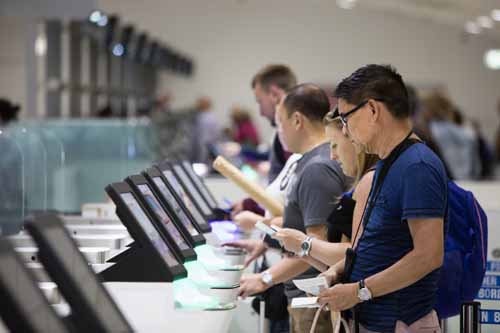
BIAL has launched the self-bag drop facility to enhance customer experience. 16 fully-automated Self Bag Drop machines have been deployed to accelerate the baggage transaction and reduce check-in queues. The bags are measured, weighed, scanned and automatically fed into the baggage handling system, thereby enabling the check-process to be completed in approximately 45 seconds.
As many as 32 brands new self-check-in kiosks are planned to be installed to print boarding passes and baggage tags. These kiosks have been specially designed for BLR Airport. The implementation of Smart security lanes with automated tray retrieval will integrate security screening with the latest technological innovations to facilitate more accurate screening and higher throughput, making the process more pervasive but less invasive.
“Passengers will breeze through the security-check area in less than five minutes, reducing stress levels for passengers. Our concerted efforts are to introduce innovative and interactive digital solutions that will create value for our passengers and concessionaires” he asserts.
Advanced Analytics for deepening the experience
The BI and analytics platform is currently under execution at KIAB and, amongst the many other benefits to the enterprise, specifically for passengers, it would help the Airport understand passenger reporting patterns, processing times, resource usage, therefore enabling the dynamic scale-up of resources. This is based on the correlation of data from various external data sources like weather, traffic, flight status, social media and analytics from various BIAL internal systems.
Analytics will also be applied using algorithms and deep learning algorithms built on the platform, enabling enhancement in passenger service and experience, reduction in the queue waiting times and improvement in process efficiencies. The BI and analytics platform will be invaluable on both on a tactical interventions level as well as from a strategic planning perspective, giving BIAL the ability to deliver enhanced services to the passengers at KIAB.
Sustainable airport
“Sustainability remains a key pillar as operations at BLR Airport are conducted in a responsible manner with various measures that enable us to aspire for the highest environmental sustainability recognition,” Marar says.
Hence, in order to create a sustainable building, Marar is launching an IoT platform and Smart Aerocity initiatives to manage various devices, equipment, etc. These IoT solutions will help in collating and analyze the data from multiple devices across the campus like street lights, HVAC, energy and water meters, temperature and weather sensors, electrical equipment and many others. The data will further be processed using algorithms to fuel-up the efficiencies, proactive maintenance of equipment to reduce downtime and enhance service levels.
Sharing of relevant information with passengers on an API ecosystem will lead to a reduction in passenger anxiety related to air travel.
“BLR Airport will continue to lead from the front in transforming air travel in India by leveraging technology. The technology used by BIAL will be advanced, yet simple enough for Indian consumers to easily adapt and experience, and at the same time, it will be secure and efficient, thereby safeguarding customer privacy. Towards this, we have an efficient team that is continually devising ways to bring new technologies to airport operations,” Marar adds.
Dwelling the skill-sets to complimenting emerging tech
BIAL signed a five-year agreement with Accenture in 2017 to create the Bangalore Airport-Accenture Innovation Centre (BAIC) on the Airport Campus. The agreement is the centerpiece of their digital transformation programme and covers both digital transformation and innovation. BIAL have a team working on about 16 new digital initiatives that are in various stages between conceptualisation and deployment.
BIAL also has an agreement with Unisys for the development of sophisticated algorithms that, over time, will use AI and ML capabilities to enable them to make informed and sophisticated decisions about every aspect of the business.
He further says, “This project is going to be central to the way we reshape our business, and our partnership with Unisys is structured over a five-year period that allows us to build up our ‘in-house’ capabilities over the course of the partnership. We strongly believe that in the future technology will be at the heart of airport operations.”
If you have an interesting article / experience / case study to share, please get in touch with us at editors@expresscomputeronline.com