
World’s top airports for Customer Experience revealed

Time-tested and first-time winners recognized from every region across the globe

Results based on ACI World’s globally-established Airport Service Quality programme

Montreal, 6 March 2019 – Airports Council International (ACI) World has today revealed the winners of its world-renowned Airport Service Quality Awards which recognize those airports around the world that deliver the best customer experience in the opinion of their own passengers.

Kempegowda International Airport, Bangalore, India, has won the first ever ASQ Arrivals Award, based on the new Arrivals Survey – it is the first airport in the world to win both a Departures and an Arrivals award.

Perennial winners from around the world include Indianapolis International Airport, Beijing Capital International Airport, Singapore Changi Airport, and Toronto Pearson,  Aeroporto di Roma-Fiumicino, Mumbai’s Chhatrapati Shivaji International Airport, Delhi’s, Indira Gandhi International Airport, Shanghai Pudong International Airport, and Sheremetyevo International Airport.

This year, a number of airports have won their first ASQ Award, including Aeropuerto Internacional Ramón Villeda Morales in Honduras, as well as Dublin, Oslo, Helsinki, Southampton, Bristol, and London City airports. Spain’s Aeropuerto de Almería, Aeropuerto de Girona, Aeropuerto de Melilla, Aeropuerto de Zaragoza, and Aeropuerto de Alicante-Elche are also first time winners. Fort McMurray Airport in Canada and Muscat Airport in Oman are also newcomers to the ASQ Awards fraternity, while several top-performing previous winners have again featured prominently.

In the new “Best Infrastructure and Facilitation” category, no fewer than seven Indonesian and eight Chinese airports are recognized in their size category.

“The Airport Service Quality Awards celebrate the achievements of airports in delivering the best customer experience and they represent the highest possible accolade for airport operators around the world,” said ACI World Director General Angela Gittens.

“In both the traditional and new categories, these airports have responded to the evolving needs of passengers to deliver higher levels of service and an award-winning performance.

“Airports have recognized that delivering a better customer experience is an important business tool in an increasingly competitive industry. ACI’s ASQ is the only globally-established programme that provides objective measurement and benchmarking for airports to help drive their performance.”

The winning airports will come together at the ASQ Awards Ceremony which will be held during the second ACI Customer Experience Global Summit, taking place in Bali, Indonesia in September.

The Airport Service Quality (ASQ) programme is the world’s leading airport passenger service and benchmarking programme. The ASQ Departures programme measures passengers’ satisfaction across 34 key performance indicators. Three quarters of the world’s 100 busiest airports are part of the ASQ programme which means that, in 2018, more than half of the world’s 8.3 billion travellers passed through an ASQ airport.

A range of new award categories, recognizing excellence in segments of the customer experience announced earlier this year, have produced a diverse group of winners, illustrating the commitment to the customer experience of airports around the world.

ASQ DEPARTURES AWARDS

Award CategoryAirport NameCity and Country
Best Airport by Size and Region
AFRICA
Under 2 million passengersKimberley National AirportKimberley, South Africa
Port Elizabeth National AirportPort Elizabeth, South Africa
Upington International AirportUpington, South Africa
5 – 15 million passengersKing Shaka International AirportDurban, South Africa
Mohammed V International AirportCasablanca, Morocco
ASIA-PACIFIC
Under 2 million passengersDepati Amir AirportPangkal Pinang City, Indonesia
Sultan Thaha AirportJambi, Indonesia
2 – 5 million passengersBiju Patnaik International AirportBhubaneswar, India
Chandigarh AirportChandigarh, India
Devi Ahilyabai Holkar AirportIndore, India
SM Badaruddin II AirportPalembang, Indonesia
SS Kasim II AirportPekanbaru, Indonesia
Yichang Sanxia AirportYichang, China
5 – 15 million passengersChangchun Longjia International AirportChangchun, China
Cochin International AirportCochin, India
Hohhot Baita International AirportHohhot, China
Nanchang Changbei International AirportNanchang, China
Sepinggan International AirportBalikpapan, Indonesia
15 – 25 million passengersHaikou Meilan International AirportHaikou, China
Sanya Fenghua International AirportSanya, China
Tianjin Binhai International AirportTianjin, China
25 – 40 million passengersChongqing Jiangbei International AirportChongqing, China
Kempegowda International AirportBangalore, India
Over 40 million passengersChhatrapati Shivaji International AirportMumbai, India
Indira Gandhi International AirportDelhi, India
Shanghai Pudong International AirportShanghai Pu Dong, China
Singapore Changi AirportSingapore, Singapore
EUROPE
Under 2 million passengersAeropuerto de AlmeriaAlmeria, Spain
Aeropuerto de Girona – Costa BravaGerona, Spain
Aeropuerto de MelillaMelilla, Spain
Aeropuerto de ZaragozaZaragoza, Spain
Skopje International AirportSkopje, Macedonia
2 – 5 million passengersLondon City AirportLondon, UK
Southampton International AirportSouthampton, UK
Tallinn AirportTallinn, Estonia
Zagreb AirportZagreb, Croatia
5 – 15 million passengersAeropuerto de Alicante-ElcheAlicante, Spain
Bergen AirportBergen, Norway
Bristol AirportBristol, UK
JSK International Airport SochiSochi, Russia
Keflavik International AirportKeflavik, Iceland
Malta International AirportLuqa, Malta
Newcastle International Airport LtdNewcastle, UK
Porto Francisco sa Carneiro AirportPorto, Portugal
15 – 25 million passengersAthens International AirportAthens, Greece
Helsinki Vantaa AirportHelsinki, Finland
Prague AirportPrague, Czech Republic
25 – 40 million passengersDublin AirportDublin, Ireland
Flughafen ZurichZurich, Switzerland
Oslo-Gardemoen AirportOslo, Norway
Over 40 million passengersAeroporto di Roma-FiumicinoRome, Italy
Sheremetyevo International AirportMoscow, Russia
LATIN AMERICA-CARIBBEAN
Under 2 million passengersAeropuerto Internacional Ramón Villeda MoralesSan Pedro Sula, Honduras
Airport International Daniel Oduber QuirosLiberia, Costa Rica
2 – 5 million passengersAeropuerto Internacional de los CabosLos Cabos, Mexico
Aeropuerto Internacional Jose Joaquin OlmedoGuayaquil, Ecuador
5 – 15 million passengersAeropuerto Internacional Punta CanaPunta Cana, Dominican Republic
Tancredo Neves-Confins International AirportBelo Horizonte, Brazil
MIDDLE EAST
5 – 15 million passengersQueen Alia International AirportAmman, Jordan
NORTH AMERICA
Under 2 million passengersFort McMurray International AirportFort McMurray, Canada
Portland International JetportPortland, United States
2 – 5 million passengersEl Paso International AirportEl Paso, United States
Ottawa International AirportOttawa, Canada
5 – 15 million passengersIndianapolis International AirportIndianapolis, United States
Jacksonville International AirportJacksonville, United States
San Antonio International AirportSan Antonio, United States
15 – 25 million passengersDallas Love Field AirportDallas, United States
25 – 40 million passengersDetroit Metropolitan Wayne County AirportDetroit, United States
Minneapolis/St Paul International AirportMinneapolis, United States
Over 40 million passengersDallas Fort Worth International AirportDallas, United States
Toronto Pearson International AirportToronto, Canada
Most Improved
AFRICAFélix-Houphouët-Boigny International AirportAbidjan, Côte d’Ivoire
ASIA-PACIFICSilangit International AirportSiborong-Borong, Indonesia
EUROPEBergen AirportBergen, Norway
LATIN AMERICA-CARIBBEANJuan Santamaria International AirportSan Jose, Costa Rica
MIDDLE EASTMuscat International AirportMuscat, Oman
NORTH AMERICAToronto Pearson International AirportToronto, Canada

NEW AWARD CATEGORIES

Award CategoryAirport NameCity and Country
Best Environment and Ambience by Size
Under 2 million passengersDepati Amir AirportPangkal Pinang City, Indonesia
RH Fisabilillah AirportBintan, Indonesia
Silangit AirportTapanuli, Indonesia
Sultan Thaha AirportJambi, Indonesia
2 – 5 million passengersChandigarh AirportChandigarh, India
SM Badaruddin II AirportPalembang, Indonesia
SS Kasim II AirportPekanbaru, Indonesia
Yichang Sanxia AirportYichang, China
5 – 15 million passengersAhmedabad International AirportAhmedabad, India
Changchun Longjia International AirportChangchun, China
Hohhot Baita International AirportHohhot, China
Nanchang Changbei International AirportNanchang, China
Sepinggan International AirportBalikpapan, Indonesia
15 – 25 million passengersHaikou Meilan International AirportHaikou, China
Tianjin Binhai International AirportTianjin, China
25 – 40 million passengersChongqing Jiangbei International AirportChongqing, China
Gimpo International AirportGimpo, South Korea
Over 40 million passengersBeijing Capital International AirportBeijing, China
Singapore Changi AirportSingapore, Singapore
Best Customer Service by Size
Under 2 million passengersDepati Amir AirportPangkal Pinang City, Indonesia
Portland International JetportPortland, United States
Silangit AirportSiborong-Borong, Indonesia
Sultan Thaha AirportJambi, Indonesia
2 – 5 million passengersDevi Ahilyabai Holkar AirportIndore, India
SM Badaruddin II AirportPalembang, Indonesia
SS Kasim II AirportPekanbaru, Indonesia
Yichang Sanxia AirportYichang, China
5 – 15 million passengersAhmedabad International AirportAhmedabad, India
Changchun Longjia International AirportChangchun, China
Hohhot Baita International AirportHohhot, China
Nanchang Changbei International AirportNanchang, China
Sepinggan International AirportBalikpapan, Indonesia
15 – 25 million passengersSanya Fenghua International AirportSanya, China
Tianjin Binhai International AirportTianjin, China
25 – 40 million passengersChongqing Jiangbei International AirportChongqing, China
Gimpo International AirportGimpo, South Korea
Over 40 million passengersBeijing Capital International AirportBeijing, China
Singapore Changi AirportSingapore, Singapore
Best Infrastructure and Facilitation by Size
Under 2 million passengersDepati Amir AirportPangkal Pinang City, Indonesia
RH Fisabilillah AirportBintan, Indonesia
Silangit AirportSiborong-Borong, Indonesia
Sultan Thaha AirportJambi, Indonesia
2 – 5 million passengersDevi Ahilyabai Holkar AirportIndore, India
SM Badaruddin II AirportPalembang, Indonesia
SS Kasim II AirportPekanbaru, Indonesia
Yichang Sanxia AirportYichang, China
5 – 15 million passengersAhmedabad International AirportAhmedabad, India
Changchun Longjia International AirportChangchun, China
Hohhot Baita International AirportHohhot, China
Nanchang Changbei International AirportNanchang, China
Sepinggan International AirportBalikpapan, Indonesia
15 – 25 million passengersHaikou Meilan International AirportHaikou, China
Tianjin Binhai International AirportTianjin, China
25 – 40 million passengersChongqing Jiangbei International AirportChongqing, China
Gimpo International AirportGimpo, South Korea
Over 40 million passengersBeijing Capital International AirportBeijing, China
Singapore Changi AirportSingapore, Singapore

ASQ ARRIVALS AWARD

CategoryAirport nameCity and Country
Best Airport Experience in ArrivalsKempegowda International AirportBangalore, India

source: https://aci.aero/news/2019/03/06/worlds-top-airports-for-customer-experience-revealed/

A Singapore spectacular: Jewel Changi Airport to open on 17 April

SINGAPORE. Jewel Changi Airport is to open on 17 April, Changi Airport Group has announced.

Described as a multi-dimensional tourist destination, the mixed-use complex will offer shopping and dining options, a hotel, a five-storey indoor garden, play attractions, and facilities for airport operations.

Jewel Changi Airport will enhance the passenger experience with its myriad range of lifestyle offerings (All photos: Jewel Changi Airport Devt).

Jewel features a distinctive dome-shaped façade made of glass and steel. The complex was designed by a consortium comprising Safdie Architects, led by architect Moshe Safdie, RSP Architects Planners and Engineers and Benoy.

Changi Airport Group said the design concept represents “the juxtaposition of a park and marketplace”. This is exemplified in the Forest Valley and Rain Vortex features that form the centrepiece of the complex, surrounded by more than 280 retail stores and food & beverage locations.


[A bird’s-eye view: This cute and colourful video offers a preview of the “wondrous world” of Jewel Changi Airport.]

Shoppers will be able to traverse seamlessly between nature and retail as they step into the corridors from the walking trails of the Forest Valley. The 40 metre Rain Vortex will be the world’s tallest indoor waterfall.

Changi Airport Group said Singapore residents will be able to preview Jewel before the public opening, between 11 and 16 April. They will be able to shop and dine at more than 90% of Jewel’s shopping and dining outlets. It will be a ticketed event, but free of charge. Registration will open online at jewelpreview.com on 12 March. A total of 500,000 tickets will be available.

Fresh look: Jewel features a distinctive dome-shaped façade made of glass and steel.

Among the anchor stores and facilities at Jewel are the largest Nike store in Southeast Asia, Marks & Spencer, Muji, Zara, Uniqlo, Shaw Theatres with IMAX and FairPrice Finest, offering exclusive products and specially curated sections and event areas.

Five Spice, the food court operated by Food Junction, will also feature over 10 local brands, such as Faai Di by Ka-Soh and Fu Lin Yong Tofu, which have more than 20 years of culinary heritage.

Jewel will launch its Double Rewards programme from 11 April for members of both Changi Rewards and CapitaStar loyalty programmes. With Double Rewards, shoppers earn both Changi Rewards points and STAR$ with each transaction at Jewel.

Jewel will offer a wide range of retail and dining offerings, including exciting new-to-Singapore concepts, top international brands and home-grown names.

Members of the public are being encouraged to use public transport to visit Jewel, with a variety of train and bus services available. Changi T1 is integrated with Jewel via the Level 1 Arrival Hall, while T2 and T3 are linked to Jewel via air-conditioned pedestrian linkways.

The new T1/Jewel car park, which opened partially in November 2018, will be fully operational from 11 April. The car park spans five underground levels.

Seamless integration: Jewel Changi Airport will be connected to Terminals 1, 2 and 3 and the MRT station via pedestrian bridges.

An Early Check-in Lounge will open on 17 April and serves passengers of 26 airlines. Changi Airport Group said a left luggage service will be available for passengers from that date.

The Canopy Park and its attractions, situated on the uppermost level of Jewel, will open in mid-2019. The below video offers a closer look.

source : https://www.moodiedavittreport.com/a-singapore-spectacular-jewel-changi-airport-to-open-on-17-april/

The World Of Vanderlande: Keflavík Airport

Keflavík Airport is one of Iceland’s major transportation hubs. It is the largest airport on the island and the country’s main transfer site for international travellers. Over the past decade, it faced a rapid growth in passenger volumes, from just over 3 million in 2013 to 9 million in 2017. In recent years, international requirements concerning aviation security issues at airports have increased substantially. Nevertheless, Keflavík has been eager to maintain – and improve – the experience for passengers. The airport chose to install Vanderlande’s PAX OPTIMA advanced passenger checkpoint (APC) solution. It has allowed Keflavík to increase passenger throughput, enhance its use of staff resources, and improve the overall experience for passengers. More information: https://www.vanderlande.com/case-stud…

No small hub-bub: Global hub competition

Back in the day, running a hub airport meant doing everything you could to ensure the health of your home carrier. Gradually, it became about doing that, while attracting a broader mix of airlines and air services and of course passengers. It’s still about those things. But increasingly, CEOs have to worry about competition from other hubs too. Report by Elliot Bailey.

The nature of the competition between airports has been well-documented over the past 10 years in particular – nowadays it typically gets a mention in articles profiling Low Cost Carrier CEOs and how they enjoy being courted by airports big and small, from far and wide, each vying for a slice of LCC growth. This has been the case for a long time, but since Ryanair’s Damascene conversion 4 years ago when they decided to shift focus to primary airports, the competition has intensified between hubs and point-to-point airports, all eager to prove they’re the best place for Ryanair to grow.

But hub competition is another strand of this evolution in the business. Hub airports are also powerful platforms for airlines to develop their networks, and therefore attract significant attention. Many regions or countries would like to develop their own hubs, to tap into the benefits of the platform.

Consider the examples of Keflavik, Abu Dhabi, Doha and Dubai – these hubs are all based in countries with small populations, but they were built with the idea of attracting lots of transfer passengers. Up and coming hubs such as Brussels, Dublin, Vienna, Stockholm and Oslo are all gaining momentum too, as is the phenomenon of self-hubbing (eg. Dublin, Gatwick and Milan). And in the past 18 months, Ryanair and easyJet have both signed cooperations with long haul airlines to act as feeders for their services. So, different types of hubbing are bubbling away under the surface of what can sometimes look like a very point-to-point market.

With several major airline groups now operating multi-hub strategies, they are able to play hub options against each other in negotiations as well. Long-term competition amongst hubs can be seen through many developments in Europe, described below.

Transfer Passenger Experience

Beyond the B2B aspect, another angle of hub competition is linked to hub airports’ own reputation and brand among travellers. In today’s multi-channel communications world, with big brands, passenger experience campaigns, pop-up stores, travel bloggers and influencers, anyone travelling to another continent can typically do it through all manner of hub transfer options. The internet is awash with listicles and travel inspiration, sagely advising those with wanderlust where the best airport experiences are and the different things on offer at a vast array of hub airports.

Now consider for a moment how you could travel from Lyon in France to a secondary airport in China. There is no direct service and the options at your disposal include transfer through Paris CDG, Amsterdam-Schiphol, Zurich, Helsinki, Istanbul or Dubai, Abu Dhabi or Doha, or Hong Kong, Beijing or Quindao or Xi’an. Independent research indicates that price is not the only determinant here and typically an air traveller will consider the nexus of price, duration of flights, airline service and airport experience.

Staying on the example of China – it will be the world’s fastest growing aviation market between now and 2040. The EU-China market will naturally grow as passengers from more European and Chinese regions transfer through hubs to reach the other region.

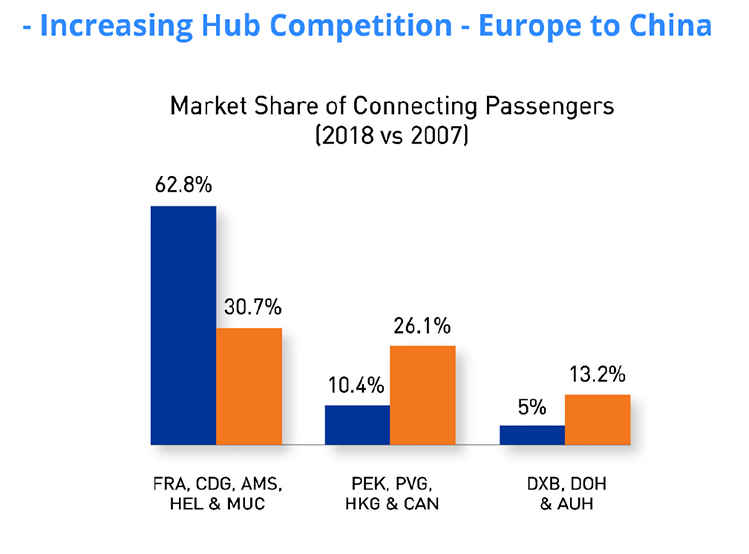
The top European hubs for air traffic between Europe and China (Frankfurt, Paris-CDG, Amsterdam-Schiphol, Helsinki and Munich) have seen their market share of connecting passengers fall significantly over the past 10 years to the benefit primarily of Chinese hubs (Beijing, Shanghai, Hong Kong and Guangzhou) and also Gulf hubs (Dubai, Doha and Abu Dhabi). To a certain extent this is expected, as Chinese airports and their airline partners develop, but the question is what size will the eventual market be and which airports will be able to have the largest share?

This is also one of the reasons why Europe’s hub airports are increasingly developing specific strategies to attract Chinese transfer passengers, eg. Groupe ADP’s campaign on Chinese social network WeChat, Finavia’s brilliant ‘MatchMadeinHEL’ campaign to name but two.

The top European hubs for air traffic between Europe and China (Frankfurt, Paris-CDG, Amsterdam-Schiphol, Helsinki and Munich) have seen their market share of connecting passengers fall significantly over the past 10 years to the benefit primarily of Chinese hubs (Beijing, Shanghai, Hong Kong and Guangzhou) and also Gulf hubs (Dubai, Doha and Abu Dhabi). To a certain extent this is expected, as Chinese airports and their airline partners develop, but the question is what size will the eventual market be and which airports will be able to have the largest share?

This is also one of the reasons why Europe’s hub airports are increasingly developing specific strategies to attract Chinese transfer passengers, eg. Groupe ADP’s campaign on Chinese social network WeChat, Finavia’s brilliant ‘MatchMadeinHEL’ campaign to name but two.

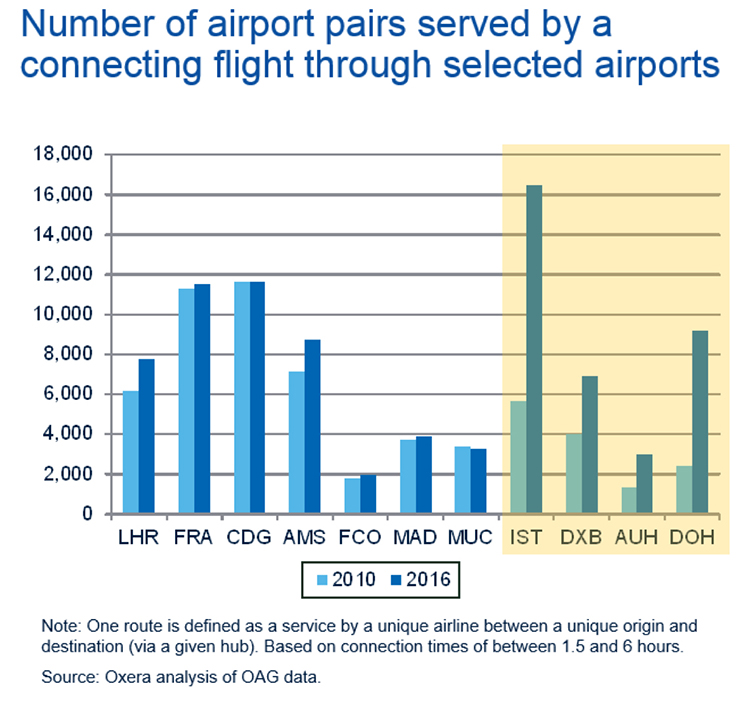
More broadly in EU-Asia connectivity, hubs in the Persian Gulf and in Turkey are using their geographical comparative advantage and alliances with airlines to develop and capture market share on the EU to Africa and Asian markets. This has seen a large increase in the share of routes from Europe’s 5 largest hubs that are now competed by the Persian Gulf and Istanbul hub airports.

Meanwhile, back in Europe, key airline groups have been making headlines for their strategic priorities.

That One Big Customer Effect

Another recent example of more local hub competition is Lufthansa’s strategy for the deployment of some of its flagship aircraft. Frankfurt Airport and Munich Airport both have the same hub customer accounting for more than 2/3 of their traffic. At Frankfurt, the Lufthansa Group has 65.5% of all traffic, and at Munich the Lufthansa Group has 68.3% of all traffic (May 2018-April 2019 season, OAG).

In June 2017, Lufthansa announced that it would move 5 of its A380s, from Frankfurt to Munich. The AFP quoted a Lufthansa spokesperson saying, “growth will happen where the best conditions are, and costs are of course a factor.”

This came in the wake Lufthansa’s previous decision to base its A350 aircraft, the newest Airbus long-haul aircraft, at Munich Airport, rather than Frankfurt.

A press release from the Lufthansa Group in September 2018 spells out the pressure, directly stating, “Our multi-hub system […] makes it possible for us to react to changing conditions with extreme speed and flexibility. Our key factors are quality, efficiency and cost effectiveness.”

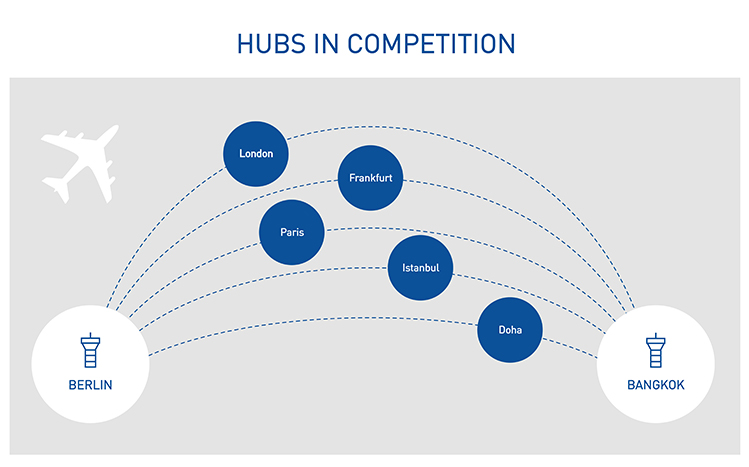
And even more interestingly, in their recent own Policy Brief newsletter, Lufthansa also explained the hub competition phenomenon by spelling out the hub airports competing with each other on a routing between Berlin and Bangkok.

Adapted from Lufthansa Policy Brief 5: https://politikbrief.lufthansagroup.com/en/policybrief-5-2018/#c6033

The ‘one big customer effect’ is pervasive. At Europe’s hubs and large airports, the dominant airline group controls on average 54.2% of all departing flights. When a business is so reliant on one customer, its development, quality and prices all become heavily influenced by that customer.

Recent market research revealed that last year, the Top 5 biggest airlines in Europe crossed the threshold of holding 50% of the market – another indication of which part of the air transport sector really holds the cards.

source : http://www.airport-business.com/2019/03/no-small-hub-bub-global-hub-competition/

Security drones: The innovations set to unlock new applications in 2019 and beyond


(Image: Skeyetech from Azur Drones is an automated surveillance drone integrated with Genetec Security Center)


Technology, regulation and legislation are all coming together to make the commercial use of drones more viable than ever before.

The last 12 months has been an exciting, and sometimes controversial, time for commercial drones in general, and their use in the security sector in particular.

Late last year saw Gatwick Airport closed due to a ‘malicious drone‘. This brought the need for drone detection and anti-drone technology to the fore.

As well as specialist, military-grade solutions, we’re seeing more commercial-level options coming on stream, including systems from major drone manufacturers such as DJI’s Aeroscope, which can not only detect drones in the air, but also the operator’s location.

Such lightweight and portable drone detection systems are increasingly used as part of the security portfolio at fixed venues and live events like festivals.

Tightening laws

In January of this year, the government reaffirmed its commitment to commercial drone use in the UK while also announcing a tightening of the laws around what private drone users can and can’t do with their off-the-shelf machines.

From November 2019, private individuals will have to register as drone operators and pass an online competency test to fly legally – a step welcomed by commercial operators who have to undergo stringent training to secure Permission for Commercial Operations from the Civil Aviation Authority.

For the first time, major manufacturers are launching more professional-grade products than consumer-level ones

The broader drone industry has seen a real focus on commercial drone technology.  For the first time, major manufacturers are releasing more professional-grade products to the market than consumer-level ones.

Of particular interest to the security sector is the ever-growing range of sensors now available – from high-end cameras with superb quality optics (including zooms) for pin-sharp visuals, to enhanced offerings in infrared, low-light and night vision products. Modular systems with ‘hot-swappable’ sensor packs are providing superbly flexible surveillance options at better price points than ever before.

Specialist manufacturers have also been making significant strides in gaining regulatory approval for the testing of fully autonomous drone systems. Companies such as Azur Drones from have been trialling pilotless systems, which are likely to pave the way for new drone uses of particular relevance to the security market.

The removal of a need for a qualified pilot for every drone is particularly exciting for any sector where rapid deployment and wide coverage is desirable.

Crucial to a fuller commercial exploitation of drones is integrating them with other air traffic. Where drones and their operators can’t communicate with air traffic control this limits the areas in which they can be used.

Because of this, the surveillance and protection of major infrastructure or private locations close to airports is currently very difficult, if not impossible, to achieve.

A major breakthrough in this area was demonstrated in November 2018 by NATS (the UK’s main air navigation services provider) and other technology partners in Operation Zenith. In this landmark live demonstration, commercial drone traffic was integrated with commercial air traffic via the control tower at Manchester International Airport during a normal operating day.

This proof of concept of a so-called UTM (unmanned traffic management) system confirms the UK’s position as a world leader in the commercial use of drone technology in 2019 and beyond.

The author, Barry Clack, is a film-maker, drone operator and aerial cinematographer. He is presenting and coordinating talks on the security applications of drones at IFSEC International 2019, in the Keynote Theatre on 18 and 19 June 2019.

IFSEC 2019 will also feature security drones from Azur Drones (stand IF433) and counter-drone technologies from Dedrone (stand IF240).

Europe’s largest annual physical security show will take place 18-20 June 2019 at ExCeL London. Book your free ticket now.

Global Commercial Airports Baggage Handling Systems Market Trends 2019

Global Research Analysis & Forecast of the Commercial Airports Baggage Handling Systems Market Report 2018 – 2024

The Commercial Airports Baggage Handling Systems report is a meticulous exploration of the Commercial Airports Baggage Handling Systems market and gives insights such as considerable approaches, scope, historical data, and statistical data of the worldwide market. It also encompasses projected statistics that are evaluated with the support of a suitable set of methodologies and postulations. The report, with all its important details, unearths the matter-of-fact data and across-the-board analysis of the Commercial Airports Baggage Handling Systems market. Whats more, the Commercial Airports Baggage Handling Systems industry development trends and marketing channels are analysed. The industry analysis have also been done to examine the impact of various factors and understand the overall attractiveness of the industry.

Get Exclusive Free Sample Report Here: www.marketdeeper.com/request-for-sample-report-32485.html

Overview of Commercial Airports Baggage Handling Systems market report:

The report provides a profound exploration of the Commercial Airports Baggage Handling Systems market comprising key trends, technologies, market challenges, drivers, deployment models, regulatory landscape, operator case studies, opportunities, strategies, value chain, standardization, future roadmap, and ecosystem player profiles.

Some Important Industry Drivers in worldwide Commercial Airports Baggage Handling Systems Market: Siemens, Vanderlande Industries, Daifuku, Pteris, Beumer, Grenzebach Maschinenbau, BCS, Logplan

Regions that we analysed Commercial Airports Baggage Handling Systems Industry Research Report: North America, Europe, Japan, China, and other regions (India, Southeast Asia)

Furthermore, the report also brings to light the all-encompassing assessment of the major market segments and their latest trends. Also, it provides details entailing the array of market factors and the impact they have on the overall market as well as individual segments. Apart from this, the report also highlights on the regional and worldwide market together with an inclusive analysis including the growth scopes of the market.

Segmentation of Commercial Airports Baggage Handling Systems Market by Type: Barcode, RFID

The research report offers information and analysis as per the categories such as applications, types, geographies, market segments, and technology. Then, the Commercial Airports Baggage Handling Systems report underlines the global key leading industry players with details such as company profiles, market share, contact details, sales, product specifications and images.

Access Complete Report with TOC Here: www.marketdeeper.com/global-commercial-airports-baggage-handling-systems-market-research-32485-32485.html

Reasons To Buy
– What was the size of the Global Commercial Airports Baggage Handling Systems market by value in 2015 and What will be in 2024?
– What factors are affecting the strength of competition in the Global Commercial Airports Baggage Handling Systems market?
– How has the market performed over the last Six years?
– What are the main segments that make up the global Commercial Airports Baggage Handling Systems market?

Segmentation of Commercial Airports Baggage Handling Systems Market by Uses: Airports, Others

The study covers historic data as well as forecasts that make the report for Commercial Airports Baggage Handling Systems market an important reserve for analysts, industry executives, product & sales managers, consultants, marketing, and other individuals seeking vital industry figures and facts in voluntarily handy documents with noticeably presented graphs and tables.

Read More reports: industrynewsblog.com/3792/global-ct-scan-and-pet-scan-market-latest-trends-and-technology-advancement-2018-to-2023/

The research was executed using an objective blend of secondary and primary details including contribution from major industry participants. It also includes a wide-ranging vendor and market landscape apart from the key vendors’ SWOT analysis. Primary sources are chiefly industry professionals from the core and allied industries, service providers, manufacturers, distributors, suppliers, and organizations connected to all segments of the supply chain of the industry. In the end, the report introduced new project SWOT analysis, investment feasibility analysis, and investment return analysis.

For more information, please read our Product Specification

source : https://marketresearchnews.us/2139/global-commercial-airports-baggage-handling-systems-market-trends-2019-siemens-vanderlande-industries-daifuku-pteris/

Are You Being Served? Reinventing The Airport Check-in Experience.

As airports handle record numbers, crowded check-in halls are becoming more commonplace, prompting airports to rethink their approach to space, resources and passenger experience.

Common-use terminals are gaining popularity as an efficient way to accommodate more travellers. With multiple airlines sharing airport space including counters and bag drops, airports can manage resources better to meet demand and improve throughput.

It’s time for a holistic approach

Sharing resources presents its own challenges. How can airports optimise the check-in process for efficiency while smoothing the travel experience? How do they balance the needs of full cost and low service airlines in one terminal? And, how do they adapt to growing preferences for online or self-service check-in?

Without a holistic view of check-in areas and the right insight tools, it’s challenging to achieve the right quality/cost balance for airline customers and passenger experience. The shift to common-use resources, therefore, requires a new approach.

Optimizing space

Typically, hall allocation is stacked in favor of heavy-hitter airlines – not towards the best use of available space.

When allocating check-in resources, consider the entire terminal. Collect and analyze queue formation data, plus processing rates by counter and airline, to identify congestion or safety issues. As well as being used for allocating a fixed resource, a holistic view also helps determine the optimum location for self-check-in kiosks

Predicting passenger behavior

Traditional check-in models allocate static desks per flight for three hours. This results in uneven capacity management. Data from Dolby and Holder Consulting suggests that fixed counter timeframes cause a 40% decrease in capacity, require 22% more handling agents, and cost 22 minutes in lost dwell time.

By layering show-up profiles with check-in preferences per flight, airports can more accurately predict resource demand. Keflavik Airport, for example, successfully adjusted worker shifts based on forecast arrival/wait times, optimizing costs and services.

Automating resourcing decisions

With sophisticated, often conflicting check-in resource planning considerations, intelligent allocation tools enable airports to automatically balance resource availability and predicted demand with factors like airline preferences and service level agreements.

Models are optimized for maximum efficiency, for instance, grouping airlines by ground handler to reduce baggage errors. Passenger experience factors, like walk time, can also be addressed by coordinating resource allocation from check-in to gate.

Intelligent automation both optimizes resources for blue-sky days and allows for flexible planning for unexpected events and improved impact forecasting.  When Sydney Airport implemented a holistic approach to check-in together with automated resource allocation, capacity increased by 15%.

Incentivizing better throughput

Directly linking resourcing to billing allows airports to demonstrate the financial and efficiency benefits of resource-sharing to airline partners, whose early engagement is critical in any operations process transformation.

Differentiated charge structures can also be used to incentivise airline efficiency including the uptake of dynamic counter allocation and self-serve check-in kiosks.  For instance, Auckland Airport differentiates charging for check-in services to distinguish between traditional counters, common-use versus dedicated bag drop facilities.

Happier passengers, more efficient airports and airlines

This holistic, predictive collaboration approach to check-ins helps reduce queues and improve the passenger experience – and happy travelers tend to spend more time and money in concessions.

Airports and airlines win too. More fluid check-in resource usage and efficiency gains enable airports to defer expansion investments and introduce common-use self-check and baggage drops, further increasing capacity

A holistic terminal approach really is a common solution for all.

Written by Siobhan Boyle, Product Marketing Manager for Veovo, an intelligent automation platform that enables airports globally, to plan, predict and perfect airport operations.

source : Christian.Carstens@veovo.com

Rapid Increase in Biometric Data in Airports Raises Privacy Concerns

In 2018, Delta paved the way in airport terminal development, by introducing the first biometric terminal at the Hartsfield-Jackson Atlanta International Airport where passengers can use facial recognition technology from curb to gate.

Delta now offers members of its Sky Club airport lounges to enter using fingerprints rather than a membership card or boarding pass. Other airlines use biometric data to verify travelers during the boarding process with a photo-capture. The photograph is then matched through biometric facial recognition technology to photos that were previously taken of the passengers for their passports, visas, or other government documentation.

Though the use of a fingerprint or facial scan aims to streamline and expedite the travel process and strengthen the security of air travel, it also presents heightened security risks for biometric data on a larger sale. As the use of biometric data increases, the more expansive the effects of the data breach becomes. While it’s possible to change a financial account number, a driver’s license number or even your social security number, you can’t change your fingerprint or your face, easily anyway. Furthermore, in the past, facial recognition software had not been able to accurately identify people of color, raising concerns that individuals may be racially profiled.

Yet, many argue that biometric-based technologies can be used to help solve vexing security and logistics challenges concerning travel. For example, in 2016, Congress authorized up to $1 billion collected from certain visa fees to fund implementation of biometric-based exit technology. That was followed by President Trump’s executive order signed in March 2017 directing the Department of Homeland Security to expedite implementation of biometric entry-exit tracking system for all travelers to the United States. As it stands, we are likely to see a rapid expansion of biometric technology used by airlines and other businesses in the travel industry, so prepare your picture-perfect travel face!

Notably, the use of biometric data is growing across all industries and in a variety of different applications – e.g., premises security, time management, systems access management. But, so is the number of state laws intending to protect that data. States such as Illinois, Texas, and Washington are leading the way with others sure to follow. Regulations include notice and consent requirements, mandates to safeguard biometric information, and obligations notify individuals in the event biometric information is breached. And, litigation is increasing. The Illinois Supreme Court recently handed down a significant decision, for example, concerning the ability of individuals to bring suit under the Illinois Biometric Information Privacy Act (BIPA). In short, individuals need not allege actual injury or adverse effect, beyond a violation of his/her rights under BIPA. The decision is likely to increase the already significant number of suits, including putative class actions, filed under the BIPA.

Companies, regardless of industry, should be reevaluating their biometric use practices and taking steps to comply with a growing body of law surrounding this sensitive information. Jackson Lewis P.C. © 2019

source : https://www.natlawreview.com/article/rapid-increase-biometric-data-airports-raises-privacy-concerns

Facial Recognition Technology Trial for Cathay Pacific Passengers at Amsterdam Schiphol

(Photo: Cathay Pacific)

Passengers traveling with Cathay Pacific can now participate in a trial of facial recognition self-boarding at Amsterdam Airport Schiphol. This trial is part of the first phase of Seamless Flow, the project that intends to make paperless travel possible in the long term.

After checking in, passengers are invited to take part in the trial. Participants are escorted to one of the special registration kiosks. At this moment, the passport and the boarding pass are scanned, while a high-quality face image is captured, in order to generate the traveller’s single token.

This will allow passengers to self-process through a boarding gate without having to show any documents. At the departure gate, they use a dedicated biometric-enabled eGate, where they simply have to look at a camera that scans their face. The live photo is automatically compared with the scan that was made at the registration process. When the face is identified, the gate opens and the passenger is boarded on the airline system. This only takes a few seconds.

Wilma van Dijk, Schiphol’s safety and security director commented: “For passengers, the journey from arrival at the airport to boarding becomes easier and more efficient. Now you have to show your passport, your boarding card or both at various checkpoints at the airport, for example, when dropping your luggage, at the entrance to the security check, when passing the border and when you go boarding. In the future you can pass these control points more smoothly because you are recognized by your face. You can leave your passport and boarding pass in the bag.”

Will Kerr-Muir, Cathay Pacific country manager Benelux & France added: “Cathay Pacific is always looking for ways to improve the experience of our customers at every stage of their journey with us, and the experience at the airport is an important and integral part of that journey. We are therefore happy to be part of this innovative trial, in order to prepare ourselves and our passengers for the future way of traveling.”

In the coming months, scanning of the face, passport and boarding pass will be experienced during registration and boarding. The next phase will add passport control to the trial.

To bring this programme to life, a partnership has been established by the Dutch Government, Amsterdam Airport Schiphol, Cathay Pacific, KLM and Vision-Box, who is responsible for the Seamless Flow technology platform.

source : https://airportsinternational.keypublishing.com/2019/02/21/facial-recognition-technology-trial-for-cathay-pacific-passengers-at-amsterdam-schiphol/?dm_i=4JU%2C64Z5E%2C5WMGQW%2CO4PW5%2C1