London City Airport has launched a new brand identity, which reflects a more dynamic, vibrant and contemporary look, synonymous with modern London. The new brand is a step-change from the previous corporate grey and blue combination, and comes as the airport continues to grow and appeal to a changing mix of passengers, particularly leisure travelers and East Londoners, joining the established business traveler base. Read more about the new branding here.
Muscat International Airport has been awarded ‘Most Improved Airport-Middle East’ at the Airports Council International’s 2018 Airport Service Quality (ASQ) Awards.
“We are delighted with this achievement. It comes within our endeavours to achieve the national strategic aspirations and objectives in the sectors of ‘Travel and Tourism’ with all our partners.” – Sheikh Aimen bin Ahmed Al Hosni, CEO of Oman Airports
He also praised this achievement of the Muscat International Airport family and all strategic partners involved.
The passenger terminal at Muscat International Airport opened on Tuesday, March 20, 2018, with the capacity for 20 million passengers per year.
Global Airport Body Scanner Market Report 2019 elaborates the precise perspective of the global Airport Body Scanner market for a long run to assist industry players with a comprehensive analysis of the flow of the market throughout the period of 2019-2024. The report widely portrays the market landscape and emphasizes details of industrial development, technological advancements, rivalry status, and prominent players operating in the market.
It offers a paramount evaluation of Airport Body Scanner market segments that provide specific details, forecast analysis, and valuable strategic counsel for each segment, which includes types, applications, regions, technologies, and end-users. The proposed segmentation analysis helps a reader to determine a target market and also facilitate to optimize its resources more effectively to get commendable outputs.
Request Global Airport Body Scanner Market Research Sample
The report also revolves over an in-depth analysis based on Airport Body Scanner market competitive landscape to provide a broad acuity of the market that aids to determine strengths, weaknesses, and strategies of the competitors within the global Airport Body Scanner market. The analysis also sheds light on numerous vital elements including market potential forecasting, pricing competition, competitor product tracking, provincial market possibilities, and economic climate.
Airport Body Scanner Manufacturer Segment Analysis (Company and Product introduction, Airport Body Scanner Sales Volume, Revenue, Price and Gross Margin):
L3
Smiths Detection
Rapisscan
Adani system
A S&E
Braun
Westminster
ODSecurity
CST
Xscann Technologies
Airport Body Scanner Application Segment Analysis (Consumption Volume and Market Share 2014-2025; Downstream Customers and Market Analysis):
Airport
Others
Obtain Exhaustive Insights into the Global Airport Body Scanner Market Study
Besides, the report renders a thorough analysis of market competitors using various analytical tools such as SWOT analysis, Porter’s Five Forces analysis, Feasibility analysis, Value Chain analysis, and Capacity utilization analysis. The report further includes organizational and financial details of a competitor that offers intact acumen for manufacturing methodology, technical adoption, pricing structure, import/export activity, raw material sources, and sale/distribution network.
It also discusses their strategic moves such as recent acquisitions, mergers, ventures, deformulation, new product launches, product alteration, and other promotional activities. The report primarily focuses on competitor revenue generation, sale volume, profit margin, and growth rate with an accurate forecast estimation that will greatly assist readers to steer towards the Airport Body Scanner industry perspective and boost stability with lucrative revenue structure.
Vital elements emphasized in the Global Airport Body Scanner Market Report:
Detailed analysis of Airport Body Scanner market overview, industry environment, and technological advancements.
Precise assessment of Airport Body Scanner market share, size, revenue, and CAGR with an authentic and reliable forecast of up to 2024.
Extensive evaluation of Airport Body Scanner market rivalry with crucial insights into contender’s strengths, weaknesses, strategies, mission, and core values.
Thorough evaluation that helps the market player to determine forthcoming opportunities, threats, obstacles, and barriers in the world Airport Body Scanner market.
Published on 07 March by Peter Drummond , Portfolio Director Baggage, SITA
On the face of it, taking a bag from a passenger at check-in and returning it to them at their destination seems like a very easy task. But think hard about it and there’s so much more going on behind the scenes:
• Identifying the bag and its flight
• Moving the bag through security
• Storing the bag until the flight is ready to be loaded
• Sorting the bag in the system to the correct loading location
• Ensuring the bag is on the right flight
• Ensuring that the passenger and bag are on the same flight in certain jurisdictions
The more legs, the more ‘risk’
And it’s not always just a matter of point-to-point flights. Every one of the above steps must be repeated for as many legs as the passenger flies. The at the end of the journey the bag must be unloaded and placed on the right baggage reclaim carousel.
A better record, but the challenge remains
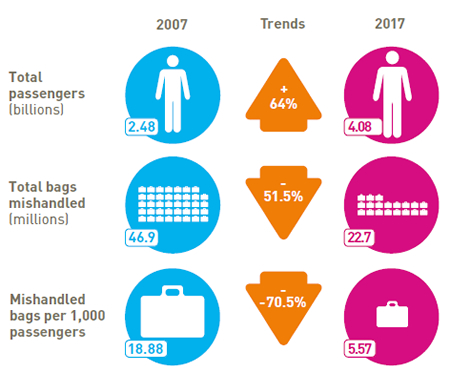
Sounds simple in theory. And indeed we’ve seen baggage operation performance rise dramatically over the last few years. SITA’s WorldTracer® data shows that even with soaring passenger numbers (64% rise between 2007 to 2017), the mishandling rate per thousand of passengers fell by 70.5%.
On top of that, there’s been a 46.2% cut in the annual cost of baggage mishandling to the industry. This is laudable. Yet the cost to the industry in 2017 still represented US$2.3 billion, so the mishandling of bags clearly remains a challenge.
2007 – 2017 long term trends
Source: SITA Baggage Report
Today’s baggage systems mis-sort only 1 in 10,000 bags, but …
Today, the vast majority of bags are checked and tracked using bar code technology generated messages. Baggage handling systems do a fantastic job of reading these bar codes and matching it to the information for the bag, allowing it to be processed. In fact, a well designed baggage system will mis-sort only 1 bag in 10,000.
… other airport processes drive up the mishandling rate
However, the overall baggage mishandling rate is around 5.57 bags per 1000 passengers flown i.e. almost 60 times higher! This difference in mishandling is not linked with the baggage system itself, but with the rest of the airport processes. And it is this as an industry that we need to address.
Enter RFID – a technology moving up the aviation CIO agenda
RFID looks to be a technology that could help. Already a proven technology in aviation, it’s used in the tracking of high-value aircraft parts and components, for example, as well as items such as ramp equipment and ULDs. Some airlines have already introduced RFID bag tracking.
Delta Air Lines was one of the first to turn to the technology, initially introducing the technology across 84 airports in the US, catching the industry and the average passenger’s attention. Anything that can tangibly reduce the number of mishandled bags is in everyone’s interest. In February 2018 , Delta Air Lines rolled out RFID baggage tags to checked luggage on its routes between the USA and London Heathrow. Scanners use radio waves to capture highly accurate and consistent data stored on the RFID chip. This followed the introduction of RFID in its domestic market in 2016. Delta has invested more than US$50 million to ensure the accurate routing and loading of the 180 million bags it handles each year. The airline noted that this commitment to reliability has been recognized with Delta recording the lowest mishandled bag numbers in US Department for Transportation data six times in recent months.
All of Delta’s 344 airports across the globe are scheduled to receive the technology, with additional European hubs, Amsterdam and Paris, due to come online in the coming months.
Following a successful roll-out in the US, we are on track to equip all of our international stations, including Heathrow, with this technology as part of our continued efforts to improve our customer experience.
Corneel Koster, Delta’s Senior VP Europe, Middle East, Africa and India
Airports recognize the benefits too. An IATA and ACI survey of airports drew responses from airports through which more than 2 billion passengers travel. The survey found that 70% of these airports are already considering RFID implementation.
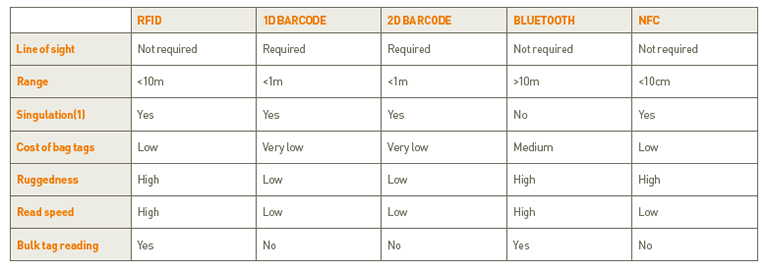
Introducing RFID as a technology for baggage tracking, has some distinct advantages. It uses radio frequency electromagnetic fields to transfer data to automatically identify and track tags attached to bags. The technology allows multiple identification and tracking tasks to be undertaken without human intervention. It has read rates that are currently unrivaled and with this can drive automation and with automation you can reduce staff injuries, and provide baggage tracking compliance without human intervention.
Comparison between technologies
(1) Singulation: Ability to read a tag without interfering with a tag nearby
Compatibility with other systems, and a $3 billion ROI
Importantly, RFID is compatible with existing barcode technology, reconciliation systems and tracking systems. With high reading performance and relatively low infrastructure costs (Capex), RFID adoption could easily provide a positive return, both in terms of cost and passenger satisfaction. The IATA business case for RFID estimates a return on investment of over $3 billion to the industry over the next seven years.
Looking ahead
Baggage operations across the air transport industry are evolving dramatically, thanks to Resolution 753 and IATA’s and ACI World’s shared strategy to drive improvements. But improvements in baggage handling performance will accelerate greatly with adoption of new scanning technologies and RFID.
London is calling
If you are planning to attend PTE 2019 in London, and would like to discuss the benefits of RFID and the latest bag tracking technology you can join me on the SITA booth.
You may also want to read the Intelligent Tracking white paper or view the BagJourney video.
Mohammed Ahli: Specialisedexhibitions best to reach out target markets
Dubai: Massive investments in airport infrastructure expansion in the Middle East, North Africa and South Asia (MENASA) continues to be a major pull for companies from across the world to further consolidate their business through participation in Dubai’s hugely-popular Airport trade exhibition.
The world’s largest annual airport exhibition is all set to be power-packed when it returns for its 19th year in Dubai this April with a record 375 exhibitors expected from 60 countries. Of these, the total number of international companies will be 150+, of which 50+ are new international exhibitors. More than 60 top industry bellwethers are also participating at the event including Ulma Handling Systems, ADB Safegate, Honeywell, Nokia, Smiths Detection, IDEMIA, DFS Aviation Services, Vanderlande and TLD.
Up to 75 per cent of last year’s exhibitors are returning to this year’s show which is held under the patronage of His Highness Sheikh Ahmed bin Saeed Al Maktoum, President of Dubai Civil Aviation Authority, Chairman of Dubai Airports and Chairman and Chief Executive of Emirates Airline and Group. The Airport Show, is organised by the Reed Exhibitions Middle East and will take place at the Dubai International Convention and Exhibition Centre (DICEC) from 29 April – 1 May.
The dedicated B2B event will have more than 7,500 attendees and will feature two co-located events: Air Traffic Control (ATC) Forum and Airport Security Middle East, as well as a newly-revamped Global Airport Leaders Forum (GALF), Women in Aviation (WIA) General Assembly and a new addition, CAPA’s Middle East & Africa Aviation Summit. This year, the event’s exclusive Business Matchmaking programme is expected to exceed 300 Hosted Buyers across the multiple content and networking events.
International exhibitors are keen to tap the vast growth potential of the aviation industry which is soaring new heights of expansion, with an investment of US$90 billion alone projected to go into the Middle East by 2020 – three-fourths of which will be in the Arabian Gulf region.
Together with the US$845 billion investment in existing airport projects such as new runways, terminal buildings and extensions, US$1.1 trillion in airport infrastructure projects are planned or underway. Airports in the UAE are investing up to US$50 billion in new and expanded projects over the next 15 years.
His Excellency Mohammed Abdulla Ahli, Director General of Dubai Civil Aviation Authority (DCAA) and CEO of Dubai Air Navigation Services (DANS), remarked: “Specialised exhibitions of an industry are a great way to reach out to a target market, create brand awareness and promote products and services to a broader group. Trade fair participation is above all targeted at gaining new customers and enabling procurement decisions.”
Daniyal Qureshi, Group Exhibition Director at Reed Exhibitions Middle East, said: “The show will once again demonstrate the UAE and MENASA region’s attractiveness for global players in the aviation industry. International exhibitors are coming in increasing numbers each year, which is a clear indication of the region’s standing as a global aviation growth market and a testimony to the ease of doing business here. Airport Show plays an important role in building long-lasting business relationships for our industry.”
Exhibitions serve as an influential platform for companies, professionals and industry experts to come together, share information and build long-lasting business relationships. Expanding markets and globalization have made trade exhibitions an inevitable part of marketing and promotions. They are one of the most effective mediums for establishing and maintaining customer relations and provide face-to-face customer contact.
Daniyal added: “Exhibiting at an international trade event is a proven investment in your company’s future. One of the benefits of being at the trade show is developing strong relationships with key decision makers at airports, ANSPs, Security agencies, Civil Aviation authorities, Ground Handlers and other government stakeholders. The Show’s considerable international appeal is reflected in the increasing percentage of exhibitors and visitors that come from abroad. This strong international appeal makes it unique throughout the aviation industry.”
Germany-based DFS Aviation Services and its subsidiary DFS Aviation Services Bahrain are looking forward to reach out to the Middle East market with a focus on expanding their network even further. DFS wants to present itself as a competent and reliable partner for ATM and consultancy services with many years of experience in the region.
Its two Managing Directors, Andreas Pötzsch and Oliver P. Cristinetti say Airport Show was one of the best possibilities to present new technologies and meet aviation leaders from the Middle East and nearby regions. The professional exchange on new developments in aviation, and getting to know potential customers will be their main focus at the Show. This year, they will be showcasing the new PHOENIX WebInnovation technology, amongst others.
Another exhibitor is Collins Aerospace. Rakan Khaled, Director of Global Business, says his company have been participating in the Airport Show for more than a decade now, having found it more solid in standing and wider in reach in the aviation domain on all levels – local, regional and global.
He remarked: “It is an excellent platform for our business globally in general and in the Middle East and Africa in particular. Collins Aerospace now proudly provides many aviation-related solutions to airports and airlines.” As this event focuses more on airports, his company will be showing more of their airport products which includes all the airport operations systems and passenger processing systems in addition to new technologies like SBD, Biometrics and Cloud Solutions.
Given the choice, most travelers will opt to fly direct. There are however, times when a layover isn’t a nuisance, but rather an experience in and of itself. While all airports have your run-of-the-mill tarmacs and terminals, some boast luxury lounges, aquariums, gardens, pools and authentic eateries.
So, the next time your trip calls for a connection, consider routing flights through these 11 airports around the world—travel hubs where experts enjoy spending their downtime in between flights.
Amsterdam Airport Schiphol (Amsterdam, The Netherlands)
Travelers waiting for departure at one of the lounges (Schengen area) at Schiphol Airport, Amsterdam, The Netherlands. EschCollection—Getty Images
Amsterdam Airport’s location means several European cities are a short flight away—and it’s a comfortable airport to stop at between jaunts, says Alberto Riva, managing editor at The Points Guy. With plush couches and numerous resting areas, “you don’t need access to a lounge to enjoy connecting through here,” Riva says. The airport offers a mini-art gallery with works from Dutch artists, duty-free shops with “all the cheese and stroopwafels you want and an indoor ‘park’ complete with the sound of chirping birds and even a viewing terrace for the aviation geeks,” he says. The park also includes bean bags to relax on and exercise bikes that charge your phone while you pedal.
Changi Airport (Changi, Singapore)
Terminal 3 at the Changi Airport, Singapore. Wajahat—Getty Images
If you happen to have an extended layover, Singapore’s Changi Airport features art installations, a rooftop garden, a lily pond and a swimming pool—so it’s unlikely you’ll experience boredom while awaiting your next flight, according to Lauren Coppola, a Southeast Asia product executive with bespoke travel company Audley Travel.
What’s more, the airport boasts a movie theater, a butterfly garden and the world’s tallest airport slide where you can plunge down the four-story chute for fun. The airport also features traditional-style Asian shophouses where you can buy local jewelry or embroidery, and a wide array of gourmet restaurants to choose from. “If you have time to go into the city, there is a convenient train link and Singapore has a clean and safe public transit system,” Coppola says. The journey from the airport to the city takes just about 30 minutes.
Dubai International Airport (Dubai, United Arab Emirates)
Modern architecture of Terminal 3 at Dubai International Airport, Dubai, UAE. Gavin Hellier—Getty Images/AWL Images RM
The airport in Dubai hosts travelers from all across the globe, and is said to be one of the busiest airports in the world. It’s no wonder it boasts an expansive and grandiose setup — from luxe shopping (think gold jewelry everywhere) to a fancy in-airport hotel health club, where travelers with some money to spare can stop in for a sweat or a shower, says Rhonda Vetere, a business executive who traveled 237 days last year. If you happen to have an extended layover, “rent a car and go on a dune buggy ride or camel ride,” she says. It’s easily accessible from the airport — just make sure to book in advance.
Munich Airport (Munich, Germany)
Christmas and Winter Market and ice rink in the Munich Airport. klug-photo—Getty Images
If you’re feeling festive, the Munich Airport is the ideal layover. “My favorite spot for an extended layover is Munich Airport, especially around Christmas,” says Nick Ewen, senior editor of points and miles at The Points Guy. Starting in late November every year, the airport transforms the open-air atrium between terminals 1 and 2 into a veritable yuletide dream, he says — replete with handmade crafts, glühwein (mulled wine) and an ice skating rink. “It’s a great way to experience the wonders of a German Christmas market while in transit,” Ewin says. In addition to the ice skating rink, the airport features a carousel for kids to enjoy.
Keflavík International Airport/Reykjavík–Keflavík Airport (Keflavík, Iceland)
A terminal in Keflavik International Airport. Donovan Reese—Getty Images
Iceland has been a stopover for flights to Europe for half a century, says Jason Cochran, editor-in-chief of Frommers.com. But part of what makes the airport a perfect layover is its close proximity to the famous Blue Lagoon. If time permits, Cochran suggests taking a trip to the geothermal spa “that weary transatlantic passengers have used to revive themselves since the Jet Age began.” With four or five hours to spare, you’ll get an authentic taste of Iceland’s natural wonders, which you can’t say of almost any other layover city, Cochran notes. The airport itself also has luggage lockers so you can explore the nearby tourist sites baggage-free.
Hamad International Airport (Doha, Qatar)
Main area of Hamad International Airport, with a giant yellow teddy bear statue in the center. Mila J—Getty Images
“I don’t find myself there often, but I really like connecting in Doha,” says Zach Honig, editor-at-large for The Points Guy. This layover is ideal for travelers who have time—and money—to spare. If you fly Qatar Airways business class, you’ll get access to the Al Mourjan Business Lounge in the airport, which includes posh showers, nap pods, a large dining room and a high-end bar, he says.
Flying first class? You can go to the Al Safwa First Lounge, where you’ll find private bedrooms, à-la-carte dining and cool architecture, he says. And if you have a little more time on your hands, consider staying at the four-star Oryx Airport Hotel located inside the airport. “Guests have access to a full-size pool and a sizable fitness center with a variety of equipment — it even includes a couple of squash courts,” Honig says.
Doha’s airport also has a variety of duty-free shops and perhaps the funkiest airport art in the world, according to Honig, including a 23-foot bronze teddy bear that sits inside a lamp.
Hartsfield-Jackson Atlanta International Airport (Atlanta, Georgia)
Travelers inside the main hall of Hartsfield-Jackson Atlanta International Airport. SeanPavonePhoto—Getty Images
At first glance, this Atlanta airport may seem like any other major U.S. travel hub, but what makes it stand out is its nod to a storied history, according to Cochran. “It’s done a good job of bringing in some authentic old-guard Atlanta restaurants,” says Cochran, who suggests making your way to The Varsity—a downtown Atlanta institution, and self-proclaimed “World’s Largest Drive-in Restaurant”— for old-school diner delights like chili dogs, onion rings and creamy milkshakes called “Frosted Oranges.” He also suggests venturing to the airport offshoot of Paschals, a legendary soul food restaurant that was a major meeting place for civil rights leaders like Martin Luther King, Jr. in the 1960s.
Velana International Airport (Hulhulé Island, Maldives)
Dhonis (traditional Maldivian boats) at the Velana International Airport. Federica Grassi—Getty Images
A layover is anything but conventional when you’re met with an ocean breeze and bright blue lagoons. Velana International Airport, an international gateway in The Maldives, is a great place to spend a few hours or even half a day, says Darren Murph, senior points and miles writer for The Points Guy. “There are priority pass lounges available in both the international and domestic terminals, and its open construction allows for fresh air to bolster your mood,” he says. Priority Pass lounges offer a vast array of amenities, from credits for food and drink to access to a lounge with spa facilities.
And for a lengthier layover, you can hire a local guide to whisk you from the airport by boat and take you to Malé, one of the most densely populated cities in the world, for a local meal or an exploration of its cultural sites, according to Murph. “Catch a glimpse of the non-resort side of this otherworldly archipelago,” he suggests.
Hong Kong International Airport (Chek Lap Kok, Hong Kong)
Shopping and dining area at Hong Kong International Airport in Hong Kong, China. Gary Conner—Getty Images
Hong Kong’s airport is decidedly high-tech, featuring magic mirrors that allow you to see what different shades of makeup or clothing look like on you. The international travel hub is also quite efficient, with its easy access to public transportation options, says Vetere. If you have five or six hours to fill, Cochran suggests taking a quick trip to nearby Disneyland. “The park is on the same island as the airport, so in about 30 minutes you can take the MTR subway train from the terminal right to the front gates of the theme park,” he says. “There’s even a kiosk where you can store your luggage for the day while you ride coasters and see the shows.” And if you need a pre-flight pick-me-up upon your return to the airport, “Cathay Pacific has a fabulous champagne lounge,” Vetere says.
Vancouver International Airport (Richmond, British Columbia)
Cast bronze sculpture, The Spirit of Haida Gwaii, the Jade Canoe, by artist Bill Reid in the Vancouver International Airport. Michael Wheatley—Getty Images/All Canada Photos
If you’re a marine life aficionado, this Canadian airport will likely make for the perfect layover. The Vancouver Aquarium runs two exhibits at the Vancouver airport, according to Santina Pacetti, an aviation manager at Audley Travel. “Head to the international terminal where a 114,000-liter aquarium sits as a permanent exhibit,” she says. It’s home to over 5,000 creatures including wolf eels, anemones, sea stars, kelp greenlings and sea urchins and an 1,800-liter jellyfish aquarium, Pacetti adds.
Incheon International Airport (Incheon, South Korea)
Indoor Garden at the Incheon International Airport. Ashley Cooper—Getty Images
“The first thing I want to do after a long flight is stretch my legs and feel connected — no matter how tangentially — to the outside world,” says Scott Mayerowitz, executive editorial director at The Points Guy. Last year, this airport opened its new Terminal 2 filled with oversized windows, natural light and lush, mini indoor gardens and trees. If you have some time to spare, the airport offers free tours of nearby local spots. “They can be as short as a one-hour hop to a local beach or a five-hour shopping excursion,” Mayerowitz says. “Personally, I would pick one of the temple or palace tours.”
Toronto Pearson recently introduced therapy dogs to provide comfort for passengers using its terminals. (Photo: Toronto Pearson Airport/Twitter) Airports Council International (ACI)
released its annual list of top global airports by size and region based on its Airport Service Quality Awards program, which measures passenger satisfaction for departures across 34 key performance indicators. Toronto Pearson International, Fort McMurray International, and Ottawa International were the lone Canadian winners in this year’s survey.
Now in its 13th year, the Airport Service Quality (ASQ) program delivers almost 650,000 surveys per year at 376 airports across 90 countries. Three quarters of the world’s 100 busiest airports are part of the 2018 ASQ program, which means that last year more than half of the world’s 8.3 billion travellers passed through an ASQ-recognized airport.
For the second consecutive year, Toronto Pearson (along with Dallas Fort Worth) was named as North America’s best airport serving more than 40-million passengers per year. Toronto Pearson was also named as North America’s most-improved airport, an honour shared with Félix-Houphouët-Boigny in Abidjan, Côte d’Ivoire (Africa region), Silangit International in Siborong-Borong, Indonesia (Asia-Pacific), Bergen Airport in Bergen, Norway (Europe), Juan Santamaria International in San Jose, Costa Rica (Latin America/Caribbean), and Muscat International in Muscat, Oman (Middle East).
Ottawa International (along with El Paso International in Texas) was named as North America’s best airport serving two to five million passengers per year. Fort McMurray International (along with Portland International) was named as North America’s best airport serving less than two million passengers per year. There are a total of six categories organized by number of passengers served, in each of the six regions outlined above in the most-improved airports listing.
In the program’s new Best Infrastructure and Facilitation category, no fewer than seven Indonesian and eight Chinese airports are recognized in their size category, which mirrors growth trajectories of these regions in terms of the global commercial aviation industry. Along these same lines, Kempegowda International Airport in Bangalore, India, won the first ever ASQ Arrivals Award, based on a new Arrivals Survey. It is the first airport in the world to win both a Departures and an Arrivals award in the ACI program.
“We’re extremely grateful to our passengers, who took time out from their travels to give their feedback and for choosing Toronto Pearson as the best large airport in North America again this year,” said Howard Eng, president and CEO, Greater Toronto Airports Authority, noting the collaboration some 50,000 airport colleagues.
In terms of Toronto Pearson’s award for the most-improved North American airport in 2018, the operation points to a range of improvements to airport ambience, including the opening of 27 new retail, food and beverage locations. GTAA also notes efforts to move passengers more quickly from curb to gate through new, faster CATSA Plus security screening lanes, the introduction of 400 new digital screens, and enhanced ground transportation options.
Toronto Pearson also notes the revitalization of all 80 washrooms in Terminal 3; improving the cleanliness of terminals; and the introduction of therapy dogs, state-of-the-art Mamava nursing pods, and Changing Places assisted changerooms. The airport also added free series of YYZ Live in-terminal musical performances and a 10x speed and capacity upgrade to its free Wi-Fi service.
“We’re doubly pleased to be recognized as the most-improved airport in this category, with improvements in nearly 90 per cent of the customer experience indicators measured,” said Eng. “This demonstrates how our passengers can count on Pearson to deliver a great travel experience and get them to their destinations smoothly, reliably and comfortably.”
Almost 10% of women are on top management positions among 500 member airports of ACI EUROPE. Although this is not yet the ideal proportion, there are good examples that show that the European airport industry is taking steps to promote the ascendancy of women leaders. Inês Rebelo reports.
The need for more gender diversity in leadership is widely acknowledged in aviation and in any other business in Europe and elsewhere. However, the reality is not yet very favourable to women, who usually do not reach managerial positions as easily as men, despite their skillset. Gender equality, particularly in decision-making roles, requires a social and cultural shift that we should make happen sooner rather than later for the benefit of women, businesses and the entire society.
It is no coincidence that the United Nations (UN) has included gender equality among its Sustainable Development Goals. For the UN, gender equality is “not only a fundamental human right, but a necessary foundation for a peaceful, prosperous and sustainable world”. Gender should not be a limitation for women to unlock their true talent and potential, and men have a role to play in supporting them and breaking the walls of gender disparity. This is why the UN launched the “He for She” global solidarity movement in 2014. It seeks to mobilise men and boys to promote gender equality and help to build a more balanced society.
Fittingly, this year’s campaign theme of the International Women’s Day (8 March) is #BalanceforBetter. This campaign, which will run all year long, calls for a more gender-balanced world. The message could not be clearer: “balance is not a women’s issue, it’s a business issue. The race is on for the gender-balanced boardroom, a gender-balanced government, gender-balanced media coverage, a gender-balance of employees, more gender-balance in wealth, gender-balanced sports coverage… Gender balance is essential for economies and communities to thrive.”
How can we have a more gender balanced and equitable workplace and world? The answer can be twofold: on the one hand, it is important to challenge existing barriers, including the male-dominated power structure, by removing cultural bias that women are born to care and serve rather than to lead. Recognising female talent and empowering women to advance in their careers is a step to a more balanced democratic society. On the other hand, it is crucial to attract and retain more young women to business areas that have always been seen as a “man’s thing”, such as aviation. Encouraging women to embrace “non-traditional” pathways and give them the same career opportunities will allow them not only to grow and succeed, but also to make those jobs much more competitive.
Accelerating women’s participation & professional growth in air transport
The transport sector is vital for the European economy. According to the European Commission, transport employs 11 million people of which only 22% are women. Across the range of transport modes, aviation is the most gender balanced mode of transport with 40% female workforce as opposed to 14% women in land transport and 20% women in waterborne transport. Yet, there is still some way to go to increase female representation in this sector.
Recognising the need to strengthen gender parity and equal employment opportunities in transport across the EU Member States, the European Commission launched the “Women in Transport – EU Platform for Change” in November 2017. The platform is open to all stakeholders in the transport sector that are committed to taking actions to improve female employment and gender equality. It also serves as a forum to exchange best practice (for more information: https://ec.europa.eu/transport/themes/social/women-transport-eu-platform-change_en)
At an international level, the International Civil Aviation Organization (ICAO) is striving to promote gender equality and the development of women in aviation. Two ICAO key initiatives in this regard have been the launch of the Aviation Scholarship for Professional Women, in conjunction with the International Aviation Women’s Association (IAWA), and the organisation of the first ever Global Aviation Gender Summit in Cape Town last August, in collaboration with UNESCO.
The airport community is also making efforts to improve gender parity and to get more women into executive positions. Since 2014, ACI World has an affiliation agreement with IAWA to work collaboratively on education, training and job opportunities in order to create the future network of airport women leaders. Moreover, in the second quarter of this year, ACI World, together with 4 other key aviation and aerospace organisations, including the International Air Transport Association (IATA), International Aviation Women’s Association (IAWA), Aerospace Industries Association (AIA) and Korn Ferry – Civil Aviation Practice, is due to release a global study on women in leadership – “Soaring Through the Glass Ceiling”. This study aims to understand the root causes of the underrepresentation of women at leadership level in aviation and to identify successful practices and stories in increasing the ratio of women in senior roles.
Women flying high at airports
At last year’s ACI EUROPE Annual Congress in Brussels, Dr Michael Kerkloh, President of ACI EUROPE and President & CEO of Munich Airport, said: “Looking at airports, our own business transformation has certainly benefited from the more prominent contribution of women. At Munich Airport we currently have a share of women in the supervisory board and executive board of more than 30 percent. We definitely see the need to systematically increase the share of women in executive roles within the next years – and we do have a series of measures & projects to do that.”
Munich Airport is not alone. Today over 40 airports in Europe have women in the top position – including Madrid, Barcelona, Venice, Catania, Stuttgart, Göteborg and Quimper-Cornouaille airports, as well as Hermes, the Cyprus airport group. Given ACI EUROPE’s airport membership as a whole (500 airports), this is not yet sufficient but it is already encouraging to see how the airport industry is actively becoming more inclusive.
In parallel to the lead interview with Monica Scarpa, CEO of the SAVE Airport Group, we decided to catch up with some of the other female CEOs of European airports, to find out how they see their job and the role of women in airport leadership, as well as what key lessons they wanted to share as a way of inspiring more women to follow in their footsteps.
Time-tested and first-time winners recognized from every region across the globe. Results based on ACI World’s globally-established Airport Service Quality programme.
MONTREAL – Airports Council International (ACI) World has revealed the winners of its world-renowned Airport Service Quality Awards which recognize those airports around the world that deliver the best customer experience in the opinion of their own passengers.
Kempegowda International Airport, Bangalore, India, has won the first ever ASQ Arrivals Award, based on the new Arrivals Survey – it is the first airport in the world to win both a Departures and an Arrivals award.
Perennial winners from around the world include Indianapolis International Airport, Beijing Capital International Airport, Singapore Changi Airport, and Toronto Pearson, Aeroporto di Roma-Fiumicino, Mumbai’s Chhatrapati Shivaji International Airport, Delhi’s, Indira Gandhi International Airport, Shanghai Pudong International Airport, and Sheremetyevo International Airport.
This year, a number of airports have won their first ASQ Award, including Aeropuerto Internacional Ramón Villeda Morales in Honduras, as well as Dublin, Oslo, Helsinki, Southampton, Bristol, and London City airports. Spain’s Aeropuerto de Almería, Aeropuerto de Girona, Aeropuerto de Melilla, Aeropuerto de Zaragoza, and Aeropuerto de Alicante-Elche are also first time winners. Fort McMurray Airport in Canada and Muscat Airport in Oman are also newcomers to the ASQ Awards fraternity, while several top-performing previous winners have again featured prominently.
In the new “Best Infrastructure and Facilitation” category, no fewer than seven Indonesian and eight Chinese airports are recognized in their size category.
“The Airport Service Quality Awards celebrate the achievements of airports in delivering the best customer experience and they represent the highest possible accolade for airport operators around the world,” said ACI World Director General Angela Gittens.
“In both the traditional and new categories, these airports have responded to the evolving needs of passengers to deliver higher levels of service and an award-winning performance.
“Airports have recognized that delivering a better customer experience is an important business tool in an increasingly competitive industry. ACI’s ASQ is the only globally-established programme that provides objective measurement and benchmarking for airports to help drive their performance.”
The winning airports will come together at the ASQ Awards Ceremony which will be held during the second ACI Customer Experience Global Summit, taking place in Bali, Indonesia in September.
The Airport Service Quality (ASQ) programme is the world’s leading airport passenger service and benchmarking programme. The ASQ Departures programme measures passengers’ satisfaction across 34 key performance indicators. Three quarters of the world’s 100 busiest airports are part of the ASQ programme which means that, in 2018, more than half of the world’s 8.3 billion travellers passed through an ASQ airport.
A range of new award categories, recognizing excellence in segments of the customer experience announced earlier this year, have produced a diverse group of winners, illustrating the commitment to the customer experience of airports around the world.
Given the choice, most travelers will opt to fly direct. There are however, times when a layover isn’t a nuisance, but rather an experience in and of itself. While all airports have your run-of-the-mill tarmacs and terminals, some boast luxury lounges, aquariums, gardens, pools and authentic eateries.
So, the next time your trip calls for a connection, consider routing flights through these 11 airports around the world—travel hubs where experts enjoy spending their downtime in between flights.
Amsterdam Airport Schiphol (Amsterdam, The Netherlands)
Travelers waiting for departure at one of the lounges (Schengen area) at Schiphol Airport, Amsterdam, The Netherlands. EschCollection—Getty Images
Amsterdam Airport’s location means several European cities are a short flight away—and it’s a comfortable airport to stop at between jaunts, says Alberto Riva, managing editor at The Points Guy. With plush couches and numerous resting areas, “you don’t need access to a lounge to enjoy connecting through here,” Riva says. The airport offers a mini-art gallery with works from Dutch artists, duty-free shops with “all the cheese and stroopwafels you want and an indoor ‘park’ complete with the sound of chirping birds and even a viewing terrace for the aviation geeks,” he says. The park also includes bean bags to relax on and exercise bikes that charge your phone while you pedal.
Changi Airport (Changi, Singapore)
Terminal 3 at the Changi Airport, Singapore.
Wajahat—Getty Images
If you happen to have an extended layover, Singapore’s Changi Airport features art installations, a rooftop garden, a lily pond and a swimming pool—so it’s unlikely you’ll experience boredom while awaiting your next flight, according to Lauren Coppola, a Southeast Asia product executive with bespoke travel company Audley Travel.
What’s more, the airport boasts a movie theater, a butterfly garden and the world’s tallest airport slide where you can plunge down the four-story chute for fun. The airport also features traditional-style Asian shophouses where you can buy local jewelry or embroidery, and a wide array of gourmet restaurants to choose from. “If you have time to go into the city, there is a convenient train link and Singapore has a clean and safe public transit system,” Coppola says. The journey from the airport to the city takes just about 30 minutes.
Dubai International Airport (Dubai, United Arab Emirates)
Modern architecture of Terminal 3 at Dubai International Airport, Dubai, UAE.
Gavin Hellier—Getty Images/AWL Images RM
The airport in Dubai hosts travelers from all across the globe, and is said to be one of the busiest airports in the world. It’s no wonder it boasts an expansive and grandiose setup — from luxe shopping (think gold jewelry everywhere) to a fancy in-airport hotel health club, where travelers with some money to spare can stop in for a sweat or a shower, says Rhonda Vetere, a business executive who traveled 237 days last year. If you happen to have an extended layover, “rent a car and go on a dune buggy ride or camel ride,” she says. It’s easily accessible from the airport — just make sure to book in advance.
Munich Airport (Munich, Germany)
Christmas and Winter Market and ice rink in the Munich Airport. klug-photo—Getty Images
If you’re feeling festive, the Munich Airport is the ideal layover. “My favorite spot for an extended layover is Munich Airport, especially around Christmas,” says Nick Ewen, senior editor of points and miles at The Points Guy. Starting in late November every year, the airport transforms the open-air atrium between terminals 1 and 2 into a veritable yuletide dream, he says — replete with handmade crafts, glühwein (mulled wine) and an ice skating rink. “It’s a great way to experience the wonders of a German Christmas market while in transit,” Ewin says. In addition to the ice skating rink, the airport features a carousel for kids to enjoy.
Keflavík International Airport/Reykjavík–Keflavík Airport (Keflavík, Iceland)
A terminal in Keflavik International Airport.
Donovan Reese—Getty Images
Iceland has been a stopover for flights to Europe for half a century, says Jason Cochran, editor-in-chief of Frommers.com. But part of what makes the airport a perfect layover is its close proximity to the famous Blue Lagoon. If time permits, Cochran suggests taking a trip to the geothermal spa “that weary transatlantic passengers have used to revive themselves since the Jet Age began.” With four or five hours to spare, you’ll get an authentic taste of Iceland’s natural wonders, which you can’t say of almost any other layover city, Cochran notes. The airport itself also has luggage lockers so you can explore the nearby tourist sites baggage-free.
Hamad International Airport (Doha, Qatar)
Main area of Hamad International Airport, with a giant yellow teddy bear statue in the center. Mila J—Getty Images
“I don’t find myself there often, but I really like connecting in Doha,” says Zach Honig, editor-at-large for The Points Guy. This layover is ideal for travelers who have time—and money—to spare. If you fly Qatar Airways business class, you’ll get access to the Al Mourjan Business Lounge in the airport, which includes posh showers, nap pods, a large dining room and a high-end bar, he says.
Flying first class? You can go to the Al Safwa First Lounge, where you’ll find private bedrooms, à-la-carte dining and cool architecture, he says. And if you have a little more time on your hands, consider staying at the four-star Oryx Airport Hotel located inside the airport. “Guests have access to a full-size pool and a sizable fitness center with a variety of equipment — it even includes a couple of squash courts,” Honig says.
Doha’s airport also has a variety of duty-free shops and perhaps the funkiest airport art in the world, according to Honig, including a 23-foot bronze teddy bear that sits inside a lamp.
Hartsfield-Jackson Atlanta International Airport (Atlanta, Georgia)
Travelers inside the main hall of Hartsfield-Jackson Atlanta International Airport. SeanPavonePhoto—Getty Images
At first glance, this Atlanta airport may seem like any other major U.S. travel hub, but what makes it stand out is its nod to a storied history, according to Cochran. “It’s done a good job of bringing in some authentic old-guard Atlanta restaurants,” says Cochran, who suggests making your way to The Varsity—a downtown Atlanta institution, and self-proclaimed “World’s Largest Drive-in Restaurant”— for old-school diner delights like chili dogs, onion rings and creamy milkshakes called “Frosted Oranges.” He also suggests venturing to the airport offshoot of Paschals, a legendary soul food restaurant that was a major meeting place for civil rights leaders like Martin Luther King, Jr. in the 1960s.
Velana International Airport (Hulhulé Island, Maldives)
Dhonis (traditional Maldivian boats) at the Velana International Airport. Federica Grassi—Getty Images
A layover is anything but conventional when you’re met with an ocean breeze and bright blue lagoons. Velana International Airport, an international gateway in The Maldives, is a great place to spend a few hours or even half a day, says Darren Murph, senior points and miles writer for The Points Guy. “There are priority pass lounges available in both the international and domestic terminals, and its open construction allows for fresh air to bolster your mood,” he says. Priority Pass lounges offer a vast array of amenities, from credits for food and drink to access to a lounge with spa facilities.
And for a lengthier layover, you can hire a local guide to whisk you from the airport by boat and take you to Malé, one of the most densely populated cities in the world, for a local meal or an exploration of its cultural sites, according to Murph. “Catch a glimpse of the non-resort side of this otherworldly archipelago,” he suggests.
Hong Kong International Airport (Chek Lap Kok, Hong Kong)
Shopping and dining area at Hong Kong International Airport in Hong Kong, China. Gary Conner—Getty Images
Hong Kong’s airport is decidedly high-tech, featuring magic mirrors that allow you to see what different shades of makeup or clothing look like on you. The international travel hub is also quite efficient, with its easy access to public transportation options, says Vetere. If you have five or six hours to fill, Cochran suggests taking a quick trip to nearby Disneyland. “The park is on the same island as the airport, so in about 30 minutes you can take the MTR subway train from the terminal right to the front gates of the theme park,” he says. “There’s even a kiosk where you can store your luggage for the day while you ride coasters and see the shows.” And if you need a pre-flight pick-me-up upon your return to the airport, “Cathay Pacific has a fabulous champagne lounge,” Vetere says.
Vancouver International Airport (Richmond, British Columbia)
Cast bronze sculpture, The Spirit of Haida Gwaii, the Jade Canoe, by artist Bill Reid in the Vancouver International Airport.
Michael Wheatley—Getty Images/All Canada Photos
If you’re a marine life aficionado, this Canadian airport will likely make for the perfect layover. The Vancouver Aquarium runs two exhibits at the Vancouver airport, according to Santina Pacetti, an aviation manager at Audley Travel. “Head to the international terminal where a 114,000-liter aquarium sits as a permanent exhibit,” she says. It’s home to over 5,000 creatures including wolf eels, anemones, sea stars, kelp greenlings and sea urchins and an 1,800-liter jellyfish aquarium, Pacetti adds.
Incheon International Airport (Incheon, South Korea)
“The first thing I want to do after a long flight is stretch my legs and feel connected — no matter how tangentially — to the outside world,” says Scott Mayerowitz, executive editorial director at The Points Guy. Last year, this airport opened its new Terminal 2 filled with oversized windows, natural light and lush, mini indoor gardens and trees. If you have some time to spare, the airport offers free tours of nearby local spots. “They can be as short as a one-hour hop to a local beach or a five-hour shopping excursion,” Mayerowitz says. “Personally, I would pick one of the temple or palace tours.”
Indoor Garden at the Incheon International Airport. Ashley Cooper—Getty Images