
Jewel Changi Airport set to be icon for Singapore

Jewel Changi Airport set to be icon for Singapore, says architect Moshe Safdie

SINGAPORE – Multi-award-winning architect Moshe Safdie says that he expects Jewel Changi Airport to become a powerful icon for Singapore.

Mr Safdie, 80, who had also designed Marina Bay Sands (MBS), said he did not expect that MBS would become a landmark symbol of Singapore, possibly exceeding the status of the Sydney Opera House.

“I do predict now, though, that Jewel will become an icon for Singapore no less than MBS,” he told reporters on Friday (April 12), ahead of Jewel Changi Airport’s official opening on Wednesday.

While many architects focus on the outward structure and form of a building, much of Jewel’s beauty lies within the 135,700 sq m development. The centrepiece of Jewel is a five-storey garden with a 40m-tall indoor waterfall and more than 2,000 trees and palms.

“That is the difference between the 10 minute ‘wow’ and the long lived ‘wow’,” said the Canadian-Israeli designer.

When he first discussed with property developer CapitaLand for a thematic attraction to go with the retail space for Jewel, he said “the obvious ideas started flying around”.

“Dinosaurs, an aquarium, some thematic kind of attraction. But we, as the architects in the room, resisted this notion of something limited.”

“Why would passengers want to come back again after seeing it once?”

Instead, he aimed for an attraction that would appeal to every age and income group.

“That led me to think of some kind of great paradise and a mystical garden. Something that would be appropriate for an airport and that is a place of serenity and repose.”

He drew inspiration from the science fiction film Avatar (2009), which had a landscape that he says blew his mind.

“At some point we tried to get a hanging rock for the garden. To be placed in the middle of the dome. But it was too heavy.”

The shape of the building, he says, is like a doughnut, or in geometrical terms, a torus.

The unique shape means that rain that falls on the dome naturally collects towards the centre, thus forming the building’s indoor waterfall.

The HSBC Rain Vortex, the world’s tallest indoor waterfall, features water falling through the roof at a velocity of 10,000 gallons per minute.

The water is then circulated through pipes concealed within the building. A water tank with a 500,000-litre capacity is stored at basement three of Jewel. Rainwater is also harvested for the landscape irrigation system.

While Mr Safdie had quite a free hand, he faced some challenges while designing Jewel.

One consideration was the existing Skytrain tracks that will run through Jewel.

“When we designed the torus, we wanted it to be symmetrical with the oculus in the middle. That would have meant that since the train runs in the centre line of the building – that every train coming through would get a train wash. I think that would have caused issues.”

So the oculus of the torus had to be moved off-centre, which was a “geometric nightmare”. But he said the asymmetry makes the building more beautiful and “created a tension in the geometry”.

Another challenge was height restrictions – the development had to be below the radar of Changi Airport’s iconic control tower.

“That limited us to about 37m above street level. We could have used more height to get more curvature to the dome as it would have been more efficient.”

But the biggest challenge, said Mr Safdie, was making sure that the building was comfortable for both people and plants.

“We needed to get enough sunlight in for the plants but still keep the temperature at a comfortable 24 degrees for the people.”

Besides air-conditioning, there are also chilled pipes in the floors and fogging devices near the top of the waterfall to cool the air. In an open space in Canopy Park, retractable shades have been mounted on the roof to help provide shade.

Asked what he thinks of comments that Jewel looks like MBS, Mr Safdie is unperturbed.

“If Jewel looks like Marina Bay Sands, then I look like a horse. I can’t see it. Yes, it has similar ingredients, it has shopping and gardens. But in essence they are totally different.”

Read full article here : https://www.straitstimes.com/singapore/transport/jewel-changi-airport-set-to-be-icon-for-singapore-says-architect-moshe-safdie
Public trial announced for airport

DUBLIN Airport is taking part in a trial that uses biometrics to help passengers seamlessly travel between two airports.

The trial, which is being undertaken by Dublin Airport, Bristol Airport and an airline partner, is thought to be the first trial that enables passengers use the same biometric system at their departure and arrival airports and with their airline.

The public trial, which passengers can opt for voluntarily, will start in Dublin this month and uses technology developed by US company Collins Aerospace, whereby a single sign up identification process streamlines the passenger’s outbound and return journey.

A passenger who opts into the SelfPass process will have the biometric data from their passport securely stored, which will help speed up the their journey.

The biometric information is used at self-service check-in and is linked to their boarding card and their self-drop bag tag. 

Using facial recognition technology, their image is checked at the boarding gate and cross referenced with the boarding card information automatically, which means they don’t have to present any documents at the gate.

“We are really pleased to be an early adopter of this new technology designed to further enhance the experience for both our passengers and our airline customers at Dublin Airport,” said Frances O’Brien, Vice President of PMO for daa.

“We are delighted with the early progress of the trial in testing so far and we look forward to extending the technology to a wider audience, including passengers travelling to the US, in the coming months.

Vice President of Global Airport Systems for Collins Aerospace, Christopher Forrest, said Dublin and Bristol airports were changing the way passengers travel and making the process easier and more efficient.

“For example, it takes less than one second to capture and process a passenger’s facial image and eliminates the need to repeatedly present travel documents,” he explained.

“We see this as another major leap forward for our biometric technology to play a key role in making the connected aviation ecosystem a reality.”

Last year, Dublin Airport welcomed 31.5 million passengers, which was a six percent increase on the previous 12 months. Passenger numbers are up nine percent in the first two months of this year, as more than four million passengers have used the airport in January and February.

source : http://www.dublinpeople.com/news/northsidewest/articles/2019/04/14/4172202-public-trial-announced-for-airport/

Dubai International Airport (DXB) Terminal 1 and 3 in 𝟒𝐊⁶⁰ᶠᵖˢ – United Arab Emirates


A night walk in Dubai International Airport. Sightseeing Terminal 1 and 3. Terminal 3 is the second-largest building in the world by floor space and the largest airport terminal in the world. Click here ⏬ to see Highlights, Guide and Equipment. Dubai International Airport is the third-busiest airport in the world by passenger traffic, the sixth-busiest cargo airport in world and the busiest airport for Airbus A380 and Boeing 777 movements.

AR wayfinding for malls, airports and retail stores

It can be difficult to find the store you’re looking for at the mall, or to figure out which way to go at the airport. Our technology integrates with the map of your indoor space, figures out where the user is, and uses virtual paths and arrows to help them find their destination. We provide a developer SDK, and services to help integrate these features into your app and indoor space. https://DentReality.com

Ontario International Airport | Fast Facts To Acquainted You With This SoCal Hotspot

Ontario International Airport is on the rise in Southern California! This premier location boosts easy access to the Los Angeles Metroplex without the craziness of LAX. Nestled perfectly between major theme parks, major cities and major coastline, ONT is the solution to all of your Southern California travel woes. This animated piece shows off the highlights of the airport with fun, bright and easy to follow graphics. No more mixing up Ontario, California with it’s Canadian counterpart. This video sets ONT apart from competitors both near and far. So get acquainted with this soon to be powerhouse airport!

Advanced Airport Technologies Market is expected to grow at a CAGR of 5.3% Analytical Research Report

Advanced Airport Technologies Market is expected to grow at a CAGR of 5.3% Analytical Research Report (Forecast 2018-2023) Covering: Major Applications, Product types, Key players, Focused Regions, Forecasting

“Latest Market Overview for Advanced Airport Technologies Market Research Report 2018-2023 with CAGR 5.3%

Global Advanced Airport Technologies Market Report 2018 provides actionable intelligence on factors that have been driving demand; key trends that are impacting the Advanced Airport Technologies marketchallenges that affect the market dynamics along with the market size, a SWOT analysis of the key vendors, and various segments.

Description of Advanced Airport Technologies Market: The advanced airport technologies market is anticipated to register a CAGR of 5.3% over the forecast period 2018 – 2023. Advanced technologies are being used in various airport systems such as airport communications, digital signage systems, airport management systems, fire, security and car parking systems.

Enhancing Passenger Security Systems

The rapid growth of the industry has put airport operators under pressure to face essential challenges such as increasing their capacity, optimizing their processes, diversifying their revenues, being part of the global passenger experience and, providing top security and cybersecurity measures. Airports recognize the need to move towards more efficient and less intrusive security to help them reduce the high cost of security implementation and to provide the hassle-free experience today’s traveler’s demand. As well as redesigning facilities and providing additional training to improve security services, airports need to take an automated, proactive approach that makes passenger journeys faster and more comfortable while taking into account the constantly evolving threat environment. Of course, this must be accomplished in a cost-efficient way to ensure it doesn’t add to already excessive security costs. Advanced detection technologies, more efficient security procedures and improved intelligence will involve close collaboration between airports, airlines, and national or regional governments to provide the safe and best passenger experience.

Approximately 1.5 million commercial aviation passengers are screened in US each day for weapons and dangerous articles before boarding an airplane. The alarm-clearing search procedures employ either a hand-wand metal detector or a physical pat-down search. The technologies for detecting metallic objects are mature, and the manner in which these technologies are implemented to ensure airport and air carrier security is familiar to travelers.

RISING INFLUX OF PASSENGERS ON AIRPORTS

The rise in the number of passengers have proven the airports inefficient in dealing with the arising passenger problems. Situations such as crowded check-in counters, last minute gate changes as well as service delays creates frustration among the passengers. These problems arise due to the lack of information as well as poor communication among the airline, airport as well as the passengers. Airports, in the present scenario have become increasingly congested and it is vital in ensuring that they have the right technology in place. Service disruptions, long check-in lines and baggage issues are the three main areas of passenger discomfort. In order to tackle these challenges and improve the experience of the customer, airports worldwide adopting newer technologies such as self-check in kiosks that will help in revolutionizing the check-in process.

Furthermore, new technologies such as face recognition systems can be seen in various airports. Facial scanning systems have been installed at the international departure airports of Boston, Chicago, Houston, Atlanta, New York City as well as Washington DC with newer facial recognition systems coming to various airports in 2018. Facial technology in airports takes the picture of the travelling passengers and the system scans the passenger’s faces and matches it to the image stored in the biometric chip of the passenger’s electronic passport or against an airline passenger manifest. This system helps the passenger to board their flights swiftly thus avoiding the process of manual passenger inspection. Furthermore, these systems shall help in reducing the queues at the check-in counters while speeding up the airline boarding process. The facial recognition technology was first used for New York based JetBlue Airways to inspect the passengers on the flight travelling from Boston (BOS) to Aruba (AUA). This technology helps in confirming the identity of the passenger in 2-3 minutes thus saving the passenger from showing his original boarding pass. Furthermore, Miami International Airport (MIA) is the first international airport in US of America to inaugurate the facility of facial recognition. In the present scenario, 100 Access500 e-kiosks have been set up at the Dubai International Airport (DXB). The systems contain facial recognition sensors as well as biometric capturing devices which shall help to identify passengers within 2-3 seconds.

Reasons to Purchase this Report1. Provides Latest Insights into the advanced airport technologies market 2. Analyzing various perspectives of the market with the help of Porter’s five forces analysis3. Detailed analysis on the region expected to witness fastest growth in the market4. Identify the latest developments, market shares, and strategies employed by the major market players5. 3 months analyst support along with the Market Estimate sheet (in excel)

Order a copy of Advanced Airport Technologies Market Report 2018 @ https://www.360researchreports.com/purchase/13104000

The Global demand for Advanced Airport Technologies Market is forecast to report strong development driven by consumption in major evolving markets. More growth opportunities to come up between 2018 and 2025 compared to a few years ago, signifying the rapid pace of change.

Following market aspects are enfolded in Global Advanced Airport Technologies Market Report:

  1. A wide summarization of the Global Advanced Airport Technologies Market.
  2. The present and forecasted regional market size data based on applications, types, and regions.
  3. Market trends, drivers and challenges for the Global Advanced Airport Technologies Market.
  4. Analysis of company profiles of Top major players functioning in the market.

Advanced Airport Technologies Market report passes on a fundamental overview of the Market including its definition, applications, and advancement. Furthermore, the Industry report investigates the ecumenical Major Advanced Airport Technologies Market players in detail. Advanced Airport Technologies Market report gives key bits of Cautiousness and subsisting status of the Players and is a basic Source obviously and heading for Companies and people energized by the Industry.

source : http://thenewsmates.com/2019/04/12/68967/advanced-airport-technologies-market-is-expected-to-grow-at-a-cagr-of-5-3-analytical-research-report-forecast-2018-2023-covering-major-applications-product-types-key-players-focused-regions-for/

Jewel Changi Airport opens to the public with a gamut of familiar and new-to-market retail and F&B experiences

SINGAPORE, 11 April 2019 – Today, Jewel Changi Airport (Jewel) gave selected members of the public a sneak peek into the one-of-a-kind lifestyle destination. The 135,700 sqm complex, built on the site of the former Terminal 1 open air carpark, is designed by world-renowned architect Moshe Safdie and features a distinctive dome-shaped façade. It will offer both local residents and international visitors a multi-faceted experience that includes attractions, unique shopping and dining concepts, as well as airport and accommodation facilities.

Ms Hung Jean, Chief Executive Officer, Jewel Changi Airport Devt, said, “The vision for Jewel Changi Airport is to be a destination where ‘The World meets Singapore, and Singapore meets the World’. The unique proposition of world-class shopping and dining, seamlessly integrated with lush greenery, fulfils the needs of increasingly discerning travellers for a meaningful and experiential journey, even for brief layovers.

“Moreover, by providing innovative and fresh experiences for Singapore residents and working professionals in its vicinity, Jewel will invigorate Singapore’s eastern precincts and provide more opportunities for the public to enjoy time with family and friends.”

Visitors to Jewel can look forward to a slew of long-awaited new-to-Singapore brands including Emack & Bolio’s, JW360˚, Lavender, OYSHO and Pokémon Center Singapore that will open their first stores alongside familiar homegrown favourites such as In Good Company, Supermama and Tiger Street Lab. These local retailers, designers and craftsmen are given the opportunity to craft a retail theatre to share the nation’s story with the world. Jewel also has a dedicated retail cluster of homegrown brands on Level 1 meant to be a one-stop shop for travellers looking to bring home a piece of Singapore.

Multiple retailing formats are present at Jewel, including duplexes, outdoor terraces and spaces within the Canopy Park on the topmost level. Several established brands such as Bengawan Solo, Nike and Tiger Street Lab will also offer new concepts and even exclusive-to-Jewel merchandise.

The majestic 40-metre HSBC Rain Vortex, the world’s tallest indoor waterfall, will greet visitors upon entering Jewel. Surrounding it are the manicured grounds of the Shiseido Forest Valley. Play attractions such as the Manulife Sky Nets, Hedge Maze, Mirror Maze and Discovery Slides were designed to blend into the unique indoor garden environment and will open on 10 June 2019.

Come May 2019, the Changi Experience Studio on Level 4 will bring visitors on a journey of fun and discovery through the virtual world of Changi Airport with interactive games, projection experiences, immersive shows and gallery exhibits.

Enhancement of capacity at Changi Airport

In conjunction with the development of Jewel, Changi Airport’s Terminal 1 has also been expanded to increase capacity by another three million passenger movements per year. This brings the airport’s total capacity to 85 million, ensuring that it remains well placed to support the growth of air travel in the region.

As part of Changi Airport’s continued focus on providing passenger convenience, airport facilities have also been added in Jewel. These include early check-in counters and kiosks, a baggage storage service and the Changi Lounge, a 150-seat lounge with shower facilities, offering seamless transfers for passengers connecting to and from cruise and ferry services.

Jewel will also house the first YOTELAIR property in Asia. With 130 smartly-designed cabins that optimise space in its Premium, Accessible and Family cabins, these rooms can be booked for a minimum of four hours, ideal for short daytime layovers or overnight stays. YOTELAIR also features time-saving airline style self-check-in kiosks that will facilitate a hassle-free check-in process.

Mr Lee Seow Hiang, Chairman of Jewel Changi Airport Devt. Pte. Ltd., and Chief Executive Officer of Changi Airport Group, said, “We are delighted to see the completion of Changi Airport’s new jewel, which we hope will contribute to many more memorable Changi experiences for our passengers. Jewel Changi Airport is a valuable addition to Singapore’s world-class tourism attractions and aviation facilities. We look forward to welcoming the world to Jewel, whether they are travelling to or through Singapore.”

Mr Lee Chee Koon, President & Group Chief Executive Officer, CapitaLand Group, said, “The opening of Jewel marks another milestone in CapitaLand’s track record of building world-class architectural icons. With its unique combination of top-notch retail offerings, attractions and facilities amidst a garden setting, Jewel demonstrates our multi-faceted capabilities in real estate development and illuminates the limitless possibilities we will have to enliven an airport precinct with retail at its core. CapitaLand is proud to present in Jewel, a category-defying icon that will be enjoyed by all Singapore residents and international tourists who pass through its doors.”

About Changi Airport Group

Changi Airport Group (Singapore) Pte Ltd (CAG) (www.changiairportgroup.com) was formed on 16 June 2009 and the corporatisation of Singapore Changi Airport (IATA: SIN, ICAO: WSSS) followed on 1 July 2009. As the company managing Changi Airport, CAG undertakes key functions focusing on airport operations and management, air hub development, commercial activities and airport emergency services. CAG also manages Seletar Airport (IATA: XSP, ICAO: WSSL) and through its subsidiary Changi Airports International, invests in and manages foreign airports.

Changi Airport is the world’s seventh busiest airport for international traffic, managing a record 65.6 million passenger movements in 2018. Changi Airport has 400 retail and service stores, as well as 140 F&B outlets. With over 100 airlines providing connectivity to 400 cities worldwide, Changi Airport handles about 7,400 flights every week, or about one every 80 seconds.

source : http://www.changiairport.com/corporate/media-centre/newsroom.html#/pressreleases/jewel-changi-airport-opens-to-the-public-with-a-gamut-of-familiar-and-new-to-market-retail-and-f-and-b-experiences-2859284

Mobile technology: the answer to better baggage handling

Mobile technology will bring far better baggage handling. This is a crucial focus for the air transport industry as passenger numbers grow, says the SITA 2019 Passenger IT Insights report.

If the air transport industry is going to improve the passenger experience, operational efficiencies and its bottom lines, then better baggage handling is undoubtedly a top agenda item. Some 4.3 billion air passengers traveled around the globe last year. That’s roughly 4.3 billion bags that have to be processed. This number will only grow.

Better baggage handling is central to a better travel experience for air passengers. Bags, after all, are personal. People are understandably attached to them. They don’t want the added stress of not trusting whether their bag will be there at the end of the journey. They just want to pick it up and be on their way.

Transforming to an intelligent baggage experience

In our 2018 SITA Baggage Report we saw how baggage management is changing, with passengers set to see some major differences. I’m pleased to say that this has come to fruition. SITA’s 2019 Passenger IT Insights report highlights enormous potential for using data and intelligence to inform air passengers of the whereabouts of their baggage. Real-time notifications and fast self-service bag drop, for example, are becoming more commonplace.

Airlines are increasingly rolling out apps for air passengers that provide them with tracking updates on their baggage in real-time. The Insights report shows that one in four passengers have used an app to collect information about their baggage, to inform them of which belt their baggage will arrive on, for example.

Tracking – tackling a pinch-point

One of the stand-out points of the SITA 2019 Passenger IT Insights report is that passengers are more satisfied when using technology. This especially applies to baggage tracking. Some 8.6% said they were more satisfied when airlines and airports share information about the whereabouts of their baggage. This is a great improvement as baggage handling is a real pinch-point for air passengers.

At SITA we’re actively working with IATA to deliver tracking to comply with the IATA Resolution 753, designed to encourage airlines to further reduce baggage mishandling by implementing cross-industry tracking for every bag journey. Data harvested at check-in, aircraft loading, transfer and arrival can be shared with stakeholders to enhance operational efficiency by reducing baggage mishandling costs and pushing forward on-time performance.

SITA’s BagJourney, for example, supports a smoother bag journey experience by making sure everyone involved in the baggage process has up-to-date information about the exact location of each bag being handled. Following the deployment of BagJourney, Etihad Airways, which processes approximately 24.5 million bags for its 8,500 scheduled flights now closes more than 90 percent of mishandled baggage cases as a result.

SITA’s BagJourney, for example, supports a smoother bag journey experience by making sure everyone involved in the baggage process has up-to-date information about the exact location of each bag being handled. Following the deployment of Bag Journey, Russia’s S7 Airlines was able to meet the requirements of Resolution 753 very quickly, as 55% of its baggage traffic was already digital thanks to SITA’s baggage services already in place. These services have also allowed the carrier to improve its passenger experience, using the SITA Bag Journey API with real time information of the baggage loading information, S7 passengers are able to track their baggage at Domodedovo Airport via the S7 mobile app.

Passengers want mobile services

SITA research also shows that the vast majority of passengers carry a smartphone, tablet or laptop – with 17% carrying all three devices. This provides an enormous opportunity for airlines and airports to provide mobile services that offer personalized information. There’s no doubt about it: the demand among passengers is definitely there.

In our 2019 Passenger IT Insights report, unsurprisingly, three of the top mobile services on air passengers’ wish lists link directly to tracking the status of their baggage: 65% said they’d definitely report mishandled bags via their mobile devices, 64% said they want to be able to track their bags via an app, and 63% would like baggage collection notifications pushed to their mobile devices on arrival. Only a quarter of air passengers say they can actually do this today.

A mobile future

This year’s Passenger IT Insights is encouraging. It makes clear that airlines and airports are keen to bring in mobile services for baggage tracking, and where such services are available passengers are getting a very positive experience.

This is great news. I believe we’re on the cusp of real change. The analysis of end-to-end baggage tracking has the power to pinpoint exactly where efficiencies can be improved, while enhancing the overall passenger experience and taking us one step closer to seamless travel. 

source : https://www.sita.aero/resources/blog/mobile-technology-the-answer-to-better-baggage-handling?mkt_tok=eyJpIjoiTUdObVlUUTJaamN3TkRNeSIsInQiOiJWTmw2aENJZzNCQlZcL0l4NnJYdHZxUHZlV2htWG81Ynh4Mmw2THZGeFZnZEFDNmx5VkJHMUc3Y09oc2ZQeEI0K1cyM1FMb2Zrd2FiSFZJUUVUeldPcUhLOVJ0MXlqb1U3UndlaFE2cTZ1YUZ5N2FVVm5aVFVWV3VCdTNWWWVsKzAifQ%3D%3D

Digital twins, the airport operations control interface of the future

Published on  11 April by Kevin O’Sullivan , Lead Engineer, SITA Lab  

A digital twin is the virtual replica of a physical asset. Formula 1 teams use digital twins to track exactly what’s happening throughout the car as it goes around the circuit. They can also make changes to the digital twin to see how the car will react, which is faster, and cheaper, than making changes to the actual car.

Clearly an F1 car is very complex but it isn’t as complex as an airport. And the latest SITA Lab project is to build digital twins of airports.                                

Getting the full picture

Information about everything that happens at an airport is largely available in the more advanced control centers. However, because the various elements are collected and presented independently, it can be difficult to see the overall picture, and how all the elements interact. It can also be hard to generate a historical view to review how the airport previously handled disruption caused by bad weather, for example.

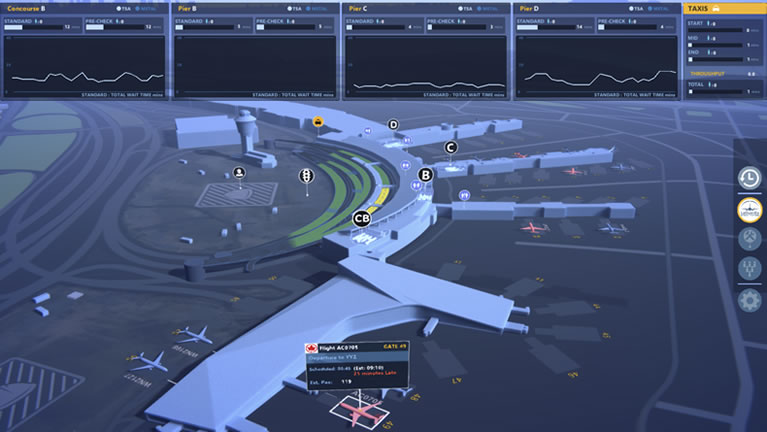
Our concept is to create the operations control interface of the future, using digital twins to bring together everything that’s happening. It covers arriving and departing aircraft, the number of passengers involved, queue wait times, escalator operations, passenger satisfaction with restrooms, traffic flows at drop-off and pick-up and much more.

Busting silos for better decision-making

What was siloed information is now all presented in one place. We are testing it at a major East coast US airport where the 3D interface is on an 86-inch touch-screen in the operations room.

digital twin airport software

The result is improved decision-making, based on the holistic view of the airport operations. As well as showing what’s happening now, we can also select a moment in history and play back exactly what happened in the past. It’s a very effective way of investigating the handling of disruption, to identify what can be done better next time.

Predict and control

The next stage, which we’re working on now, is to build in a view of what is going to happen. By feeding in flight information, weather data and other operational information we can use the digital twin to predict what will happen at the airport next.

As an example, you would be able to see that three wide-bodied aircraft will be landing at the same time because two of them were delayed causing unanticipated congestion. By shifting their gates, you can stagger passengers’ arrival at passport control or you can deploy more resources and open up more border control gates. You can arrange your ground handling resources to alleviate delays at baggage collection.  And you can arrange all this before the planes have even landed.

Our goal is for digital twin technology to start making recommendations based on what the data shows will happen. The airport can then set its own rules about how those recommendations are actioned.

The potential is becoming clear

Some will be handled automatically. When dissatisfied feedback from a restroom passes a set threshold, a cleaner can be dispatched, for example. Other decisions will always need human input, particularly during times of heavy disruption.

However, the recommendations made by digital twin technology will help inform that decision-making. And the technology will learn which recommendations are typically accepted and suggest a new rule to make the process even more efficient.

A fully-functioning productized digital twin of an airport is still some time off. But as we build it out more widely and deeply, the full extent of its potential is becoming clear.

source : https://www.sita.aero/resources/blog/digital-twins-the-airport-operations-control-interface-of-the-future?mkt_tok=eyJpIjoiTUdObVlUUTJaamN3TkRNeSIsInQiOiJWTmw2aENJZzNCQlZcL0l4NnJYdHZxUHZlV2htWG81Ynh4Mmw2THZGeFZnZEFDNmx5VkJHMUc3Y09oc2ZQeEI0K1cyM1FMb2Zrd2FiSFZJUUVUeldPcUhLOVJ0MXlqb1U3UndlaFE2cTZ1YUZ5N2FVVm5aVFVWV3VCdTNWWWVsKzAifQ%3D%3D

The Great Move: Atatürk Airport operations moved to Istanbul Airport

The biggest logistical operation in the world aviation history was held between 5 and 6 April 2019. In a total of 33 hours, 12 hours earlier than expected, all airlines moved from Atatürk Airport to their brand-new home Istanbul Airport. For Turkish Airlines alone around 1,800 personnel transferred approximately 47,300 tons of equipment. The combined size of it covered 33 football pitches.

The whole moving operation went smoothly and exactly as planned. In the afternoon of 6 April, all airlines and their passenger systems become fully operational in the new mega hub. Kadri Samsunlu, CEO and Chairman of the Executive Board at iGA Airport Operations, expressed his excitement about the new beginning: “This exercise was simply unprecedented: No move between two globally-important hub airports has ever been attempted on anything like this scale before. Yet we achieved it without disruption, especially to the hundreds of thousands of travellers who continued to transit seamlessly between Asia, Africa and Europe over Istanbul Airport, while benefitting from the most advanced passenger experience technologies combined with superb shopping and eating. The smooth move to our new home, follows a record five-year fast-build, and firmly sets Istanbul Airport on the path to growth as one of the world’s most significant air transport centres.”

Istanbul Airport, the world’s new hub, officially opened on 29 October 2018, the 95th anniversary of the founding of the Turkish Republic. Once fully completed, including four phases with six runways, the airport is set to serve 200 million passengers annually. At full capacity, Istanbul Airport will become a global aviation hub with flights to over 300 destinations around the world. With its exclusive passenger services, Istanbul Airport will create the best passenger experience for people all over the world.

In addition to this, passenger comfort, convenience and connectivity are central to Istanbul Airport. A mix of latest technical advances, a smart wayfinding system, excellent design and a wide choice of shopping and retail experiences will enhance the passenger experience. The airport is also well connected by train, bus and car, thus offering passengers a variety of reliable ways to travel to and from Istanbul Airport.

source : http://www.pps-publications.com/html/emails/iga/index-10.html