Hong Kong Airport’s IoT

Hong Kong Airport’s IoT, smart airport initiatives win big in ICT Awards 2019

Hong Kong Airport’s IoT, smart airport initiatives win big in ICT Awards 2019

HKIA’s IoT-Augmented Airfield Service System received The Smart Mobility Grand Award. PHOTO from HKIA

The Hong Kong ICT Awards 2019 has acknowledged Hong Kong International Airport’s (HKIA) smart airport initiatives.

HKIA’s IoT-Augmented Airfield Service System (AS2) received both the Grand and Gold awards in the Smart Mobility category while its Baggage Handling Performance Monitoring System and HKIA Digital Twin project won the Silver Award and Certificate of Merit in the  Smart Business category, respectively.

“HKIA is one of the busiest airports in the world, and it is very important for us to meet the airport’s growing air traffic demand with higher efficiency,” said Steven Yiu, Deputy Director, Service Delivery of Airport Authority Hong Kong (AA), in a media statement.

“By implementing state-of-the-art technologies, we are able to identify potential problems and solve them before happening. In addition, big data analysis allows us to better utilise various resources to enhance the airport’s operational efficiency,” he added.

AS2, a cloud-based, service-oriented system jointly developed by the AA, The Chinese University of Hong Kong, and ubiZense Ltd., gathers data from various sources at HKIA and consolidates it into meaningful forecasts through artificial intelligence (AI).

Ground handlers are then alerted to potential delays, which enables them to better deploy manpower and resources, the HKIA said.

Meanwhile, the Baggage Handling Performance Monitoring System analyzes baggage, vehicles, conveyer systems, and baggage handling facilities using video analytics methodology.

According to HKIA, it systematically turns video footage into a set of quantitative performance metrics, which is useful for process control and safety assurance.

The HKIA Digital Twin collects real-time data fed from Internet of things (IoT) devices deployed throughout the airport and transforms it into easy-to-read formats.

“With the use of predictive analytics, it can also provide alerts to the airport community, enabling better deployment of resources and resulting in cost saving and enhanced service,” HKIA said.

In December 2018, HKIA has showcased many of its innovations at the Smart Airport Technovation Conference and Exhibition held at the Hong Kong Convention and Exhibition Centre.

Established in 2006, The Hong Kong ICT Awards were recognizes outstanding information and communications technology inventions and applications.

source : https://futureiot.tech/hong-kong-airports-iot-smart-airport-initiatives-win-big-in-ict-awards-2019/

Dubai aiming to do away with airport check-in desks – CEO

Paul Griffiths, CEO of Dubai Airports, said baggage would be the biggest challenge

Dubai International airport holds the title of the world’s busiest international airport and last year its annual traffic surpassed 89.1 million.

Dubai is aiming to eventually do away with physical check-in desks at its airports, according to Paul Griffiths, CEO of Dubai Airports.

“What we want is to eliminate them altogether. Soon, I don’t think you’ll need to check-in using any physical token of booking. Most of it will be done at the time of booking the in office or home,” Griffiths told Arabian Business’ sister website Aviation Business.

“We just need to find a way of dealing with baggage and I think technology is moving towards that area too,” he added.

A year ago, Emirates introduced ‘Home Check-in’, a service which allows customers to check in for their flights from anywhere in Dubai.

The paid-for service is available for customers across all classes travelling on Emirates flights, the airline said in a statement in April 2018.

The new service enables Emirates passengers to complete the security check and check-in from the comfort of their home, hotel or office and have their luggage transported to the airport prior to their flight.

An Emirates check-in agent will arrive at the preferred location to weigh and tag the bags as well as check-in the customers and issue boarding passes. Customers can then make their own way to the airport and head directly to immigration, bypassing the check-in desks at the airport.

Dubai International airport holds the title of the world’s busiest international airport and last year its annual traffic surpassed 89.1 million. The airport also managed to reduce waiting times by 28 percent, a feat reportedly achieved thanks to the airport’s introduction of smart gates and an advanced operations centre.

“We have now decided that not only is growth very much on our agenda for present and future, we are now seeing a maturity in the aviation market, which is putting us in a position where we want to be not just the biggest airport for international traffic but the best,” Griffiths said.

Read the full interview with Paul Griffiths.

source : https://www.arabianbusiness.com/transport/419350-dubai-aiming-to-do-away-with-airport-check-in-desks-ceo

Global Advanced Airport Technologies Market Insights & Deap Analysis 2019-2024

Global Advanced Airport Technologies Market Insights & Deap Analysis 2019-2024: Thales ATM S.A., Raytheon Corp., Smiths Detection International

The present report for the worldwide “Advanced Airport Technologies Market” underscores an in-depth analysis and study of the global market for Advanced Airport Technologies which approximates market volumes, and also examines the assessment of the market in the approximated time. The competitive players with regards to the global Advanced Airport Technologies market have also been thoroughly summarized with methodical details, for example, business outlines, the organization’s revenue division, product segmentation and latest developments. The major competitors in the worldwide Advanced Airport Technologies market are Thales ATM S.A., Raytheon Corp., Smiths Detection International, Siemens Airports, Oshkosh Truck Corp., L-3 Commenications Security, Hitachi,Ltd., ACS Transport Solutions,Inc., Bosch Security Systems,Inc., CISCO Systems,Inc., Honeywell Airport Systems, IER, ATG Airpoprts,Ltd., Tyco Fire And Security, SAIC,Inc., Rockwell Automation, QinetiQ,Ltd., Airport Information Systems,Ltd., ARINC, Garrett Metal Detectors, KUKA Roboter, Passur Truck Corp., Pensher Skytech.

Click here to access the report:: www.99strategy.biz/request-for-sample.html?repid=43391

Through the use of SWOT analysis, demonstration of the market leaders’ weaknesses, as well as their strengths, has been demonstrated in the report. In addition, the Advanced Airport Technologies market report provides information regarding expansion and diversification of key players during the forecast period. Other than this, there is also provision of important suggestions.

It also functions as an adviser for upcoming promising players entering the global Advanced Airport Technologies market. Various methodological processes and techniques have been utilized during analysis to review market expansion in the forecasted period. The market has been estimated with regards to quantity (x MT) as well as revenue (in million USD). It demonstrates various segments Security, Fire and Emergency Services, Communications Systems, Passenger and Baggage Handling and Control and sub-segments Domestic Airport, International Airport of the global Advanced Airport Technologies market.

Read Detailed Index of full Research Study at:: www.99strategy.biz/global-advanced-airport-technologies-market-study-2015-2025.html

Also, the various factors strengthening or weakening the growth of the company on the global level have been included in report. The global Advanced Airport Technologies market reports the various opportunities for market expansion during forecast period.

The report additionally forecasts global Advanced Airport Technologies market development, along with classification based on geographical conditions. The regions are classified as. The data which is furnished in the report of the global Advanced Airport Technologies market is always gathered from dependable manufacturing organizations for forecasting development of every segment in global market.

There are 15 Chapters to display the Global Advanced Airport Technologies market

Chapter 1, Definition, Specifications and Classification of Advanced Airport Technologies , Applications of Advanced Airport Technologies , Market Segment by Regions;
Chapter 2, Manufacturing Cost Structure, Raw Material and Suppliers, Manufacturing Process, Industry Chain Structure;
Chapter 3, Technical Data and Manufacturing Plants Analysis of Advanced Airport Technologies , Capacity and Commercial Production Date, Manufacturing Plants Distribution, R&D Status and Technology Source, Raw Materials Sources Analysis;
Chapter 4, Overall Market Analysis, Capacity Analysis (Company Segment), Sales Analysis (Company Segment), Sales Price Analysis (Company Segment);
Chapter 5 and 6, Regional Market Analysis that includes United States, China, Europe, Japan, Korea & Taiwan, Advanced Airport Technologies Segment Market Analysis (by Type);
Chapter 7 and 8, The Advanced Airport Technologies Segment Market Analysis (by Application) Major Manufacturers Analysis of Advanced Airport Technologies ;
Chapter 9, Market Trend Analysis, Regional Market Trend, Market Trend by Product Type Security, Fire and Emergency Services, Communications Systems, Passenger and Baggage Handling and Control, Market Trend by Application Domestic Airport, International Airport;
Chapter 10, Regional Marketing Type Analysis, International Trade Type Analysis, Supply Chain Analysis;
Chapter 11, The Consumers Analysis of Global Advanced Airport Technologies ;
Chapter 12, Advanced Airport Technologies Research Findings and Conclusion, Appendix, methodology and data source;
Chapter 13, 14 and 15, Advanced Airport Technologies sales channel, distributors, traders, dealers, Research Findings and Conclusion, appendix and data source.

Enquire Here Get customization & check discount for report @: www.99strategy.biz/inquiry-for-buying.html?repid=43391

source : http://newsstockexchange.com/33723/global-advanced-airport-technologies-market-insights-deap-analysis-2019-2024-thales-atm-s-a-raytheon-corp-smiths-detection-international/

128 Smart Gates at DXB Process Border Control in Seconds

Over 80% airport passengers had auto-preclearance in 2018

Dubai International, the world’s number one airport for international travellers for the past five years, has 128 Smart Gates which helped millions of passengers clear border control formalities within a record span of six to nine seconds on an average, an official told a conference in Dubai.

In her presentation at the Global Airport Leaders Forum (GALF), Radwa Hozien, Chief Software Officer at emaratech, a technology and management consulting company of the Investment Corporation Dubai (ICD), said DXB last year handled an average of 120,000 passengers daily during peak times.

The processing time for immigration formalities per passenger took just a few seconds.

According to the IATA, 80% of the global passengers will be offered with a complete and relevant self-service suite throughout their journeys even as iris biometric becomes more and more accurate, she said.

Ms Hozein added that Next-Gen technology has been helping process the entry and exit of passengers amazingly faster than ever before.

DXB and DWC ‘Good to Go’ for Runway Closure

Technology, she explained, has been helping the airport and other authorities to know the passenger much before he/she arrives at the airport for their journeys.

On another important issue, in his keynote address, Abdulqader Ali, CEO of Smartworld, the telecom provider for Dubai South and Managed Services provider for UAE government entities, said there will be 30 million Unmanned Aircraft System (UAS) by 2021.

This poses a serious challenge to the functioning of airports across the world.

The scenario has been undergoing a paradigm shift from 2D to 3D, requiring new technologies to stop UAS posing challenges and threats and controlling them effectively.

In his address, Dieter Heinz, Honorary President of German Airport Technology and Equipment (GATE), highlighted the major milestones of airport technology which the Dubai had used it extensively to improvise the performance and efficiencies of its airports much to everyone’s delight.

He praised the authorities for continuing their proactive approach and being a good model for airport management.

In another panel discussion on ‘Privatisation leading to Smart Airports’, another group of experts referred to the bottlenecks and hurdles coming in the way towards airport privatisation.

Javed Malik, Group COO, AirAsia, Stefan Ruter, CFO, Oman Airports, Keven Riordan, Head of Airport and Checkpoint Solutions, Smiths Detection and Brian Kaasner Krishtiansen, Managing Director of Epinion Global, participated. Dr. Fethi Chebil, an aviation advisor, moderated.

The panellists suggested optimizing the assets by benefiting from the different streams of revenues available at the airports.

Read More: 63% of DXB Passengers in Transit During 2018

source : https://www.transportandlogisticsme.com/smart-air-freight/2019/05/04/128-smart-gates-at-dxb-process-border-control-in-seconds

The VIP experience: An untapped revenue opportunity within airports

The appeal of the airport lounge is waning, so airports must start looking at how to broaden the number of accessible revenue streams. David Ellis and Tom Hardiman from Egremont Group explain how the market is changing, with a case study from Dublin Airport.

The appeal of the airport lounge is clear from the passengers’ point of view; it provides a quiet space to work, relax, get away from the hassle of the main airport terminal. Yet these areas are increasingly becoming overcrowded due to the proliferation of airline frequent flyer programmes.

While the concept of the airport lounge has evolved slightly in the past 20 years, the main innovations have focused on the look and feel rather than creating a new experience.

Savvy travellers are voting with their feet and starting to distribute their spending along the journey steps in different ways. This may mean buying a low-cost flight but upgrading the airport experience with premium parking, fast-track security and a pay-to-use lounge. It is this ‘choose your own experience’ that is opening up a number of new revenue streams for the airports.

The opportunity for airports

Across the world all airports generate income from non-aeronautical commercial revenue streams and this trend is now accelerating in the U.S. Traditionally, this revenue has been earned from retail, car-parking and property. Yet these traditional categories are facing their own pressures with the rise of online retail eating away at traditional duty-free retail goods revenue and the introduction of Uber and better transport links threatening car-park revenue.

Leading airports are tackling this by creating a differentiated passenger experience, especially those that aspire to become, or already are, international hubs. This is particularly evident in the investment and innovation in the food and beverage offering to the extent that it is starting to overtake retail in terms of concession rates and income in some smaller airports. However, this is just the tip of the iceberg.

Upgrading the airport experience

As a first move, airports have begun to create pay-to-use lounges. A great example of this is the 1903 lounge at Manchester Airport, recently voted the third best airport lounge in the world. Available to any traveller these lounges compliment overcrowded airline-owned lounges, offering passengers greater choice irrespective of the ticket the passenger has bought. From a commercial perspective, this model may be provided in house or through a lounge provider.

The 1903 lounge at Manchester Airport

An alternative solution is bundling various premium services: Car-parks, fast track security and lounges; offering these services as part of a membership scheme.

The biggest and most exciting trend is the complete overhaul of the passenger experience, which streamlines the whole customer journey from arrival at the airport right through to boarding the plane. Originally operated as a protocol service for government officials and VIPs, this new end-to-end experience is being commercialised and opened up for use by passengers willing to pay the extra: The re-imagined VIP Service.

What is a VIP service and how can it create revenue?

A VIP service is a dedicated facilitation service that has a separate entrance to the airport, private terminal building which includes premium parking, private and discreet fast-track check-in and security screening plus luxury individual lounges. The final part of the journey to the aircraft is carried out in a chauffeur driven limousine.

Interestingly, prices do vary; the most recent launch has been the Private Suite at LAX, very similar to the Heathrow proposition and priced around £3000.

Dublin Airport has launched Platinum Services – a private terminal that offers similar services to LAX and Heathrow but at a different price point. Grainne Morrison, Head of Business Development at Dublin Airport, below explains how Platinum Services operates.

In 2012 the commercial team at Dublin Airport were asked to take on the private terminal aspect of the business, with a view to making it more commercially viable. Previously this side of the business was facilitating a combination of commercial and diplomatic passengers. A three-year programme began to examine and redevelop the business model; scaling it for growth.

Doors shut in early 2015 to renovate the building and recruit and train staff. Platinum Services launched on 30 August 2015, not just as a VIP offering, but as a fixed price private terminal premium service for all.

Platinum Services has just had its three-year anniversary, growing year on year since it launched handling 35,000 passengers a year and the team has recently been nominated for two International Customer Experience Awards.

“We opened with commercial general aviation in mind, in other words, passengers who arrive in on scheduled and private aircraft who require a bespoke service,” said Grainne Morrison, Head of Business Development at Dublin Airport. “This enabled us to engineer a partnership deal early on with both Signature Flight Support and Universal Aviation so that Platinum Services would handle all general aviation movement through Dublin Airport. This move gave us the scale we needed to open the terminal 24/7 and at the same time trebling the team and saving the business from a commercial perspective. Business trebled overnight as the service became mandatory for all general aviation passengers.”

All private passenger security screening is now provided by Platinum Services. The centralised, private passenger security screening area allows Dublin Airport to offer and create a bespoke customer experience in keeping with expectations of the premium market. Located in a discreet area beside the terminal with a private entrance and car park, clients can relax in the private suite with a dedicated team to look after them.

Morrison explained that much of what the team do is often invisible to the passengers. “We take away the pain points of the airport experience, on the surface it all looks seamless but underneath there is a huge amount of coordination.” This co-ordination is helped by the fact that Dublin’s service is run by the airport authority itself, rather than relying on a concessions model.

TARGET MARKET: Predominantly high-end C suite executives, plus ultra-high net worth individuals from general aviation. The team also handle diplomatic, ministerial and state movements – notably the Pope’s recent visit to Ireland.

ETHOS: One standard of excellence for all passengers. Dublin Airport’s Platinum Services is available to all passengers and is not dependent on the class of ticket. Customer service and the human touch is at the heart of the business model and day-to-day operations.

Morrison continued: “We are the first welcome and final farewell for a range of clients from home and abroad all with different backgrounds. Our service reflects the professionalism that is adopted throughout our entire airport operations and our staff take great pride in what they do. We have a policy of never saying no, and source whatever a passenger needs doing so with a smile.”

THE TEAM: Platinum Services Manager, Philip Bolger, leads a team drawn from across the airport’s staff.

“When we started to redesign the operating model in 2015 we had no doubt that we had the skills within our existing staff to create a new premium service. By recruiting from all departments in the airport our team has a great mix of expertise and wide-reaching contacts, perfect for the unpredictable nature of servicing passengers from the general aviation market. If they don’t know the answer, they know someone who does,” explained Morrison.

PRICE POINT: Dublin’s Platinum Services are deliberately priced for a business audience.

“Our passengers are mainly business users, some of whom travel through the private terminal three or four times a week, we are literally an extension of their office. As such we have priced our services to be acceptable in a business context,” said Morrison.

FINAL WORD: Passengers may forget what you did but they will never forget how you made them feel.

Morrison concluded: “The growth of VIP services around the world has meant there is a drive to be the slickest and the shiniest. If you push it too far there is a real danger you lose the human element of the offering. Never lose sight of the people coming through the door, read them, understand them and make their day better. If you push it the service becomes sterile and predictable, our passengers check into our services to relax, our team know them and want to do their best by them, that is why they come back time and again.”

A conservative estimate would be that the VIP services could generate between $10 million and $40 million revenue per year. In addition to charging passenger facilitation fees, the airport can also create further revenue or benefit-in-kind from sponsorship and placement deals.

But it’s more than revenue

It is clear that a VIP service improves the experience for passengers who are willing to pay and therefore generates revenue from this. However, this is not the whole story. VIP services can also support airport strategies in other ways, i.e. by acting as the key example of an airports desire to innovate and improve the overall customer experience.

The VIP service also plays a role in supporting the local economy. It can act as a key facilitation role for the business and government community. For example, one particular airport sees a VIP facility service as vital for supporting the growing film industry in the region. The VIP service can support the facilitation of people flying in for regional events, assist in the promotion of tourism, and facilitate high-profile groups such as sports teams.

Moving forward

As airports get bigger and busier the VIP proposition will continue to evolve; developing a wider variety of specific products and price points to meet local demand. Some of the propositions could well be based more on ease and efficiency than the exclusivity of existing offers. More airports will consider whether a tailored VIP proposition can complement their range of premium products and passenger choices.

One word of caution, it doesn’t matter how shiny the new private terminal, if it doesn’t link seamlessly with the existing airport it won’t work and if the passengers are not made to feel special they will quickly go elsewhere.

source : https://www.internationalairportreview.com/article/89672/vip-experience-increasing-revenues/

How Mumbai Airport has enabled itself with technology

oday technology acts as a backbone for most airports and as an airport operator, Chhatrapati Shivaji Maharaj International Airport (CSMIA) is equipped with best-in-class technology

At CSMIA, right from the time passengers arrive at the airport, till they take off or vice versa, they interact with technology – for generating self-boarding pass and baggage tags, during check-ins, or whilst checking the flight information on the screen, among others.

Being a technology driven airport, CSMIA utilises the global ticketing passenger management system which helps provide passengers hassle-free entry and exit. The airport has also introduced paperless boarding pass facility, eradicating ‘boarding pass stamping’ for all domestic airlines operating out of Terminal 2. This technological offering was the first for any airport in India.

CSMIA has also introduced a mobile application, Mumbai Titu, for seamless indoor navigation. The application’s latest offering accentuates the various products and services within the terminal, right from passenger entry to their exit. The mobile application comes with features which can be used for booking taxis, m-commerce for the Duty Free, auto Wi-Fi authentication for frequent travellers, pre-ordering of meals and more. Apart from this, the app also acts as an assistant to air travellers to locate, track and enjoy various facilities at the airport through one-click process.

Tech at play
Technology plays a crucial role in the consistency and precise operations of the airport and CSMIA regularly upgrades its technology offerings to help improve the day-to-day operations within the airport. The technology upgradation at the airside has resulted into handling 1,004 aircraft on a single runway on December 8, 2018, surpassing its previous record of handling 1,003 flight movements in a day, in June 2018.

“Since the past five years of operations, the Chhatrapati Shivaji Maharaj International Airport has seen 25 per cent growth in Air Traffic Movement, with a reduced Runway Occupancy Time (ROT) from 65 seconds then, to 47-49 seconds now. Currently, CSMIA operates to 112 destinations in India and around the world and witnesses heavy passenger traffic throughout the year. A database of the passenger traffic is maintained by the airport, and a detailed analysis is conducted, which further helps amplifying the facilities, services and offerings for passengers travelling from the airport,” informs an official spokesperson of CSMIA.

Ensuring cyber security
In the world of modern application development, applications are launched, changed, and decommissioned rapidly. As a global organisation, it becomes equally important for CSMIA to enhance, adapt, and implement the best security inside its premises. The airport sees heavy passenger traffic everyday, hence it is critical for the airport to secure the data, systems and technology used within its property to help lakhs of passengers travel hassle free.

“Cyber-attack threats do persist, but that’s where technology comes to play. The IT and the cyber security teams at CSMIA make sure that only the latest upgraded technology is implemented. The systems within the airport are protected with limited access to open sites preventing malware; the policies and security layers are reviewed often inline with the active changes in the technology industry. CSMIA constantly works towards security and safe functioning against the increasing cyber threats at any given point in time. The systems provide granular segmenting of the traffic helping the IT teams to minutely cover and identify threats and hazards. Simultaneously, the amalgamated firewalling planning system eliminates additional network trips and traffic, due to the policies enforced at the airport,” the spokesperson informs.

CSMIA also leverages emerging technologies by integrating them to the systems, making it more advanced and smarter for passengers. “The airport is working towards the implementation these technologies, be it upgrading AI, VR or machine learning under the IoT umbrella catering to every aspect of the offering within the airport,” the spokesperson says.

Sustainability efforts
Sustainability is closely connected to the use of technology and it is at the helm of GVK’s ideology as part of its core values. Sustainable practices are imbibed into the daily functioning of the airport. Artificial intelligence is part of the everyday functioning of the airport. As a result, CSMIA uses the systems that are advanced and at the same time evaluate them at regular intervals. CSMIA was the first airport to eradicate baggage tags aimed to decongest the pre-embarkation security check area. It is also the first to introduce a mobile application for an airport operator making the entire travel process smoother for air passengers.

“The airport was also the pioneer in offering automated check-in facility through common use self service (CUSS) kiosks. The elimination of the boarding pass has encouraged paperless travel, thereby providing a sustainable alternative to the precious resources. With the best-in-class technology incorporated in our system that works towards an efficient and sustainable airport, CSMIA has digitised the entire travel experience of the passengers at the Mumbai airport, making it hassle-free,” the spokesperson explains.

source : https://www.expresscomputer.in/artificial-intelligence-ai/how-mumbai-airport-has-enabled-itself-with-technology/35519/

Why Counter Drone Technology is a Critical Piece of UTM: Fortem Technologies on Partners and Collaborators

Unmanned Traffic Management (UTM) is a critical step in full integration of drones into the airspace.  Until a robust framework that allows manned aircraft pilots and airports to feel confident that they know exactly what’s in the airspace, commercial drone applications will be limited – and safety will continue to be a concern.

UTM isn’t one thing – it’s a complex structure of regulations, technologies, and software.  Partnerships and collaborations are forming rapidly as the leading players work to provide a flexible framework that includes all of the necessary components. While UTM includes drone tracking and ID, airspace intelligence, and communications systems so that drones and air traffic control can stay connected, another important feature of UTM is counter drone technology.

This week is AUVSI’s Xponential show – and safety and security experts Fortem Technologies announced today a partnership with  Unifly, a leading UTM provider.  The two “will collaborate to develop a joint airspace safety and security solution for a drone-enabled society,” says a Fortem press release.  “This new end-to-end solution will allow UTM and U-space architectures to be used by public safety officers, military groups and other government agencies to secure airspace around critical infrastructure, airports, stadiums, public venues and more.”

This announcement follows on the heels of last month’s announcement that Fortem had partnered with AirMap, another leading airspace intelligence and UTM platform.   DRONELIFE had the opportunity to speak with Timothy Bean, Fortem Technologies’ CEO, to find out why counter drone technology – or rather, airspace security – solutions are so important to UTM.

Bean begins by giving me a crash course in Fortem’s drone security system.  “Two or three years ago if you wanted to stop a drone, you’d buy an antenna,” says Bean.  “The antenna could hear the drone signal, and if you didn’t want it there, you could just jam the signal… and then you’d go look for the guy with the joystick,” he laughs.

As drone technology has advanced, however, the threats have gotten more sophisticated.  “Drones are flying on iPads, not joysticks, now.  That antenna has nothing to listen to – the drones are flying around listening to GPS,” explains Bean.  “And the bigger threat is that drones are now flying on terrain maps – they aren’t even listening to GPS, they are designed for a GPS deprived envioronment.”

“That’s scary,” says Bean.  “The operator can be hundreds of miles away – there is no operator.”

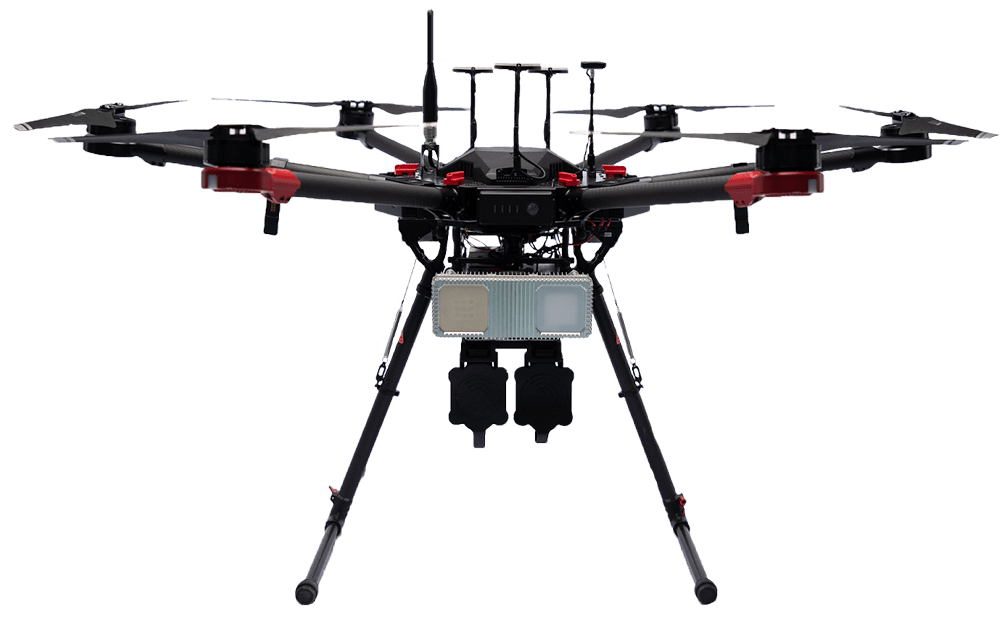
That’s why radar has become important in drone detection – but not the traditional large equipment.  “Radar is usually big,” explains Bean.  “It weighs about 50 pounds, sometimes you need your own power station, and traditional radar has a narrow point of view.”

“The other problem is that radar can’t see through buildings,” he continues.  “Radar sees day and night, and through clouds: but it’s topology challenged, it can’t see through buildings and through hills.”

Fortem’s radar is a different thing.  “Our disruption is that we’ve built a small radar – one is the size of a pencil case, and one is the size of a laptop.  They see 120×120 – so we can put them on all sides of a building, or all over a city – and then we aggregate the data with our software to give you complete visibility, about a mile in the sky,” Bean says.

The Fortem platform offers other advantages.  “People don’t like radar because it is stochastic, and you get a lot of false positives.  That’s why traditional long range radar takes time to focus in on something.”

“Another big disruption that our technology offers is the NVIDIA chip that goes in the radar to get rid of all of the noise.”  NVIDIA is the leading maker of edge AI technology – they’ve miniaturized their computer to allow powerful processing on small devices, which is known as “edge” computing.  With edge computing on Fortem’s radars, they’re able to achieve more accurate results: 1 meter as opposed to 50 – 100 meters.  Software associates the tracks from all of the radars positioned around a protected area to get one single picture of everything in the airspace.

image courtesy Fortem Technologies

“With that 3D view, we can create these geofences,” says Bean.  “Customers can create rules about what they want to happen when a drone enters that area – to communicate with the operator, or with authorities, or to use the DroneHunter to take it down.”

By collaborating with UTM providers like Unifly, Fortem can differentiate between drones with a legitimate purpose in the airspace and those that don’t belong.  Bean gives an example: a customer protecting some piece of critical infrastructure might have 5 drones flying for inspection purposes, and using Unifly for airspace intelligence.  Identifying every drone in the airspace using radar, Fortem’s software can then eliminate those in the Unifly system from the list of potential threats.  They may choose to communicate with the provider rather than take measures towards mitigation.

The total solution is an elegant one – and one that takes into consideration the needs of organizations who want to protect their airspace, while also taking advantage of the benefits of commercial drones.

The following is taken from a Fortem press release. 

“Recent security breaches have caused the demand for digitized airspace above a venue or across a city to skyrocket, particularly for solutions that can detect drones with no RF emissions,” said Fortem Technologies CEO Timothy Bean, “Fortem SkyDome supports drone service providers like Unifly to pave the way for safe and secure drone operations in an urban environment.”

Unifly recently announced Unifly BLIP (Broadcast Location and Identity Platform), an e-Identification sensor that detects position, altitude, temperature, pressure, speed and direction, when placed directly on a drone. This information can be accessed in real-time by relevant authorities, such as police officers or government organizations, through secured applications. Fortem SkyDome is an AI data platform that uses distributed Fortem TrueView radar to digitize the airspace above and around infrastructure, venues, events and cities, for approved drones to fly safely and unapproved drones to be identified quickly. The new joint solution will combine and leverage the capabilities offered by these solutions.

“Safety and situational awareness are the two key elements that come into play for organizations working to develop and deploy new drone technology,” said Laurent Huenaerts, General Manager of Unifly. “Combining Unifly’s solutions with Fortem’s is a milestone that will allow us to serve the needs of more stakeholders and accelerate towards the safe drone-enabled airspace we envision.”

Fortem Technologies and Unifly were both chosen to participate in the UAS Integration Pilot Program, which sets out to accelerate the safe integration of UAS into the airspace. Fortem is also running tests with various Departments of Transportation (DOT) at the state level, and Fortem SkyDome is being tested by the Utah Department of Transportation at Salt Lake City Airport, as well as with additional domestic and international airports. Unifly and Fortem have also both partnered with the State of Nevada UAS Test Site for the FAA UTM Pilot Program, a joint initiative from the FAA and NASA that seeks to manage the airspace for the safe deployment of drones in the US National Airspace System (NAS).

source : https://dronelife.com/2019/04/29/why-counter-drone-technology-is-a-critical-piece-of-utm-fortem-technologies-on-partners-and-collaborators/

TSA says an airport full-body scanner must add a filter to protect travelers’ privacy

A full-body scanner that the Transportation Security Administration hopes can speed up airport security checkpoints must go back to the drawing board for software to protect the privacy of travelers being scanned.

The scanner, built by British firm Thruvision, was promoted as being able to simultaneously screen multiple airport passengers from a distance of up to 25 feet away. The TSA began trying out the device last year at an Arlington, Va., testing facility before planning to use it on a trial basis at U.S. airports.

But now the federal agency is requiring the scanner to add a “privacy filter” before the TSA can test the scanner “in a live environment,” according to a TSA document.

The March 26 document was posted on a public website, but many details were redacted, including the name of the manufacturer and the cost of adding the privacy filter.

In a statement, Thruvision confirmed that the TSA document referred to the Thruvision scanner, which is currently being used at some Los Angeles subway and light-rail stations.

TSA and Thruvision said the software is being added to comply with a federal law passed in the wake of a 2013 controversy involving body scanners that may have shown too much.

The scanner doesn’t violate travelers’ privacy or show details of a person’s anatomy, Thruvision Americas Vice President Kevin Gramer said.

Images provided by Thruvision show that the scanner creates a fuzzy, green image depicting a traveler’s body with a dark outline of potential weapons or explosives that are hidden under their clothes.

“A piece of narrowly drawn legislation from several years ago created a requirement that all people-screening technologies used at U.S. airport checkpoints have a privacy filter regardless of the image displayed,” Gramer said in a statement. “Thruvision screening equipment has been deployed internationally for years because of the tremendous privacy and safety benefit of its passive terahertz technology and it is a candidate for use at U.S. airports specifically because of those benefits.”

In 2013, the TSA removed about 200 full-body scanners after protests because the scanners used low levels of radiation to create what resembles a nude image of screened passengers. Critics called the device the “nudie scanner” before the TSA ended its contract with the manufacturer.

Three years later, Congress adopted legislation requiring that all full-body scanners used at U.S. airports include privacy software filters that keep the devices from showing details of a traveler’s body on the screens monitored by the TSA.

The full-body scanners used at the nation’s airport create a generic human avatar of each traveler that appears on TSA screens. Weapons or explosives hidden under the traveler’s clothes are shown as yellow squares on the screen.

The Metropolitan Transportation Authority in Los Angeles began using Thruvision scanners last year. An MTA spokesman said the transportation agency bought a handful of Thruvision devices but did not add privacy software because the images created by the device don’t show details of a commuter’s anatomy but instead depict each person as a “green blob.”

A full-body scanner with privacy software installed is used at Ontario International Airport.
A full-body scanner with privacy software installed is used at Ontario International Airport. (Irfan Khan / Los Angeles Times)

The Thruvision scanner is one of several new technologies being tested under the TSA’s “Innovation Task Force” as part of an effort to improve screening and speed up the queues at airport security checkpoints.

The task force’s efforts included the 2016 launch of a new conveyor belt system to move luggage and passengers through a security checkpoint faster.

Innovation lanes, now used at several terminals at Los Angeles International Airport, are designed to move travelers and carry-on bags through the security checkpoint faster
Innovation lanes, now used at several terminals at Los Angeles International Airport, are designed to move travelers and carry-on bags through the security checkpoint faster (Hugo Martin / Los Angeles Times)

Under the full-body scanning program, the TSA purchased several Thruvision devices to begin testing in November 2018.

The existing full-body scanners used at U.S. airports bounce millimeter waves off passengers to spot objects hidden under their clothes. But Gramer said the Thruvision device uses a passive terahertz technology that reads the energy emitted by a person, similar to thermal imaging used in night-vision goggles.

Thruvision has promoted its scanning devices as being able to screen up to 2,000 people in an hour and detect a concealed weapon at a distance of up to 25 feet.

The screening device was used in 2017 to scan people attending a tribute concert organized by U.S. singer Ariana Grande after her May 22, 2017, concert in Manchester, England, ended in a suicide bombing that killed 23 people and wounded 139 others

source : https://www.latimes.com/business/la-fi-tsa-body-scanner-20190429-story.html

50 new technologies and innovations showcased at Dubai Airport Show

Screening system that avoids need to take out laptops at airports, unique loading system, baggage handling system

Press Release

Dubai: The 19th edition of Dubai Airport Show, the world’s largest airport exhibition, witnessed the showcasing of new technologies and innovations in the aviation industry.

More than 50 new technologies and innovative products and services were unveiled on the first day of the three-day exhibitions with participation of 375 exhibitors from 60 countries at the Dubai International Convention and Exhibition Centre (DICEC).

Smiths Detection unveiled Hi-Scan 6040 CTiX security screening system that uses computed Tomography technology for cabin baggage. The advanced detection capability offered byt CT eliminates the need to remove electronic devices and liquids from hand baggage.

“This means passengers need not take out their laptops and bottles with liquids while screening at the airports,” said Tom Squier, Smiths Detections Managing Director for Middle East.

Smiths Detection also showcased the next-generation portable desktop system, the Ionscan 600, to detect and identify trace amounts of explosives.

ADP Ingénierie, involved in designing greenfield airports and maintenance, unveiled a Baggage Handling System (BHS) system design using virtual reality meant for airport operators who are willing to see in term of design, to see the end results of what they are designing. The technology can be used for optimising the existing systems.

The system can optimise the operations of bagging handling of passengers through virtual reality, said Philippe Martinet, Deputy Managing Director, ADP Ingenierie.

Twenty companies are participating under the Swiss flag, showcasing cutting edge technologies. Chris Watts, Consul General of Switzerland, said Swiss companies have contributed to the development of the region.

The prominent Swiss company participating at the show is EuroPoles, which unveiled a unique loading system, has recently signed a deal with Dubai Airports for the calling points systems and energy saving systems.

Nokia is showcasing its innovative technologies, along with managed services for building highly reliable and secure mission-critical domestic as well as international aviation networking. These technologies help both airports and Air Navigation Service Providers (ANSPs) meet key regulatory and unique network communications upgrade challenges.

Kamal Ballout, head of the TEPS MEA and Global Energy Segment, Nokia, said: “As ATC infrastructure forms a critical foundation for the aviation industry, one of the most important aspects is to ensure the support of legacy applications and services while moving toward an IP environment. Nokia has helped many ANSPs overcome these legacy application support issues with robust network solutions allowing seamless connectivity and reduced costs.”

ITW GSE is launching its new battery powered Nissan leaf battery packs for GPUs (ground power units) to support the green airports and a better working environment for the airport staff. A battery powered 400 Hz unit that will help airports reduce their carbon foot print, replacing their diesel powered GPUs by clean eGPUs.

David Feuga, Sales Director, Middle East and Africa, ITW GSE said: “The challenges are congested airport, flexible infrastructures, carbon emissions control, noise, health and safety for operators in the ramp.”

DFS Aviation Services is showcasing the PHOENIX WebInnovation System. This web-based cloud solution enables air traffic controllers to use PHOENIX tracker not only at their controller working position but also anytime and anywhere. The product targets ANSP’s, airports and airlines as well as any other stakeholder involved in ATM.

“We believe that airports will have to tackle positive challenges like growth and expansion. We look forward to strengthening DFS Aviation Services in the UAE and Middle East market as a competent and reliable partner for ATM and consultancy,” said Oliver P Cristinetti, General Manager, DFS Aviation Services.

Saudi Ground Handling Services (SGS) is studying some projects outside Saudi Arabia, with different partners from these countries.

“With Vision 2020 and Vision 2030, we have lots of changes in the government to open up the tourism industry to make it attractive for foreigners. There are big expansion plans at the airports,” said Abdullah Marie Al Ghamdi, Director, Commercial, Saudi Ground Handling Services.

“We are implementing a new system, InForm system, which will link manpower, rostering and equipment. It is an IT solution linking planning, equipment, manpower which will give real-time of equipment needed. This we are implementing in Jeddah and later will be used in other airports,” he said.

Ground Handling Logistics of Saudi Arabia showcased their PRM (Passengers with Restricted Mobility) technology.  PRM products and equipment give special care for people with special needs.

“We try to provide all equipment and system to make all the airports accessible for passengers with special needs,” said Yasser Kusibati, Chief Business Development, with Ground Handling Logistics.

source : https://www.zawya.com/mena/en/press-releases/story/50_new_technologies_and_innovations_showcased_at_Dubai_Airport_Show-ZAWYA20190430090755/

The future of flying? AI that shames you into being a better passenger

The AI-powered airport of the future is full of promise–and peril, writes Teague futurist Devin Liddell.

The future of flying? AI that shames you into being a better passenger

[Source Image: MicrovOne/iStock]

The first biometric airport terminal is already up and running, thanks to Delta’s collaboration with U.S. Customs and Border Protection, the Transportation Security Administration, and Hartsfield-Jackson Atlanta International Airport. Similar systems are now operational at Dubai International Airport, at least for first- and business-class passengers. While groundbreaking, these systems—powered by artificial intelligence—are early exemplars of the emerging technological transformation of airport and airline operations. They are working preludes to artificial intelligence’s eventual forays throughout the passenger experience. Part of these forays will be driven by technology; we’ll have increasingly smarter and capable tools for independently managing enormous complexities and creating new efficiencies. Another part will be driven by new competitive pressures; in the face of autonomous vehicles that will offer compelling alternatives to flying, the future of air travel will require robust improvements.

Taken together, we can reasonably anticipate artificial intelligence to finally solve for some of the most intractable problems that have frustrated passengers and vexed airlines and airports for decades. But this likely won’t be a glitch-free parade into a utopian future, and artificial intelligence represents some serious threats to passenger privacy as well as the potential for unanticipated misuses. Here are three of the biggest problems in air travel and how AI might transform them into better experiences for passengers–from eliminating lines to shaming bad behavior–along with some related visions of what could go wrong.

[Source Photo: Chris Brignola/Unsplash]

Replacing glacial and dehumanizing boarding processes

One of the benefits of artificial intelligence is its capacity for seeing what’s happening in ways that humans simply cannot. As an example, Google uses AI and satellite data to observe the world’s fishing fleets at work across all 1.4 billion square miles of Earth’s oceans as part of efforts to prevent illegal fishing. This same capability to see and then make sense of noisy, complex data can be used to create and manage better aircraft boarding processes. Instead of the creeping parade of inefficiency we have now, AI-powered computer vision could help architect just-in-time, queue-less experiences.

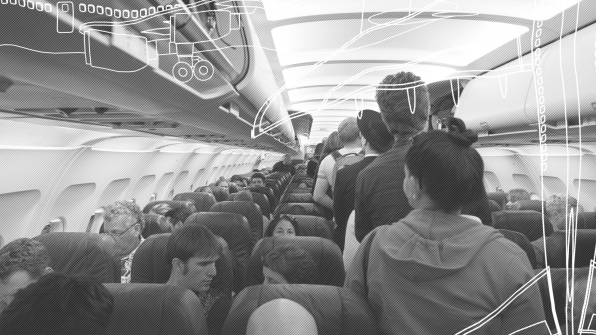
What could this look like? Imagine even an early version—informed by cameras, sensors, and an airport network in which every passenger and every bag is a node—that simply develops a basic understanding of a few interrelated data sets. A computer vision system with a dynamic comprehension of who’s at the gate and who’s not, the bags they have and the other people they’re traveling with, and even how these people physically move, can then bring those disparate data sets together to answer the question that matters most: How can we board everyone in the fastest way that never creates a line? The system would also coordinate communications with you and your fellow passengers in ways that are far more personalized than the class- and zone-based boarding routines used today. This future could liberate flyers—and the gate itself—in ways that are difficult to predict. At the very least, airport gates would feature fewer crowded waiting rooms, and passengers would spend more leisure time at airport restaurants and stores—or, even better, less time in the airport overall.

There is a more pessimistic side to this narrative, though. If AI can be used to optimize airport and airline processes, it can be used to re-architect those processes in ways that don’t necessarily benefit passengers, and instead benefit commercial interests. Put simply, AI’s strength at seeing what’s happening could be used to manipulate passengers. That fatigued family with three bored and hungry kids? AI could help ensure they’re funneled through a security checkpoint that’s adjacent to a toy shop or fast-food restaurant where they are more likely to make impulsive purchases. That lonely-looking solo traveler on a bereavement fare? AI could serve up two-for-one offers at airport bars. While this type of marketing-centric predation isn’t much different from what we already endure online, the central danger here is the challenge to human agency within an environment that should have our best interests at heart—but just as easily might be more interested in profiting from our highly contextualized personal information.

[Source Photo: Roman Tiraspolsky/iStock]

Stitching together the winged and the wheeled

Fueled by big data and machine learning, a strength of AI is grappling with complex problems and then learning innovative ways forward, which is one of the reasons various artificial intelligences have already annihilated the best human players at board games like chess and Go. This ability to create new moves—based on a practiced understanding of countless previous moves—makes AI well suited to solve for the complex machinations and movements within an airport.

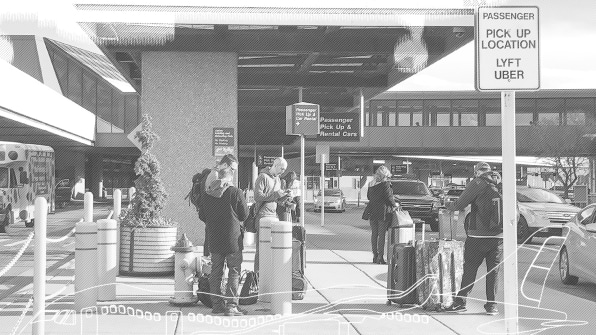
Right now, the link between ground transportation and air travel in both directions is hardly ideal. For evidence, see the curbside traffic snarls at the arrivals and departures lanes of any major airport. Or, see that many airports are still grappling with how to manage the rise of ride sharing, including where to stage waiting drivers and how to replace lost revenue from parking.

Fortunately, these struggles are not our future. Instead, the north star that AI could help create is essentially an orchestrated stroll to a waiting vehicle. To facilitate this stroll, AI would continuously learn how to manage thousands and thousands of travelers at any given time as interrelated moves on a game board. Upon arrival, you would move from the aircraft through the terminal to the curb just as an autonomous vehicle—which has already been loaded with your luggage—arrives to transfer you onward. That vehicle would likely be managed by the airport but branded by the airline, offering a true door-to-door experience within a single, all-transit-included fare. Alternately, autonomous luggage carts would seek you out in the terminal or at a connected public transportation hub, or even catch their own rides to your hotel or home.

What would be missing from these experiences? Baggage carousels. Parking lots. Cell-phone lots. Jammed curbs. In their place would be a far more robust connection between the airside and landside that eliminates a currently disjointed relationship between aircraft and ground transportation.

Unfortunately, there is an opportunity for abuse here, as well. If AI can be used to move passengers from one modality to the next by essentially managing everyone as moves on a gameboard, it could also alter the rules of the game for some passengers. AI’s capabilities for learning new moves could be used to create better experiences for some passengers and less optimal experiences for others. How could this happen? Consider that we are a species with a well-documented history of racism, sexism, ageism, and more. Those same biases could find their ways into the artificial intelligences we create and manage in either accidental or overt ways, ushering in a sort of invisibly governed discrimination. Members of one religion might enjoy favored status in one airport and feel decidedly less welcome as they maneuver another. Passengers might find themselves curiously sorted by race in airport-operated vehicles. People who conform to supposed gender norms in their appearance might be rewarded with faster throughput while others confound the system, creating delays that essentially operationalize everyday social ills like sexism and transphobia. Many people are already well-acquainted with these types of discrimination, of course. But one of air travel’s underlying benefits is its ability to make the world and all people more connected, so AI working against that value would be an especially troubling outcome.

Bringing some humanity—and decorum—back to gates and cabins

Technology might seem like an unlikely savior for the more human touchpoints of travel, and it’s certainly true that the future of air travel is not all ones and zeroes. There is simply no replacement for another human who is there to lead and help us in our journey. That said, humanity is arguably not at a high point in contemporary air travel. Bad behavior abounds, from cluelessness at security checkpoints and space-hogging at gates to bare feet, nail clipping, and other sins against common sense and decency inside cabins.

Part of the problem here is actually our human preference for avoiding conflict. All this bad behavior by a subset of flyers thrives largely because no one steps forward to correct it in the moment. Put more bluntly: We’ve proven that we are not up to the task of policing and preventing our worst selves from ruining the experience for everyone else.

But, while we generally default to being overly polite, AI won’t have to be programmed with any such compunctions. Instead, AI-powered robots at the airport and AI-powered in-flight entertainment systems—and, yes, the latter would put those disabled cameras in seat-back screens to work—could broker the intelligent sharing of resources (think: more cooperative approaches to bin space use) and discretely remind flyers of their responsibility for basic decorum.

This is very adventurous territory, of course, and one fraught with Orwellian anxieties. The concept of AI-powered robots policing humans is the stuff of dystopian science fiction. That said, consider that it’s already happening; AI-powered systems in China are at work now shaming jaywalkers in a bid to improve traffic safety. So, perhaps the question isn’t whether or not we want AI prompting us toward our better selves, but rather how we can design those AI-powered systems in ways that balance individual privacy and the collective good.

About the author

Devin is a futurist who works collaboratively with clients such as Boeing, Intel, JW Marriott, Nike, Starbucks, and Toyota to design preferred futures in aviation, automotive, smart cities, personal mobility, space travel, and more. Devin also leads TEAGUE’s future-focused conceptual projects .

Source : https://www.fastcompany.com/90333075/the-future-of-air-travel-ai-that-shames-you-into-being-a-better-passenger