Touchless tech: Airports and airlines take steady steps to restore confidence in flying

By Linda Fox | August 4, 2020

Every week an airline announces its take on safety and hygiene measures in a bid to get consumers flying again – government restrictions allowing.

For example, Lufthansa says it is linking tickets to COVID-19 tests, while Emirates will provide free insurance for virus-related medical and quarantine expenses incurred by passengers.

It’s hard to blame these badly hit businesses for introducing measures to try to instill confidence in consumers that flying is safe against the backdrop of $84 billion in losses, predicted by IATA this year, and ongoing conflicting advice from governments.

While many governments maintain they are following science, a recent cry from European airports and airlines to governments says the lack of consistency in implementing science-based approaches is “crippling Europe’s economies.”

They are calling for “harmonized implementation” of the Take-Off Aviation Health Protocols devised by the European Centre for Disease Prevention and Control, the European Union Aviation Safety Agency and the International Civil Aviation Organization.

In the meantime, IATA now expects full recovery to 2019 levels to be delayed until 2023 – a revision by one year from a previous estimate.

The reality is that it will take more than virus tests and the lifting of restrictions to entice customers back – meaning that technology has a huge role to play.

Last week, JetBlue announced an ultraviolet cleaning robot was being piloted on aircraft at New York’s John F. Kennedy International Airport and Florida’s Fort Lauderdale-Hollywood International Airport, as part of its health and hygiene measures.

This is just one in a series of new technologies and measures that consumers will have to become accustomed to as travel takes steps toward recovery.

Touchless (eventually seamless)

A recent report from Simpliflying, published in partnership with Elenium, highlights how touchless technology will come into play throughout the passenger journey.

It charts how technologies such as biometrics, screening and scanners for temperature and other vital signs, as well for touchless bag drop, will become the so-called new normal for air travel.

Many initiatives are already underway, with CLEAR offering fast-track screening through airport security lines using a combination of biometric data, temperature readings and COVID-19 testing from passengers, according to reports.

At Denver International Airport, biometric and identity management specialist Daon is piloting biometric solutions to passengers and employees, following a partnership between the two companies.

Other solutions are emerging that look to make the most of resources already available to cash-strapped airlines and airports.

A recent announcement between Amadeus and Norwegian airport operator Avinor paves the way for a touchless travel journey for passengers.

Avinor, which operates 44 airports, is trialling touchless technology that allows passengers to check in, drop bags, proceed through security and board their flight.

The journey starts with remote flight check-in and a boarding pass in barcode form sent to mobile devices.

The code also acts as a coupon to print bag tags via self-service kiosk at airports, enabling passengers to drop their luggage at self-service units.

Avinor already offered touchless boarding at airports, and these latest upgrades make more elements of the journey contact-free.

Brede Nielsen, chief information officer of Avinor, says the company has often held back from expensive IT investment, but this time wanted to do something “more edgy” and in a short space of time.

From discussions with Amadeus in mid-March to the trials starting with two airports in mid-July, Yannick Beunardeau, vice president of airport IT, EMEA, for Amadeus, describes the implementation as the quickest it has done for this sort of safety solution. 

He adds: “Lot of airports are talking to us about some other solutions, some even more complex, but from time to time the simplest is the most efficient.”

Nielsen says 17 of Avinor’s airports have the potential to implement the technology relatively quickly and adds that passenger acceptance is the only thing that might hold things back.

“We’ve launched something that we think is a good solution, but everything is about the customer experience. We’re a little bit tense about whether they will understand the new way to do things.”

One major positive for Avinor with deploying the technology is that it hasn’t meant huge investment.

Nielsen says: “We didn’t discuss big solutions such as face recognition. We talked about the equipment we have, what we can do with that and how we can change the process with what we have.”

This is sentiment being echoed across much of the industry.

Andrew O’Connor, vice president of airports and borders for SITA, says that while technology to improve the customer experience have been coming at a “certain pace,” there is renewed interest when it comes to low-touch technology.

He adds that it’s about layering new features and functionality on top of the common-use platform already employed at hundreds of airports.

O’Connor says a new features set called SITA Flex enables previous touch points to be driven by mobile devices relatively easily.

SITA, he says, has realized people are not going to invest new money in infrastructure and systems, whether biometric innovation or mobile-enabled solutions.

“We’re building on a foundation, the common-use footprint, that is already out there, and it’s relatively easy to add on these other enabling features.

Both O’Connor and Beunardeau see an acceleration of technologies that were already being trialled.

Beunardeau says: “We know that the new reality will be different, so we’re looking at what the near future will be, anticipating what the touchless travel solutions will be and developing a family of solutions concerning social distancing, hygiene, self-service, biometric technology.

“[The virus] has helped us to accelerate all that so now we’re ready for this new reality. It’s quite astonishing how a trauma like COVID-19 could accelerate things in this area.”

Stakeholders also agree that collaboration is critical.

O’Connor says: “Reaching a kind of nirvana state in the way these things work has relied upon more and more collaboration between airline, airport and government.

“This situation has probably driven a very good and deeper understanding of the whole ecosystem and how it works and how even individual government policies and decisions link together.” 

Certainly in the case of Avinor’s developments, there was a greater understanding from airport management, airlines and even national security organizations of what needed to be achieved, according to Nielsen.

And any new spirit of collaboration could be a catalyst to drive digital technology in aviation beyond what it has been able to do so far.

O’Connor sees the collaboration as an accelerator to that “ultimate vision” proposed by organizations including IATA with its OneID concept of using biometrics to move through airports seamlessly “without breaking stride.”

He concludes: “There’s the more tactical measures to get things moving, but I think there will be a standing back to think about how we set ourselves up for the future.”

source : https://www.phocuswire.com/airline-contactless-tech

Passengers can now text cleaning and safety questions directly to United Airlines

United Airlines launched a new chat function – the United Automated Assistant – to give customers a contactless option to receive immediate access to information about cleaning and safety procedures put in place due to COVID-19. Customers can text “Clean” to FLYUA (35982) and get answers to questions about masks, boarding procedures, touchless check-in options and more, without having to call, search online or wait in a line for an answer.

“The travel experience has changed a lot from just a few months ago – we’ve overhauled our safety and cleaning procedures and this new text functionality makes it easier for our customers to stay informed,” said Linda Jojo, Executive Vice President for Technology and Chief Digital Officer. “Whether you want to know the latest about our social distancing and face covering policies or see how the boarding and deplaning process has changed, our Automated Assistant is designed to meet the customer where they are and get them answers in a simple, fast and easy way.”

The airline is also taking steps to limit the overall number of people onboard and separate customers wherever possible. United switched to a larger plane 66 times a day in May and June, for a total of more than 4,000 flights during those months, creating more space onboard. As a result, the airline’s consolidated average seat factor – or the percentage of occupied seats including customers and non-revenue passengers – was 38% in May; 57% in June and is expected to be about 45% in July, with less than 15% of flights operating with more than 70% seats filled, it said.Several of the airline’s precautionary measures to further ensure a cleaner environment include:

At Check-In

  • Implementing temperature checks for every employee working at all stations throughout the airline’s system
  • Installing sneeze guards at check-in and gate podiums
  • Promoting social distancing with floor decals to help customers stand six feet apart
  • Becoming the first U.S. carrier to roll out touchless check-in capabilities for customers with bags

At the Gate

  • Disinfecting high-touch areas such as door handles, handrails, elevator buttons, telephones and computers
  • Providing hand sanitizer and disinfectant wipes
  • Rolling out Clorox Total 360 Electrostatic Sprayers in select markets to disinfect gate areas at United’s hub airports
  • Enabling customers to self-scan boarding passes
  • Boarding fewer customers at a time and, after pre-boarding, boarding from the back of the plane to the front
  • Introducing real-time seat assignment update text and email notifications to further United’s touchless airport experience

On Board

  • Using electrostatic spraying to disinfect 95%+ of aircraft
  • Disinfecting high-touch areas – such as tray tables and armrests – prior to boarding
  • Reducing contact between flight attendants and customers during snack and beverage service
  • Deplaning in groups of five rows at a time to reduce crowding

source : https://www.securitymagazine.com/articles/92965-passengers-can-now-text-cleaning-and-safety-questions-directly-to-united-airlines

UAE tops world countries in detecting COVID-19 with police dogs

Use of police dogs in UAE airports is now an additional defense line against COVID-19

Abu Dhabi: The UAE has realised a new achievement as part of its continuous efforts and preventive and precautionary measures it put in place to curb the spread of COVID-19 to ensure the safety of the community.

The new achievement comes after the successful practical use of police dogs all over the UAE airports as an additional defense line in detecting presumed COVID-19 cases. In this way, the UAE is considered the first country in the world to put this method into action which is still under study and training stage in other countries.

source : https://gulfnews.com/uae/health/video-uae-tops-world-countries-in-detecting-covid-19-with-police-dogs-1.1596134510615

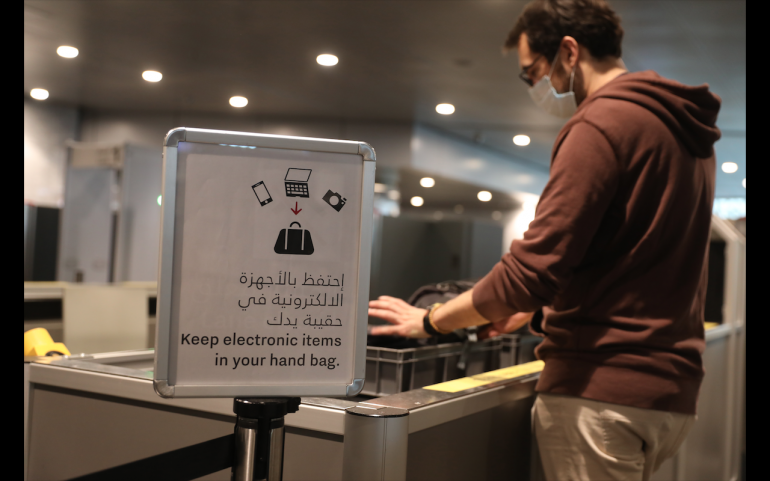
Qatar airport’s new technology allows passengers to keep electronic items in hand luggage during screening

The Peninsula

Doha: Hamad International Airport (HIA) has installed the latest security screening technology which is an advanced algorithm that enables security personnel to easily detect explosive materials held in complex items and structures. The technology also allows transfer passengers the freedom to keep electronic devices such as laptops, tablets, digital cameras, etc. in their hand luggage while going through security checkpoints improving levels of customer service and the need for further divestment that has also a hygiene benefit.

The new C2 technology will be initially implemented across all transfer screening checkpoints, upon the gradual reopening of transfer gates. It will significantly enhance airport security while speeding up the inspection process and boosting throughput. The application of this system will allow HIA to reach a higher and internationally recognized explosives detection system standard.

The ECAC C2 Detection standard can identify threat materials in congested bags, including electronic devices that had to be segregated from bags earlier. Once the bag is placed on the X-ray for screening, it can be collected without any further stops for re-screening or physical inspections. The system is also a significant counter COVID-19 measure, that reduces possible cross-contamination among passenger carry-on bags. The implementation of the technology will elevate the airport’s hygiene standards, by limiting human contact at the security checkpoints, making the process safer and faster for both staff and passengers.

Saeed Yousef Al-Sulaiti, Vice President – Security at Hamad International Airport said: “The security process at HIA is continuously improving through the introduction of cutting-edge technologies. Our goal is to make the travel journey safer, given the current COVID-19 pandemic. During these challenging times, our priority remains to protect passengers while preserving security. Through the implementation of C2 technology, we can accomplish a more efficient protocol that addresses all passenger concerns. Our passenger-centric strategy helps us continue our investments towards that front while developing solutions that are in the best interest of our people.”

Applying this latest technology will boost HIA’s passenger processing capacity while reducing queuing times at security points. This allows HIA to provide a smooth and hassle-free journey to all passengers and maintain its recognition as an airport that consistently meets the highest standards of safety and world-class security.

HIA is looking into the prospect of implementing body scanners, to provide better security outcomes while slowly easing all body search procedures. This potential technology will prove to be helpful in the COVID-19 climate as it helps reduce contact during body searches. Qatar’s international airport is also exploring the introduction of a combination of anti-bacterial trays at checkpoints and automated UV emitting modules that will automatically disinfect the trays passengers touch to further safeguard the health and safety of all HIA passengers.

HIA has recorded previous milestones in its industry-leading transfer security screening in 2019, witnessing shorter queuing times at security points which can accommodate up to 6,000 passengers during peak hours. The airport also introduced additional transfer halls that allow 95% of transfer passengers to queue for under five minutes. Qatar’s airport recently announced the successful completion of the second phase of its Smart Airport Program, offering a fast, secure and contactless airport experience by implementing biometric identification technology. The technology allows passengers to combine their flight, passport, and facial biometric information in a ‘single travel token’ at the self-check-in kiosk. This digital identity record ultimately makes the passenger’s face their pass at key airport touchpoints, such as self-service bag-drop, pre-immigration, e-Gate and the self-boarding gate. HIA’s visionary approach and early investment in the biometric identification technology proved to be an extremely efficient tool in HIA’s battle against COVID-19, allowing passengers to move through key touchpoints with minimal physical contact.

In its effort to safeguard its staff and passengers against COVID-19, the world’s third-best airport has introduced a series of unprecedented measures including its investment in robotics and advanced thermal screening helmets. HIA also acquired disinfectant robots, which are fully autonomous mobile devices emitting concentrated UV-C light, known to be effective in eliminating the majority of infectious microorganisms. The robots are being deployed in vulnerable high passenger flow areas across the terminal to reduce the spread of pathogens. The airport also implemented ultraviolet disinfection tunnels that will be used to disinfect all checked-in passenger luggage (departing, arriving and transferring).

source : https://www.thepeninsulaqatar.com/article/25/07/2020/Qatar-airport%E2%80%99s-new-technology-allows-passengers-to-keep-electronic-items-in-hand-luggage-during-screening

Frankfurt Airport Slowly Recovering from COVID-19

The number of passengers at Frankfurt’s airport has decreased by 79 per cent from July 20 to 26, compared to the same time period last year.

Airport operator Fraport has reported that a total of 321,746 passengers were registered at Frankfurt’s airport, from July 20 to July 26, while the number during the last year, on the same period, was 79.7 per cent higher, SchengenVisaInfo.com reports.

Still, compared to the previous week, there have been 14,000 passengers more in Germany’s largest airport, marking a slight increase in the number of passengers. Compared to the same period last year, there is an 80.5 per cent decrease.

During June, the number of passengers dropped nearly 91 per cent, compared to the same period a year earlier.

As for the flight movements, the number has shown a decrease by 66.1 per cent compared to the same period one year earlier, while freight and airmail volumes dropped 18.4 per cent to 33,272 tons after a decrease of 18.9 per cent the previous week from the previous year.

To prevent an increase in the number of Coronavirus cases, due to summer travel, Germany’s Health Ministry announced that the airport will offer free COVID-19 tests to returning travellers at all Germany’s airports.

The tests would initially be non-mandatory, and the state would cover the costs in all cases, Berlin’s Health Minister, Dilek Kalayci stressed regarding the issue.

Since July 2, the country opened its doors for residents of 11 third-countries, considered by the EU Council as “safe”.

The Coronavirus situation left many Schengen visa holders stranded in Germany, due to travel restrictions and other imposed bans. Still, Germany, earlier this month announced that will permit all stranded internationals to continue staying in the country until September 30.

On June 15, the German Federal Minister of Interior, Horst Seehofer lifted the majority of border checks at the internal borders, after asserting that the Coronavirus situation permits such a step to be taken.

Germany also had previously reported that the country has extended the travel warning for its citizens wishing to travel to third-countries, until August 31, as a preventive measure in the fight against COVID-19.

source : https://www.schengenvisainfo.com/news/frankfurt-airport-slowly-recovering-from-covid-19/

Airports and COVID19

Airports and COVID19 – Interview with SITA’s President for Asia Pacific, Sumesh Patel

SITA, which stands for Société Internationale de Télécommunications Aéronautiques, was founded in 1949 and plays an extremely important part in nearly every single person’s air travel experience. INTRO TO BE EXPANDED VERY SOON.