Global Airport Robots Market Growth, Trends, and Forecasts 2019-2024

Global Airport Robots Market Growth, Trends, and Forecasts 2019-2024: Focus on Valet Parking, Airport Security, Boarding Pass Scanning, Passenger Guidance, & Airport Baggage Handling Systems

DUBLIN, March 22, 2019 /PRNewswire/ — The “Airport Robots Market – Growth, Trends, and Forecast (2019 – 2024)” report has been added to ResearchAndMarkets.com’s offering.

The airport robots market is estimated to register a CAGR of over 15% during the forecast period, 2019-2024.

Various airports worldwide are making use of robots that are helping airport officials interact with passengers and provide them assistance at the airport. Moreover, airports across the world are engaged in conducting trials with robots, in terms of providing information, guidance, and entertainment solutions to passengers. Additionally, robots have also been introduced for cleaning, as well as security services. The increasing number of robots being used in airports worldwide is likely to drive the growth of the market in the near future.

The introduction of advanced technology robots to improve airport services is expected to lead to enhanced customer experience, in the years to come.

The increasing adoption of artificial intelligence, as well as chatbots, for handling airline bookings and queries is expected to provide growth opportunities for the market in the future.

Scope of the Report

Airport robots is a new-age concept that has been introduced in several airports, worldwide. In the coming years, robots are set to replace airport staff, in terms of airport operation handling. The integration of artificial intelligence within airports may lead to robots performing airport operations, such as airport cleaning, providing security services, baggage handling, and may also act as passenger guidance systems.

The market study includes the various applications of robots in valet parking, airport security, boarding pass scanning, passenger guidance, as well as airport baggage handling system.

Key Market Trends

Autonomous Robots are Helping the Airport Security Segment

Currently, the airport security segment has the highest share among all the segments. Airport security is one of the biggest concerns faced by airport officials, worldwide. The rise in terrorism worldwide has led to airport officials taking extra precaution and being highly focused toward airport security. In order to prevent any unwanted incidents, airports around the world have taken a step further and have started the testing of autonomous robots, which is expected to help security officials provide adequate security at the airport.

Airports, such as Hamad International Airport and La Guardia Airport, have started deploying security robots to provide the next level of airport security. The robots come equipped with an in-built facial recognition system, cameras, and sensors. They can measure pulse rate remotely, and thus, detect suspicious persons, credit cards, fake currencies, abandoned objects, and explosives, without disturbing the passenger flow at the airport terminal.

Developments in Airport Security in Asia-Pacific, Especially China

In the airport robots market, the growth of the Asia-Pacific region is expected to be more during the forecast period. China is one of the fastest-growing air travel markets. According to the IATA (International Air Transport Association), China is set to displace the United States as the world’s largest aviation market, by mid-2020. The rebalancing of China’s economy is likely to support strong passenger demand over the long term.

Moreover, since 2017, Shenzhen Bao’an Airport in China is engaged in operating Anbot, a robot programmed to carry out security checks at the departure hall of Terminal 3. Developed by Shenzhen Public Security Bureau and the Chinese National Defense University, the robot has been fitted with four high-definition cameras, as well as a facial recognition software, which can take pictures of passengers and send them for analysis at security stations. Such developments are expected to have a positive impact on the growth of the market.

Competitive Landscape

The airport robots market is consolidated, with only a handful of players controlling the market. LG Electronics Inc. and Stanley Robotics SAS are the leading players in the market. Both the companies have been occupying leading positions in the market for a long time. The companies have been engaged in various initiatives and product innovations, which have led them to strengthen their presence in the market.

For example, LG Electronics Ltd reported setting trial services for a number of airport guide robots, as well as airport cleaning robots, at the Incheon International Airport, South Korea.

source : https://www.prnewswire.com/news-releases/global-airport-robots-market-growth-trends-and-forecasts-2019-2024-focus-on-valet-parking-airport-security-boarding-pass-scanning-passenger-guidance–airport-baggage-handling-systems-300816947.html

Data and AI – Piloting Airports into the Future

Artificial Intelligence offers a new way to build an efficient and enjoyable airport operation

Sahadev Singh

Sahadev Singh Wipro

Airports are evolving from being a transport hub to becoming an experience hub, and the future is all about a seamless and personalized passenger experience. Airports are investing billions of dollars into large scale infrastructure projects, modernization of facilities and particularly in cutting edge technologies to deliver a personalized, seamless, secure and new age airport experience. The entire passenger journey from parking to check-in, security, immigration, retail, wayfinding, and boarding can be transformed with the help of technology. In addition, technology will be a key enabler in addressing capacity challenges and increased complexity of operations evident from the fact that more than 1.5 billion passengers passed through the 20 busiest airports in the world in 2017.

Airports are evolving from being a transport hub to becoming an experience hub, and the future is all about a seamless and personalized passenger experience. Airports are investing billions of dollars into large scale infrastructure projects, modernization of facilities and particularly in cutting edge technologies to deliver a personalized, seamless, secure and new age airport experience. The entire passenger journey from parking to check-in, security, immigration, retail, wayfinding, and boarding can be transformed with the help of technology. In addition, technology will be a key enabler in addressing capacity challenges and increased complexity of operations evident from the fact that more than 1.5 billion passengers passed through the 20 busiest airports in the world in 2017.

Getting smarter – the intelligent airport

Among the several new age technologies that have, potential to significantly transform the passenger experience and airport operations, Artificial Intelligence (AI) looks most promising. AI systems could be the invisible threads that connect multiple interaction points – delivering required assistance, insights, or functionalities where and when needed. AI systems could interact with passengers and staff, manage connected devices, and control intelligent machines. For instance, imagine an AI-powered robot equipped with biometric scanning helping you check into your flight in a language of your choice, collect your bags, conduct a security scan and hand you a smart boarding card that will guide you to your gate.

Needless to say, the potential gains from AI applications in airports are immense. Airports are already investing in AI for the following:

Personalized Passenger Communication

Personalized customer service is a major focus across industries, and airports are no exception. Airports are increasingly making themselves available to interact with passengers through multiple channels to ensure passengers have access to information anytime-anywhere. Also, airports are leveraging insights into the passenger’s journey and behavior coupled with AI to automate these interactions through chatbot, AI enabled website, mobile app and contact center, wayfinding, smart robots, Click and Collect and personalized retail promotions. This is evident from the fact that 42% of airports plan to adopt AI-driven chatbot services[ii].

Seamless Curb to Gate Experience

AI systems connected to smart devices can also enable a far superior user experience. The check-in to boarding process could be made more user-friendly, seamless and requiring minimal input from passengers. Some airports have already taken the next step with biometrics / facial recognition enabled check-in, security as well as boarding process like Hartsfield-Jackson Atlanta International Airport which recently announced the first fully biometric US airport terminal for Delta airlines[iii]. Many airports have adopted self-bag drop kiosks that automatically checks-in the bags and eGates / automated border control systems for passport checks, boarding, and immigration. Accuracy and efficiency of these smart systems can greatly be enhanced by leveraging AI and Machine Learning thus reducing the manual intervention required.

Resilient and Efficient Airport Operations

The complexity of airport operations increases greatly due to the ripple effects that each unplanned event can have. For example, when Hurricane Sandy hit the East Coast of the United States in 2012, more than 15,000 flights arriving in New York and other east coast airports were canceled[iv]. AI-based prediction and planning system can enable airport readiness to handle such events proactively.

While harsh weather can surely grind flight operations to halt, more than 90% of flight delays actually happen due to inefficiencies in the turnaround time (i.e. fueling, catering, cleaning etc.) in making an aircraft ready for flight[v]. AI, which is embedded in airport operations via connected devices and connected systems, can analyze real-time data and help with real-time decision making for operational incidents.

Also, several airports are piloting the use of AI and predictive analytics to improve airport resource management and assets maintenance. The benefits include improved allocation check-in, security, immigration support staff to optimize the passenger processing times and reduce delays and queues; effective and efficient utilization of airport resources like gates and check-in resources to maximize the capacity; and preventing impact to airport operations by reducing the breakdown of physical assets through predictive maintenance.

Boosting Airport Security

Security checkpoints are major pain points in a travelers’ journey – yet, they are essential to ensuring, safety of all personnel and passengers. The process of separately scanning every bag, removing articles of clothing such as shoes and belts, taking out items such as laptops for scanning, is a time consuming and inconvenient process. Introducing AI in security systems can help identify potential threats faster than a human operator could. If a significant number of people, bags, and cargo are automatically cleared, human intervention will be needed only for a few exceptional cases, reducing the overall time and effort involved. Some projects in this area are already underway. In 2018, the UK government invested in trialing of new AI-based security systems to boost security and alleviate wait times across some of the country’s busiest airports.

Unfortunately, even with the promise of significant benefits, today’s airports are nowhere near AI ready. One key reason why the uptake is slow is inertia – no one wants to disrupt operations and take on new costs with no precedent of ROI. Still, nascent steps have been taken, and we will only continue to witness a rise in AI adoption. The question is – are you ready to move to the next orbit?


Sahadev Singh is the Global head of Wipro’s Engineering and Construction services business. With over 25 years of experience in helping customers unlock value from their IT investments and drive business transformation strategies, Sahadev is a highly respected advisor to Wipro’s E&C industry customers and partners. Under Sahadev’s leadership, Wipro has built long terms strategic partnerships with leading global enterprises and established a proven track record for delivering predictable business value across a range of industry sectors. He has cultivated an extensive network within Wipro and its partners, and is able to leverage this network to meet client’s challenging needs. 

Facial recognition takes off at airports. Privacy experts want it grounded

A growing Customs and Border Protection program pits convenience and security against privacy.

In the not too distant future, you could walk into the international terminal of almost any US airport and board a plane without showing anyone your passport. 

At the check-in counter, you’d pose in front of a camera that scans your face and sends your image to a remote system that matches it to a stored copy of your passport photo. You’d have your photo taken again at the security line, and again at the gate. If everything still matched up, you’d be on board, quietly warring with your seat mate over the armrest.

Part of that automated future has already rolled out. The US Customs and Border Protection program, called Biometric Exit, includes a face-matching system and is used at departure gates in 17 airports in the US.

And that’s just the start. The agency plans to have the system scan 97 percent of all outbound international travelers by 2021. Airlines and the Transportation Security Agency also are testing facial recognition cameras throughout airports, meaning you might someday be able to travel without interacting with another human being at all.

“US Customs and Border Protection is changing the face of travel with its cloud-based facial biometric matching service,” the agency says in a pamphlet explaining the technology. “This matching service is envisioned to replace the need to manually check paper travel documents by providing an automated identity verification process everywhere a traveler shows their travel document across every step in the travel continuum.”

There may be no more dramatic example of the tension between convenience and privacy inherent in facial recognition than the prospect of giving up your identity to clear through security faster. That benefit, after all, comes at a cost. Academic research has shown that facial recognition algorithms have error rates that vary depending on a person’s race or gender, meaning some groups could face extra screening more often than others. The technology can be used without your knowledge. And the unalterable data that facial recognition systems collect — an image of your face — raises concerns that your movements can be tracked over the course of your life if the records are kept indefinitely.

CBP says facial recognition technology has the potential to make travel both more convenient and more secure because it creates a digital template that’s unique to you. Machines are getting faster at matching faces and, CBP says, do a better job than humans do.

But critics say CBP has already pushed — and possibly broken — the boundaries of the US law. One specific complaint: The technology has debuted in airports without being subject to a public comment period.

The potential for multiple government agencies to track you using facial recognition is real, says Jeramie Scott, senior counsel at the Electronic Privacy Information Center. In recently released documents his organization obtained, CBP noted that other government agencies with an interest in the photos of foreign nationals gathered at airports are Immigration and Customs Enforcement and the US Coast Guard.

“When you create the infrastructure for widespread use of facial recognition, people will find additional ways to use it,” Scott said.

CBP says the program isn’t intended for surveillance and was implemented in accordance with the law. US citizens can opt out, and the agency doesn’t keep their images long term.

How it works

The system is designed to be a snap: The airport or airline you’re flying with takes your picture at the gate, sending the encrypted image to CBP’s Traveler Verification Service system, which runs on a cloud server. There, CBP’s face-matching algorithm confirms that the person in the image is the same one that’s in your passport photo.

The system does this by creating a biometric template based on the passenger’s photograph. The template is a set of measurements of the size and shape of features, like eyes, and the distance between features, like your nose and upper lip. The system compares that template to a preloaded gallery of passenger photos, pulled from passports and other sources.

Facial recognition 101: Everything you need to know about face-matching tech

Airlines including JetBlue, British Airways and Delta, along with organizations that run airports in cities like Miami and San Jose, California, have already partnered with CBP to implement the system. The airlines or airports own the cameras and take passenger photos. In Atlanta, Delta Air Lines has introduced facial recognition checks throughout its international terminal in partnership with CBP and TSA.

CBP says it keeps photos of US citizens in the Traveler Verification Service system for 12 hours, and photos of noncitizens for 14 days. It also sends photos of noncitizens to the US Department of Homeland Security IDENT database, which stores information for 75 years on visitors to the US.

The airlines and airports aren’t allowed to keep copies of the photos and must immediately purge them from their systems, according to CBP. However, they’re allowed to use other photos they take with the same cameras for commercial purposes. That means they could take a second photo and use it in their own facial recognition system to target ads to you.

Airlines and airports are required to tell CBP if they plan to use photos for commercial purposes. So far, none has. JetBlue and Delta said separately that they don’t have plans to use facial recognition for commercial purposes, and added that their cameras capture images only when a passenger stands in front of the camera and actively triggers the scan. A spokeswoman for Mineta San Jose Airport says it only facilitates the CBP program and doesn’t have access to the photos.

Legal authority

The program has raised questions about its legality. The American Civil Liberties Union, the Electronic Privacy Information Center, the Electronic Frontier Foundation and other organizations say there’s no law that allows CBP to collect biometric information on US citizens, regardless of how long it’s stored. What’s more, they say, the agency’s choice to use facial recognition, rather than biometrics like fingerprints, is unnecessarily invasive.

CBP says a number of laws allow it to gather biometric information. For example, the law that established the Department of Homeland Security, CBP’s parent agency, gives it the authority to use technology to get all the data it needs for the biometric entry and exit program.

Congress first ordered the collection of biometric data from foreign nationals entering and exiting the country in 1996. It ordered the creation of a biometric entry-exit program in 2002 and authorized funds for it in 2016. However, privacy law experts point out that while some of the laws CBP cites apply specifically to noncitizens, none of them explicitly references situations involving citizens.

“US citizens have been conspicuously absent from the statutory text of every law under this program for the last 14 years,” according to a 2017 report by the Georgetown Law Center on Privacy & Technology.

If a US citizen opts out of the Biometric Exit program, the passenger can have his or her travel documents and passport checked by an airline employee, CBP says. If something doesn’t check out, the airline can ask a CBP officer for assistance.

Agencies like CBP typically go through a rule-making process to explain how new programs implement the underlying law and get feedback from the public. That hasn’t happened with the Biometric Exit program.

In a proposed rule, CBP wants to require US citizens to submit to facial recognition both at boarding and re-entry to the US.

Simply asking people whether they’re citizens before requiring them to submit to facial recognition would lead to people lying, CBP says. The agency says that biometric facial recognition is more accurate than humans checking passport photos against a person’s face, so it’s better at catching people traveling fraudulently with US passports. The system caught three imposters at Washington Dulles Airport in a period of 40 days, according to CBP.

Error rates

Academic studies have shown that some facial recognition algorithms are less accurate for some groups of people depending on their skin color and gender. One study found that commercial facial recognition products from companies like Amazon and Microsoft had higher error rates for black women. Others were more likely to give false negatives to white men, according to research from the National Institute of Standards and Technology.

A false negative — the algorithm incorrectly says your face doesn’t match your photo — has the potential to make travel more inconvenient for legitimate passengers. It would be unfair for some groups of people to face additional screening more often than others, advocates say.

“We’re talking about something that discriminates based off of what you look like,” said Mana Azarmi, policy council at the Center for Democracy and Technology.

Without oversight, it would be hard to know whether the system has higher error rates for some groups of people. CBP is working with NIST and the DHS Science and Technology Directorate to monitor problems, the agency says. CBP hasn’t revealed its false negative or other error rates, or how they affect different groups. CBP told Buzzfeed that it confirms 98.6 percent of passengers who go through the Biometric Exit system.

Face forward

Even if CBP had full legal authority to collect biometric information from all passengers before they leave the country, privacy advocates think facial recognition isn’t the right biometric to collect.

That’s because facial recognition can be conducted without targets realizing it. The technology doesn’t require physical contact, as fingerprints do, and it’s progressing so that low-quality photos taken from the side are sufficient to identify someone. Once people realize that facial recognition is unavoidable at airports, they may become discouraged from traveling and taking part in political activity, like the 2017 protests in US airports against travel bans, advocates say.

In a November report on the program, CBP said the system is preferable because passengers experience it as being less invasive than fingerprints.

But perception isn’t what matters, said Neema Singh Guliani, a senior legislative counsel at the ACLU.

“These are programs that have such an extreme effect on people’s rights,” she said, “and a process that’s not transparent.”

source : https://www.cnet.com/news/facial-recognition-takes-off-at-airports-privacy-experts-want-it-grounded/

Bots, A.I, wearables and VR to create billion-dollar savings in the tourism industry

The impact of disruptive technologies on the tourism industry is set to create multi-billion dollar savings through the use of IoT, robotics, artificial intelligence (A.I), Virtual Reality (VR) and wearable technology according to data published ahead of Arabian Travel Market (ATM) 2019, which takes place at Dubai World Trade Centre from 28 April – 1 May 2019.

The latest research from Colliers International, in partnership with ATM 2019, reveals that in addition to vast cost savings, the customer experience is set to be more streamlined with travel set to become better, smoother and more personalised with travel bookings on VR platforms, AI chatbots guiding customers through the booking process and IOT providing internet based inter-connectivity between everyday devices.

Danielle Curtis, Exhibition Director ME, Arabian Travel Market, said: “Technology, and the use of technology, is evolving every day. The tourism industry is at the very forefront of tech innovation with companies investing huge sums of money to improve the customer journey and experience.

“Airports and airlines accounted for US$30 billion of investment in IT in 2018, however this will be offset by the implementation of technology that will see fuel savings alone top US$30 billion in the next 15 years.

“We’ve seen incredible developments in recent years, SITA, the multinational tech company to the air transport industry for example, is using robots to check travelers onto flights and to transport their luggage, while, although in the infancy stage, robots have been used in some hotels to welcome guests and show them to their room.”

ATM 2019 has adopted cutting-edge technology and innovation as its main theme and this will be integrated across all show verticals and activities, including focused seminar sessions.

Running throughout the event, professionals from across the industry spectrum will discuss the ongoing unprecedented digital disruption, and the emergence of innovative technologies that will fundamentally alter the way in which the hospitality industry operates in the region.

Discussing the defining evolutions of hospitality technology, the Travel Tech Show will return to ATM 2019 with 45 dedicated international exhibitors and an influential agenda of discussion and debate in the Travel Tech Theatre – sponsored by Sabre Corporation.

Launching this year will be the inaugural Arabian Travel Week, an umbrella brand which comprises four co-located shows: ATM 2019; CONNECT Middle East, India and Africa – a new route development forum, ILTM Arabia and new consumer-led event – ATM Holiday Shopper.

Curtis said: “The success of both ATM and ILTM Arabia has provided us with the platform to not only introduce two new events for 2019 – but to create a travel week which encompasses the Middle East’s inbound and outbound markets for general leisure tourism and luxury travel as well as providing a dedicated networking forum, CONNECT  Middle East India & Africa 2019 for the region’s top airline specialists, aviation authorities, tourism boards, airports and tour operators.”

Another debutant this year is the Arabia China Tourism Forum at ATM which takes place on the Global Stage on Sunday 28th April. With China set to account for a quarter of international tourism by 2030, an expert panel will discuss how destinations around the world can capitalise on this growth. The forum will also include a 30-minute networking session with over 80 Chinese buyers.

Once again, we are delighted to be working with our partners UNWTO and welcoming back the UNWTO Ministers Summit which will also take place on the Global Stage on Sunday 28th April.

Other Global Stage highlights will include a focused seminar on Saudi Arabia’s tourism potential, the Global Halal Tourism Summit and the debut ATM Hotel Industry Summit which will host various expert panels to debate and provide an insight on the latest hotel developments and innovative digital infrastructure shaping the future of the hospitality sector.

Following a successful launch last year, the second edition of ATM Student Conference – ‘Career in Travel’ will return on the final day of ATM. This programme allows students and graduates to listen to a range of guest speakers and travel industry leaders. It will also help provide a greater understanding of the industry and potential career paths.

As well as the ultra-innovative Travel Tech Show at ATM, other features returning to the show repertoire this year include the Digital Influencers and Buyers’ Speed Networking Events which will feature 20 Chinese buyers for the first time, the ATM Best Stand Awards and the Travel Agents Academy.

ATM, considered by industry professionals as a barometer for the Middle East and North Africa tourism sector, welcomed over 39,000 people to its 2018 event, showcasing the largest exhibition in the history of the show, with hotels comprising 20% of the floor area.

For more information on Arabian Travel Market 2019, please log on to:  https://arabiantravelmarket.wtm.com/.

source : https://www.eturbonews.com/247867/bots-a-i-wearables-and-vr-to-create-billion-dollar-savings-in-the-tourism-industry

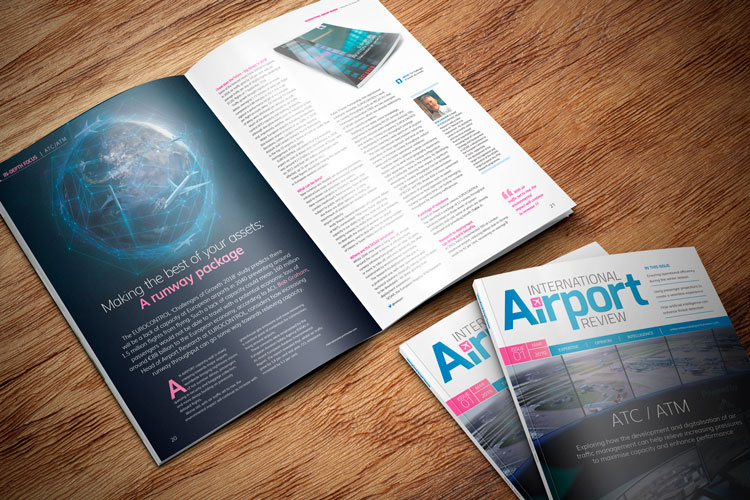
International Airport Review Issue 1 2019

In this issue: ensuring operational efficiency during the winter season, using passenger projections to create a seamless experience, and how AI can enhance threat detection.

IAR issue 1 2019 magazine

I am happy to be contacted by the following sponsors:NATS

Included in this edition:

  • LEADERS’ SERIES
    Collaboration in the global aviation system
    Karen Dee, Chief Executive, Airport Operators Association
  • INTELLIGENT PASSENGER FLOW MANAGEMENT
    A smarter way to cut the queues
    Eman Al-Hillawi and Matthew Garrett, Entec Si
  • WINTER OPERATIONS
    Keeping snowfall under control
    Lars Faurschou, Head of Airside Support, Copenhagen Airports A/S
  • SECURITY
    Reimagining security screening to relieve checkpoint pressures
    Nathalie Herbelles, Head of Security, ACI World
  • ATC/ATM
    Why ATM reform matters
    David McMillan, Chair, ATM Policy Institute
  • TERMINAL TECHNOLOGIES
    Information makes the airport go around
    Christian Poulsen, Vice President of Assets and Technology, Copenhagen Airports

source: https://www.internationalairportreview.com/article/81753/international-airport-review-issue-1-2019/?utm_source=Email+marketing&utm_medium=email&utm_campaign=IAR+-+Digital+Issue+%231+2019+-+Out+Now+-+13+Mar+2019&utm_term=Our+first+Issue+of+2019+is+available+to+download+now!&utm_content=http%3a%2f%2femails.internationalairportreview.com%2frussellpublishinglz%2f&gator_td=OBsKv6KrlmLqrMJ6wg2l2%2foIzWRs8P5NzyB0GdKoTxy6TdVuBdNPk6E4QWoH4RNr%2bSBiAcPXCeOUYgvLwoKKhL640cA8U14zKUxVNvGm7PZjJzIf7U6heWO6IItaQ5BfpeBRXKXe8J4WdSYxO2g7BUlTU6ZEYQ89I3eDsdXnoh41QzDkW8o1r0dlY9194JjN%2faa2n3%2bqI9k%2bt3ZRHHeF8VENe6GLtpbUNN%2f0gY%2bijxQ%3d

The digital traveler has arrived

Published on 14 March by Matthys Serfontein , President, Air Travel Solutions, SITA

Technology is central to the future of the air transport industry. So it’s very encouraging to see that travelers are actively adopting new technologies to put them more in control of their journey and time spent at the airport.

There are many ways that technology can now contribute to a smoother, more personalized passenger journey – from pre-travel arrangements to self-bag drop. But to me, one thing is clear from the newly launched SITA Passenger IT Insights 2019. The research shows that across the world, there’s a difference in the types of technologies being adopted, and that this is down to differences in services offered by airlines and airports, or regulatory issues, as opposed to passenger reluctance to engage with tech.

Passengers are happy interacting with technology

This year’s SITA Passenger IT Insights results show that technology is undoubtedly giving passengers more control over their journey, as well as providing them with more up-to-date information, improving efficiencies and taking them a step closer to the seamless passenger journey.

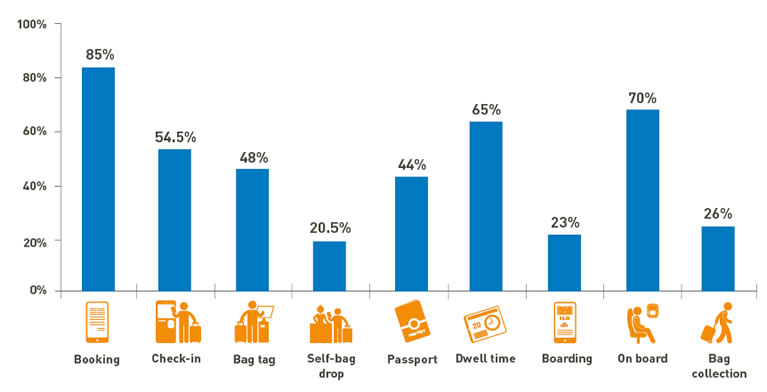
Technology use remains high at the pre-travel stage, which includes booking and check-in. The level of use by passengers is now at 85% and 54.5% respectively, as passengers are likely to find them easy to complete online. Some technologies have plateaued slightly – a good example being self bag-drop at 20.5% usage. Yet this is largely due to the lack of availability of this technology at airports, and not the passenger’s appetite for using it. Currently, there is, of course, a lack of self bag-drop availability in many airports across the globe.

Where technologies have been made available, passengers have been quick to use them. Take automated e-gates and passport control. Usage has more than doubled from 21% in 2017 to 44% now. This shows that if the technology is there, digital travelers across generations are confident in using it.

Percentage of passengers using technology in 2018

2019 Passenger IT Insights © SITA 2019

Always connected is always important

It’s hardly surprising that digital travelers prioritize connectivity. They typically consume a mix of free and paid services at dwell time. Wi-Fi is the most popular complimentary service with 55% of passengers taking advantage of the free connectivity available during their dwell time. A small proportion of passengers also pay for Wi-Fi connectivity access: some 7% spend $25 on connectivity and 1% are prepared to spend over $100. This equates to $10 billion worldwide annually.

SITA’s Passenger IT Insights research also shows that tech-enabled passengers are almost one and a half times more likely to consume paid-for services at the airport than non-tech users. What this says to me is that clearly this offers the industry the potential of an additional non-aeronautical revenue stream.

Technology makes for more satisfied passengers

One of the highlights I took from this year’s survey is that passengers feel more satisfied when they’re using technology. Many digital travelers are now so comfortable with technology that they choose to use it rather than interacting with people, such as by opting for automated check-in.

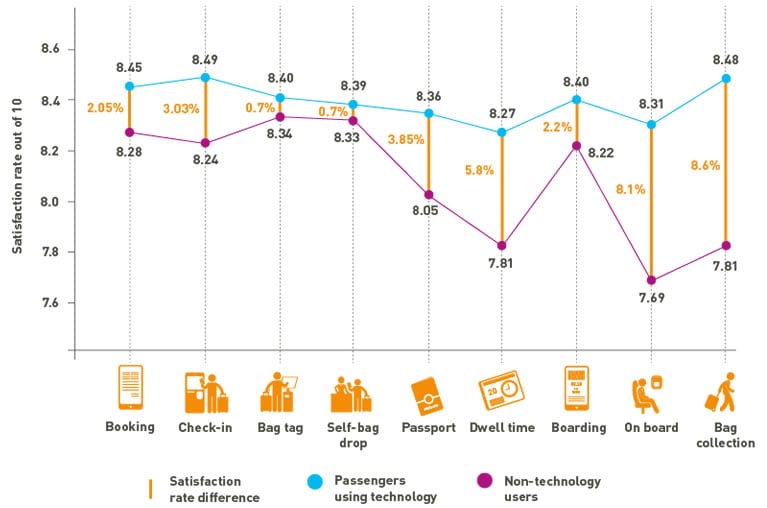
I’m especially interested to see that the contrast in satisfaction rate between tech-enabled digital travelers, and those using traditional face-to-face mechanisms, is significant during key travel steps. For passport control, the satisfaction rate is higher by 3.85%. During dwell time it’s +5.8%, and when collecting luggage at the carousel, it’s +8.6%. Technology usage and connectivity actively contribute to a positive passenger experience.

Passengers experience the most negative emotions (such as stress and anxiety) during security screening, passport control and baggage collection. We’ve already noted that passengers are happy using automated e-gates and passport control, which is helping to alleviate some of this stress. Baggage collection is also benefiting from the positive effect of technology. When passengers use services such as real-time baggage notifications their satisfaction is 8.6 % higher.

With passenger rates set to almost double to nearly 8 billion by 2036, airlines and airports are looking at improving customer satisfaction to enhance the customer experience and grow customer loyalty. In my opinion, technology is proving to be an effective tool in growing customer satisfaction and fueling the long-term growth of their businesses.

2018 passenger satisfaction rate

2019 Passenger IT Insights © SITA 2019

The future is digital

… and we must meet the digital traveler’s expectations


SITA’s Passenger IT Insights highlights the fact that once passengers are converted from person-to-person interactions to an automated experience along the touch-points in their journey, then there’s no going back.

My final observation is this. The technology for digital travel is ever more available, which will be clearly evident in the displays at this year’s Passenger Terminal Expo. We’ll see a bright spotlight on technology that impact the passenger experience across the journey. The challenge now is for airlines and airports to more rapidly deploy the technologies passengers are demanding to fulfill their digital travel expectations.

For more

Please visit SITA at stand #5010 at The Passenger Terminal Expo 2019 and take the opportunity to meet with our solution experts.

source: https://www.sita.aero/resources/blog/the-digital-traveler-has-arrived?utm_source=social&utm_medium=linkedin&utm_theme=pte-2019&utm_type=campaign&hootPostID=28ed80ecdbc0ef7b84357292a4d7f983

Oslo Airport Is the First Major Airport to Fully Digitize Parking

As of March 8th, 2019, Autopay Manages All 23,000 Parking Spots at Oslo Airport. Autopay Replaces the Existing Barriers and Ticket Spitters with a State of the Art ANPR Solution.

Autopay is a complete ANPR based parking revenue management system developed by 2Park. The Autopay solution is live in 8 countries and over 100 locations, handling 40+ million parking sessions per year and generating over 100 million USD in parking revenue.

The launch of Autopay at Oslo Airport has been the result of close cooperation between the parking operator ONEPARK, the system architects 2Park and Avinor who runs the airport

Before the launch, Autopay went through a year-long testing period on the Oslo Airport forecourt which functions as a drop-off area for passengers. Autopay was used to enforce a time limit that cars were allowed to spend in this area. Through this solution, Autopay was able to reduce abuse by 50% resulting in zero congestion and increased revenues for Avinor.

Per Rune Lunderby, Avinor Commercial Director said “With this solution, it will be even easier to park at Oslo Airport, since the new system automatically detects all cars entering the parking areas. We have already tested the solution on the Airport forecourt.

2Park has worked closely with Avinor to understand the challenges that are unique for airport parking. This has resulted in integrations, adjustments and new developments across the platform. Booking integration allows Avinor to continue using its existing booking platform with Autopay and the integration with the personnel system streamlines the authentication and distribution of parking permits to six thousand airport staff across more than 200 different companies.

Digitizing parking at airports makes the experience for the end user completely frictionless. Now that Oslo Airport has cleared Autopay for takeoff we will continue to innovate and create opportunities for Oslo Airport and continue improving the customer journey,” said Erik Elmsäter, 2Park CEO.

About 2Park 

Company logo, 2Park

2PARK Technologies (2PARK) is a Norwegian company developing innovative, customer friendly and future safe solutions for the parking industry. The new AUTOPAY concept with leading-edge ANPR technology is currently installed in 7 countries and expanding.

source : http://www.parking-net.com/parking-news/2park-technologies/oslo-airport-is-the-first-major-airport-to-fully-digitize-parking

Jewel Changi Airport

Jewel is an iconic mixed-use complex to be built at Singapore Changi Airport. It is a joint development project of Changi Airport Group and CaptaMalls Asia. The signature lifestyle destination will offer aviation and travel-related facilities, a wide range of retail offerings, as well as unique leisure attractions, including a large-scale, lush indoor garden.

Automated robotic parking launched at Lyon-Saint Exupéry Airport

Developed in partnership with Aéroports de Lyon, Stanley Robotics has completed the full deployment of its autonomous robotic valet system in the P5+ outdoor parking lot at Lyon-Saint Exupéry Airport, France.

The setup includes four autonomous robots and 12 cabins for vehicle drop-off and collection. As the vehicles are deposited within a few centimeters of one another, the innovative system will enable more than 500 vehicles to be parked in P5+, a potential space saving of up to 50%.

Lyon Airport began trialling the autonomous parking system last year before deciding to scale up operations and now making the service available to the public.

Aéroports de Lyon plans to continue the development and further increase the capacity of the parking lot to eventually reach 6000 spaces in total.

To use the service, passengers simply book a parking space on the Lyon Airport website and drop-off their vehicle in the allocated cabin. They then reach the terminals via the shuttle located in the immediate vicinity. The valet robot collects the car and parks it in the secure parking lot. Upon returning from a trip the passenger recovers their available vehicle in one of the cabins.

Nicolas Notebaert, CEO of Vinci Concessions and chairman of Vinci Airports, the airport owner, said, “In an increasingly open world, mobility is increasing. For us, this represents a daily challenge: to serve more and more passengers without compromising on the quality of their experience and with a sense of sustainability.

“To solve this equation, we use the potential of new technologies to improve fluidity and quality across our network. With this new initiative, we are confirming our commitment to continue shaping the mobility of the future.”

Tanguy Bertolus, CEO of Aéroports de Lyon, said, “Thanks to our innovative approach, Aéroports de Lyon has always been one step ahead in terms of customer experience and service quality. In 2018, Lyon-Saint Exupéry airport thus became the leading French airport in terms of customer satisfaction (European ASQ survey). The experimentation of the valet robot is completely in line with this logic of innovation to meet the continuous improvement requirements of Aéroports de Lyon and Vinci Airports.”

Clément Boussard, CEO of Stanley Robotics, said, “We are proud to be leading this operation with Aéroports de Lyon, and to be able to present to the world, for the first time, the operation of Stanley Robotics’ outdoor valet robot service. We have designed the service to be the simplest and most enjoyable experience for the users.”

Stanley Robotics will be exhibiting at Passenger Terminal Expo, on March 26, 27 and 28, 2019, in London. Click here to see just some of the new products on show. Meanwhile Christophe Girard, head of customer relationships, Aéroports de Lyon, will present ‘Lyon Airport robotic parking: one year of operational experience’ at the Passenger Terminal Conference. Register here for your delegate pass.

source : https://www.passengerterminaltoday.com/news/parking/automated-robotic-parking-launched-at-lyon-saint-exupery-airport.html

Rotterdam The Hague Airport future-proofing baggage handling with autonomous vehicle technology

Vanderlande’s baggage logistics solution FLEET has completed a three-month readiness test in live conditions, following a joint innovation programme involving Rotterdam The Hague Airport and ground handler Aviapartner. Report by Ross Falconer

In line with its progressive approach, Rotterdam The Hague Airport (RTHA) has collaborated with Vanderlande to improve the baggage handling process at the airport, through the use of intelligent automated vehicle technology. In November 2018, Vanderlande’s baggage logistics solution FLEET began a three-month readiness test period in live operations at RTHA, with the joint innovation programme also involving ground handler Aviapartner.

Vanderlande’s baggage logistics solution FLEET has completed a three-month readiness test in live conditions, following a joint innovation programme involving Rotterdam The Hague Airport and ground handler Aviapartner.

During the three-month readiness period, FLEET was continuously tested in an operational environment. This meant Vanderlande could see how handlers interacted with the FLEET system, and how human factors play a role in the use of FLEET. The company also looked at how the operation with FLEET fitted in with the current processes of the handler and airport, how those processes had to be adjusted for FLEET, and how overall operations were improved with FLEET being implemented.

“The agreement and subsequent trial represents an important milestone for Vanderlande, as it proved the reliability of FLEET in a live environment,” says Andrew Manship, Executive Vice President Airports and Member of the Board, Vanderlande. “It also contributed to our main goal, which is to make this solution an essential part of the daily activities at an airport.”

Indeed, FLEET will continue to be a part of the live operations at RTHA in the future.

“We are excited about the possibilities that lie ahead,” comments Ron Louwerse, Director, Rotterdam The Hague Airport. “By having FLEET commence live operations, we are taking a major step forward and are confident of realising a number of operational benefits. This will help contribute to RTHA’s sustainability ambitions in terms of energy usage and will also align with our vision to be more than just an airport, but also a hub for innovation and education.”

FLEET is a scalable and flexible solution designed to match airports’ growth needs. It also aims to guarantee operational certainty – if a vehicle fails to operate, others can manoeuvre around it, meaning only one bag is affected.

Meanwhile, sustainability is at the heart of the innovation programme. FLEET is said to use 50% less energy than traditional systems. “In a traditional system, conveyors and sorters remain in operation even with a minimal number of bags,” Esther Kersten, Director Strategy and Sustainability, explains. “With FLEET, a vehicle only moves when a bag must be transported from check-in to the desired output location. Smart software calculates the most efficient routes, reducing the total distance travelled per bag.”

The vehicles store energy inside their batteries, while smart software determines the most optimal charging strategy. This means the energy consumption from the power infrastructure can be optimised. A reduction in peak energy consumption reduces the required power infrastructure of the airport, as well as the infrastructure of the surrounding power grid.

In addition, the energy for the vehicles is generated by solar panels, in order to contribute to an emission-free baggage handling solution for RTHA. Meanwhile, the vehicles are designed to be easily recycled as part of a circular economy.

“From many conversations with airports and thorough analysis of current business cases, we are convinced that the scalability and resilience of FLEET will also bring high value to larger airports. Soon, the first FLEET system in the USA will be operational and there is interest from various other, larger, airports,” Manship concludes.

source : http://www.airport-business.com/2019/03/rotterdam-hague-airport-future-proofing-baggage-handling-autonomous-vehicle-technology/