Dublin Airport to participate in first of its kind biometrics trial

Dublin Airport is taking part in a trial that uses biometrics to help passengers seamlessly travel between Ireland and Bristol Airport.

Dublin Airport to participate in first of it's kind biometrics trial

The trial is thought to be the first biometric trial that enables passengers to use the same biometric system at their departure and arrival airports and with their airline.

The public trial, which passengers can opt for voluntarily, will start in Dublin in April 2019, and uses technology developed by the U.S. company Collins Aerospace, whereby a single sign up identification process streamlines the passenger’s outbound and return journey. 

A passenger who opts into the SelfPass process will have the biometric data from their passport securely stored which will help speed up the passenger journey. The biometric information is used at self-service check-in and is linked to their boarding card and their self-drop bag tag. Using facial recognition technology, their image is checked at the boarding gate and is automatically cross referenced with the boarding card information, which means they don’t have to present any documents at the gate.

Frances O’Brien, Vice President of PMO for daa, said: “We are really pleased to be an early adopter of this new technology designed to further enhance the experience for both our passengers and our airline customers at Dublin Airport. We are delighted with the early progress of the trial in testing so far and we look forward to extending the technology to a wider audience, including passengers travelling to the U.S. in the coming months.”

Christopher Forrest, Vice President of Global Airport Systems for Collins Aerospace, commented: “Dublin and Bristol airports are changing the way passengers travel and making the process easier and more efficient. For example, it takes less than one second to capture and process a passenger’s facial image and eliminates the need to repeatedly present travel documents. We see this as another major leap forward for our biometric technology to play a key role in making the connected aviation ecosystem a reality.”

In 2019, Dublin Airport welcomed 31.5 million passengers, which was a six per cent increase on the previous 12 months. Passenger numbers are up nine per cent in the first two months of 2019, as more than four million passengers have used the airport in January and February alone.

Dublin Airport has flights to almost 200 destinations in 43 countries, operated by 56 airlines and is the 11th busiest airport in the European Union. It is one of Ireland’s key economic assets, as it generates or facilitates 117,300 jobs and €8.3 billion worth of economic activity.

source :https://www.internationalairportreview.com/news/83724/dublin-biometrics-trail/

Airport biometrics trials expand on three continents Mar 27, 2019 | Chris Burt

SITA Smart Path has been deployed for a trial of using facial recognition instead of a boarding pass for security processing at Athens International Airport, the company announced. The airport, Greece’s largest, is the first in Europe to use biometric identity at security, according to the announcement.

“Passengers really appreciate the ease of using SITA’s Smart Path trial,” says Alexandros Ziomas, acting director of Athens International Airport’s IT&T Business Unit. “It has reduced the time taken to check in and verify passenger identity at security to only a few seconds. It will solve a key challenge for us by ensuring a steady flow of passengers to the security area. This is a service we would like to extend to other steps in the journey over time.”

The biometric service is being offered to Aegean Airlines passengers, and because Smart Path can be tailored to specific airport or airline requirements, could also be extended to other airlines operating out of Athens in the future.

“As most airports around the world already have self-service infrastructure in place, installing Smart Path is cost-effective and easy to implement,” comments SITA President for Europe Sergio Colella. “Yet, the improvement to security and the passenger experience is tremendously positive. It explains the growing interest in this solution from both airlines and airports in Europe and around the world.”

Palm vein biometrics deployed to 14 Korean airports

The Korea Airports Corporation has deployed Fujitsu’s biometric palm vein authentication system to all 14 domestic airports under its jurisdiction. The system began operation on December 28, 2018, and has been used more than a million times by 160,000 individuals with registered palm vein patterns.

Passenger identity is confirmed with biometrics instead of the citizen ID card which was previously required. The automated process both improves the accuracy of identification and significantly shortens the time taken for the process, according to the announcement.

Facial recognition-powered customer service kiosks reach Chinese airports

Chinese technology expert Matthew Brennan has filmed a kiosk as it identified him with facial biometrics, provided flight plan information, and offered him directions to his gate, Fast Company reports.

Fast Company suggests that the system represents a warning about the potential of facial recognition and collection of personal data for abuse, and says the Chinese government can clearly identify citizens anywhere with the technology.

Panasonic recently demonstrated similar technology as part of its One ID biometric airport solution.

JFK facial recognition trial to expand

The facial recognition technology deployed to a boarding gate at JFK’s terminal 5 for JetBlue passengers in partnership with U.S. Customs and Border Protection (CBP) is reducing the amount of time necessary for passengers to move through the airport while increasing security, according to Collins Aerospace VP of Global Airport Systems Christopher Forrest.

The trial was launched in November, and may soon be expanded to include either self-service baggage drop or an end-to-end system powered by facial biometrics, based on previous comments by Forrest.

Collins Aerospace says in the trial announcement that its SelfPass system is uniquely scalable and hardware-independent, enabling airports and airlines to add biometric capabilities to various touchpoints.

“The innovative use of biometrics for customer processing is driving the aviation industry forward and aligns with IATA’s One ID concept,” said Ian Deason, senior vice president of customer experience for JetBlue. “By working together with Collins Aerospace, we’re bringing JetBlue customers a personal, helpful and simple experience each time they fly.”

SelfPass trials at Bristol and Dublin airports

Collins Aerospace also announced today that its SelfPass airport biometric solution is now being trialed at Bristol Airport and Dublin Airport, enabling passengers to use a single biometric enrollment in multiple countries.

Bristol Airport offers passengers multiple biometric checkpoints, making the process easy from check-in to boarding. When SelfPass rolls out in Dublin next month, passengers will be the first to be able to take advantage of the multi-country solution.

“Dublin and Bristol Airports are changing the way passengers travel and making the process easier and more efficient,” explains Forrest. “For example, it takes less than one second to capture and process a passenger’s facial image and eliminates the need to repeatedly present travel documents. We see this as another leap forward for our biometric technology to play a key role in making the connected aviation ecosystem a reality.”

At Bristol, the new trial will biometrically enable multiple touchpoints, including: check-in, self-bag drop, security and boarding gates and the initial trial will be extended to include website and mobile enrollment, and lounge access.

“The passenger growth at Bristol Airport is increasing, and we are looking at using technology like the Collins Aerospace biometric solution set to help make our airport a high-quality experience for our customers,” said Graeme Gamble, chief operating officer for Bristol Airport. “The cooperation of Collins and the Bristol Airport team is making Bristol a leader in Airport innovation and customer service.”

“We are really pleased to be an early adopter of this new technology designed to further enhance the experience for both our passengers and our airline customers at Dublin Airport,” added Frances O’Brien, vice president of PMO for daa. “We are delighted with the progress of the trial so far and look forward to extending the offering to a wider audience, including those travelling to the U.S. in the coming months.”

Early results of LAX trial

The facial recognition system from Gemalto deployed for a trial of American Airlines passengers’ CBP checks at Los Angeles Airport has been largely successful through its first 90 days, airport-technology.com reports.

Gemalto VP of Mobile Financial Solutions Amol Deshmukh says the exceptions to the trial’s success involve specific cases such as toddlers, who may not match even relatively recent passport images.

In a recent Department of Homeland Services biometric testing rally, Gemalto’s system successfully acquired images in less than five seconds for 99 percent of subjects, compared to an average of 65 percent, according to the report.

source : https://www.biometricupdate.com/201903/airport-biometrics-trials-expand-on-three-continents

Dublin Airport participates in biometrics trial

Dublin Airport is taking part in a trial that uses biometrics to help passengers seamlessly travel between two airports.

The trial, which is being undertaken by Dublin Airport, Bristol Airport and an airline partner, is thought to be the first biometric trial that enables passengers to use the same biometric system at their departure and arrival airports, and with their airline.

The public trial, which passengers can opt for voluntarily, will start in Dublin next month and uses technology developed by US company Collins Aerospace, whereby a single sign-up identification process streamlines the passenger’s outbound and return journey.

A passenger who opts into the SelfPass process will have the biometric data from their passport securely stored, which will help speed up the passenger journey. The biometric information is used at self-service check-in and is linked to their boarding card and their self-drop bag tag. Using facial recognition technology, their image is checked at the boarding gate and is cross-referenced with the boarding card information automatically, which means they don’t have to present any documents at the gate.

Frances O’Brien, vice president of PMO for Dublin Airport, said, “We are really pleased to be an early adopter of this new technology designed to further enhance the experience for both our passengers and our airline customers at Dublin Airport.

“We are delighted with the early progress of the trial in testing so far and we look forward to extending the technology to a wider audience, including passengers traveling to the USA in the coming months.”

Christopher Forrest, vice president of global airport systems for Collins Aerospace, added, “Dublin and Bristol airports are changing the way passengers travel and making the process easier and more efficient.

“For example, it takes less than one second to capture and process a passenger’s facial image and eliminates the need to repeatedly present travel documents. We see this as another major leap forward for our biometric technology to play a key role in making the connected aviation ecosystem a reality.”

source : https://www.passengerterminaltoday.com/news/airport/dublin-airport-participates-in-biometrics-trial.html

Hamad International Airport Ranked Fourth Best Airport in the World

Hamad International Airport Ranked Fourth Best Airport in the World by Skytrax World Airport Awards 2019 Advancing From Last Year’s Ranking.

DOHA, Qatar, March 27, 2019 /PRNewswire/ — Hamad International Airport has been ranked as the fourth best airport in the world at the SKYTRAX World Airport Awards 2019, which took place during the Passenger Terminal Expo 2019 in London, United Kingdom. HIA has also once again been ranked as a five-star Airport and was honoured with the title of ‘Best Airport in the Middle East’ for the fifth year in a row and ‘Best Staff Service in the Middle East’ for the fourth year in a row.

The awards recognize HIA’s innovative facilities, five-star customer service and state-of-the-art terminal which accommodates more than 30 million passengers annually. The 2019 World Airport Awards by Skytrax are based on nominations from millions of passengers across more than 500 participating airports worldwide, making them one of largest passenger interaction survey awards in the world.

Commenting on the results of the Skytrax World Airport Awards, Engr. Badr Mohammed Al Meer, Chief Operating Officer at Hamad International Airport, stated: “We are delighted with our progress and ranking at this year’s Skytrax Awards as we successfully moved up in our ranking to ‘Fourth Best Airport in the World’ while maintaining our five-star status and our titles as ‘Best Airport in the Middle East’ for the fifth consecutive year and ‘Best Staff Service in the Middle East’ for the fourth consecutive year. We are committed to raising the bar when it comes to the airport experience and will continue to invest in our facilities, services and technologies that distinguish us as the airport of choice for millions of passengers around the world.”

“Skytrax holds a very special place for all us at HIA, because it’s a platform for our passengers and travellers to share their view on their experiences with us. We are truly honoured and humbled by the support and loyalty of our customers and are motivated more than ever to continue to deliver excellence and meet the needs of our passengers and community at large,” Al Meer added.

The Skytrax survey evaluates customer satisfaction across 39 key performance indicators for airport service and product – from check-in, arrivals, transfers, shopping, security and immigration, through to departure at the gate.

HIA, the gateway to Qatar and to the World.

Positioned at the edge of the Arabian Gulf, Hamad International Airport’s tranquil waterside setting provides a perfect backdrop for its stylish architectural elements, underpinned by advanced airport systems in line with its ‘Smart Airport’ vision. Operating 24/7, the airport features two runways, a state-of-the-art air traffic control tower and currently processes 30 million passengers per year and 360,000 aircraft per year. With over 40,000 square meters of combined retail, food and beverage facilities, unmatched spa facilities and a collection of unique art pieces from internationally acclaimed artists, HIA is a destination on its own, designed for the modern traveler. 

source : https://www.prnewswire.com/news-releases/hamad-international-airport-ranked-fourth-best-airport-in-the-world-by-skytrax-world-airport-awards-2019-advancing-from-last-years-ranking-300819843.html

Veovo Launches Next-generation Revenue Management Platform to Deliver Better Financial Outcomes for Airports

R8 Revenue Management unifies automation, predictive insight and charge flexibility to help airports accelerate time-to-revenue realisation, improve cash flow visibility and maximise growth opportunities.

(London, 27. March 2019) – Veovo, the leading supplier of airport management, guest predictability and revenue maximisation solutions, today unveiled the Veovo R8 Revenue Management System – its next-generation aero and non-aero billing platform – at PTE 2019.

With significant enhancements to processing speed, automation, charge management and user experience, R8 Revenue Management helps airports accelerate time to invoice, improve revenue forecasting, win new carriers and expand routes.

“As airports face a new era of capacity constraints, they urgently need to find ways to reduce revenue leakage and create new sources of revenue to fund future infrastructure development,” said Chris Warrington, VP Veovo. “R8 Revenue Management has been designed to tackle these challenges head-on and is the industry’s only platform that provides bill-ready aero transactions, real-time revenue recognition, and unparalleled charge flexibility.”

The largest airport source of income is aeronautical charges levied per flight, calculated on factors such as landing weight, time of day, passenger numbers, and resources like baggage belts, gates and buses. However, the complexity of airport operations and the disconnect between revenue and operational systems can delay billing data availability and slow revenue realisation.

R8 Revenue Management addresses this by:

Accelerating time-to-revenue generation through end-to-end automated processing: Bill-ready aero transactions and intelligent exception handling slashes time to invoice.

Smoothing cash flow with real-time revenue recognition:

In-line analytics gives financial managers a real-time view of the economic impact of operations, with insight into aero and non-aero accrued revenue.

Winning new carriers and improving throughput with any charge, discount and billing criteria:

Airports can create the differentiated tariff structures they need to expand routes, promote off-peak slot uptake or encourage faster aircraft turnarounds.  

R8 Revenue Management is a key module of Veovo’s Predictive Collaboration Platform which connects, automates and optimises processes against real-time events across the airport. By generating a role-specific and business-orientated answer to challenges, Veovo helps airports plan, predict and perfect operations, and improve financial and guest experience outcomes.

Over 70 airports worldwide benefit from Veovo’s Revenue Management software, including Dublin, Melbourne, Hong Kong International and the UK’s AGS Group. The new R8 version is currently being rolled out to several airports including Belfast International and a Tier 1 US airport.

Veovo is demonstrating the new R8 Revenue Management software and its other operations, guest predictability and concessionaire management systems, at booth 2075 at Passenger Terminal Expo 2019 in London, from 26 to 28 March.

source :http:// www.veovo.com.

Passenger satisfaction at baggage collection jumps to a new high with mobile notifications

Location: London

25 March 2019

Updates at arrivals are an added benefit of baggage tracking

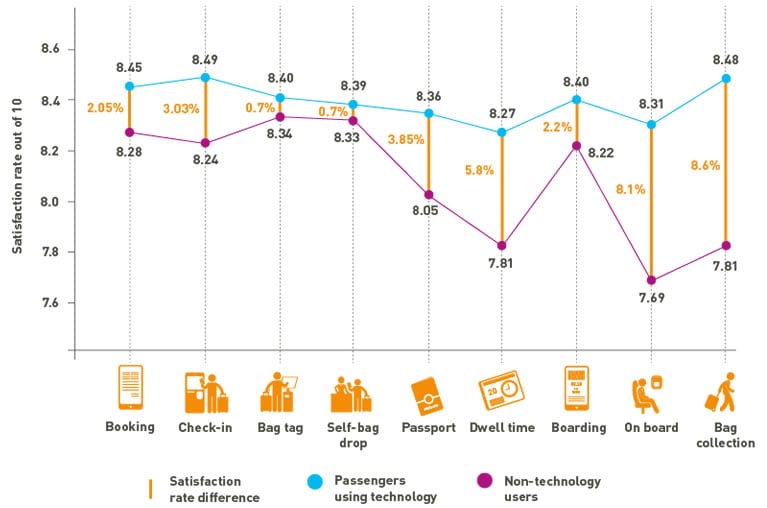
While the adoption of technology has improved passenger satisfaction across the airport journey, the biggest jump by far over the past year was at baggage collection. SITA’s 2019 Passenger IT Insights shows that passengers are demanding more mobile services in relation to their baggage and where these are available, satisfaction levels have surged.

SITA’s research shows that 26% of passengers in 2018 used their mobile device to receive status updates on their baggage at arrival, up from 14% in 2017. At the same time, there is a growing demand from passengers to receive more baggage information via their mobile devices. A majority of passengers said they would definitely use mobile notifications providing information on baggage at arrival while a similar proportion said they would use their mobiles to track their bags or to report mishandled baggage. 

These mobile services have dramatically improved passenger satisfaction levels. In 2018, those travelers who used their mobile to receive updates at baggage collection were 8.6% more satisfied than those who relied on traditional voice announcements or flight information screens for information. In fact, those who relied on traditional voice or screen announcements for updates ranked baggage collection as one of the lowest points in their journey while those receiving mobile updates perceived this step as one where they were most satisfied.

2018 passenger satisfaction rate

2019 Passenger IT Insights © SITA 

Peter Drummond, Director of Baggage at SITA, said: “Today airports and airlines are increasingly tracking bags at key points across their journey. While this tracking data is primarily used to provide better oversight of baggage and reduce mishandling, many operators are providing some, or all, of this information to passengers as a mobile service. This is being done either through the airline or airport mobile app or other notifications such as SMS. 

“As we have seen from the survey, this service has a tremendously positive impact on passengers’ airport experience. It provides a significant positive boost to the way they perceive their travel, while reducing anxiety around baggage. It is a strong endorsement of the benefits of baggage tracking in addition to the improvements in mishandling rates we have already seen where tracking solutions are in place,” said Drummond. Today, airlines using SITA’s technology to track bags are enjoying a significant reduction in the rates of mishandling.

A potential force driving adoption of mobile baggage services is the growing number of checked bags in 2018. Drummond added: “More than 4.3 billion bags were checked in by passengers globally. This is an average of 1.2 bags per person, up from 1.08 bags per passenger in 2017. The rise in checked baggage is likely to drive demand for more services as passengers want to know where their bags are at all times. Those airports that track bags across the journey are well placed to offer this service.”

The key findings of SITA’s report are based on a survey of passengers from 19 countries across the Americas, Asia, Europe, Middle East and Africa, representing over 70% of global passenger traffic. This is the 13th edition of the SITA Passenger IT Insights

source : https://www.sita.aero/pressroom/news-releases/passenger-satisfaction-at-baggage-collection-jumps-to-a-new-high-with-mobile-notifications?mkt_tok=eyJpIjoiTVdKaFl6QmhORGhqWVRBeiIsInQiOiJHc2RCMGV0aGhBclJMZ1d6WUlsV3RwTDFuMXpqVGhpY0ZjTkdrVUdvOHZISEo0SEcrVlVLNFwvWlJyamhxUjU2QVZ6UzhmSXpFRUt3ckNha2NhQnJiXC94UksxV3p4OXNXWGdLUHVwZWhjM1ZEOGVuMHZXbnRNYmhmdEVVS0JpN2JZIn0%3D

New biometric trial to help change the way people travel?

Dublin Airport is taking part in a trial that will allow passengers to use the same biometric technology, processes and procedures to “seamlessly travel” between it and Bristol Airport in the UK.

The public trial, which passengers can opt for voluntarily, will start in Dublin next month and uses technology developed by the US company Collins Aerospace, whereby a single sign up identification process streamlines the passenger’s outbound and return journey.

The trial, which is being undertaken in collaboration with an airline partner, is thought to be the first biometric trial that enables passengers to use the same biometric system at their departure and arrival airports and with their airline.

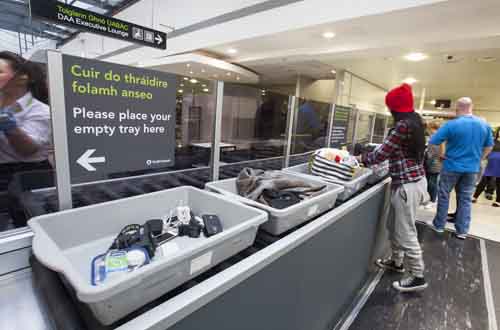
dublin security

A passenger who opts into the SelfPass process will have the biometric data from their passport securely stored which will help speed up the passenger journey. The biometric information is used at self-service check-in and is linked to their boarding card and their self-drop bag tag.

Using facial recognition technology their image is checked at the boarding gate and is cross referenced with the boarding card information automatically, which means they don’t have to present any documents at the gate.

“We are really pleased to be an early adopter of this new technology designed to further enhance the experience for both our passengers and our airline customers at Dublin Airport,” said Frances O’Brien, daa’s vice president of PMO.

“We’re delighted with the early progress of the trial in testing so far and we look forward to extending the technology to a wider audience, including passengers travelling to the US in the coming months.”

Christopher Forrest, vice president of global airport systems for Collins Aerospace, says: “Dublin and Bristol airports are changing the way passengers travel and making the process easier and more efficient. 

“For example, it takes less than one second to capture and process a passenger’s facial image and eliminates the need to repeatedly present travel documents. 

“We see this as another major leap forward for our biometric technology to play a key role in making the connected aviation ecosystem a reality.”

Collins Aerospace, which is based in Maryland and is part of the United Technologies Corporation, was created last year by bringing together UTC Aerospace Systems and Rockwell Collins.

source: http://www.airport-world.com/news/general-news/7087-new-biometric-trial-to-help-change-the-way-people-travel.html

Facial recognition at LAX: glimpsing the new face of airport security

Los Angeles Airport recently kicked off a pilot scheme testing the viability of facial recognition as part of its famously strict US border security checks. Gemalto, the company in charge of running the programme, is convinced it will help speed up queues at border checks as well as improve passenger experience. But how does it work and can it ever be implemented on a large scale?

As part of a new trial, passengers travelling on international flights at LAX no longer required their boarding pass to fly. Credit: American Airlines.

In an increasingly cosmopolitan world, time and security have become essential tiebreakers in determining passenger satisfaction at airports as customers expect to be guaranteed seamless operations and safety while travelling.

But with air traffic forecast to reach 7.8 billion passengers by 2036, putting together a fast and efficient service while maintaining security at border checks is no easy task for an airport, especially those that deal with millions of passengers every year.

In this context, biometric technology seems to be the most talked about solution. As technology advances and companies gain growing access to large databases, both airlines and airports are increasingly trialling facial recognition at gates around the world in an effort to speed up border checks and boost their satisfaction rates.

One solution certainly worthy of mention was tested by digital security provider Gemalto and American Airlines in December 2018 at Los Angeles Airport (LAX) as part of a pilot scheme which ran for over a month at the hub’s Terminal 4.

During this period, passengers travelling on international flights no longer required their boarding pass to fly. Instead, a machine would scan their faces at the boarding gate and match their identity with a cloud-based database belonging to the US Customs and Border Protection (CBP) in a matter of seconds.

A single-step technology that could significantly cut waiting times

While American Airlines is still compiling data on the trial, Gemalto vice president of Mobile Financial Solutions Amol Deshmukh is confident that his technology is the only way forward for airport security and airlines. “It’s very natural from a passenger’s point of view.”

Particularly, it is the only one on the market to rely on a single-step process instead of the predominant dual-step verification technologies. This means that while passengers usually need their boarding pass, which is scanned and then sent to the CBP, in the case of Gemalto’s technology the boarding pass is no longer needed.

“It’s very natural from a passenger’s point of view,” says Deshmukh; “some of them (taking part in the trial) were actually quite surprised that they were already done with boarding and could just keep walking on.”

He adds that despite still being in its early stages – and having only been tested over a 90-day period – chances are high that Gemalto’s biometric solution could soon be adopted in other airports, as well as in other scenarios: “The same exact technology can be used for self-service bag drop, eventually even TSA or duty-free shopping and such.

“These are different touch points which frame from the same user story and technology and they will be enabled incrementally,” he continues.

Small issues stand in the way

Despite its initial success and high rates of passenger satisfaction, the technology is far from being perfect and, if not improved, risks being limited to particular circumstances.

In fact, as Deshmukh explains, while facial recognition works well for the vast majority of passengers, it fails to apply in some specific cases that would still require the traditional dual-step methods. This is the case, for example, of toddlers, whose passport photographs don’t always match the looks. “Gemalto achieved a 99% successful acquisition rate in less five seconds, compared to an average 65%.”

In these cases, Deshmukh says, “the fall-back is still the boarding pass and both boarding systems work in parallel, so it really doesn’t stop anything and it really happens in isolated situations.”

Nevertheless, as isolated as these cases can be, it is clear that if the technology ever bids to replace the traditional system as a whole, in the future the process will have to work for everybody without exceptions.

In the meantime, however, Gemalto is looking to expand and trial its technologies in other American locations and promote biometrics around the world. Having achieved a 99% successful acquisition rate in less five seconds – compared to an average 65% – at a recent Department of Homeland Security biometric testing rally, the omens seem to be good.

source : https://www.airport-technology.com/features/facial-recognition-technology-in-airports/

Future Travel Experience EMEA 2019


To commemorate the landmark opening of the new Istanbul Airport mega-hub, which opened on 29 October 2018, Future Travel Experience is taking its Europe and Ancillary shows to Istanbul, rebranding them as Future Travel Experience EMEA, and co-locating the event with The New Airport Show Istanbul.

These outstanding shows will collectively provide the perfect platform to bring together the world’s airlines, airports, vendors, startups, OEMs, government agencies, destination partners and various other key travel industry stakeholders. They will gather in Istanbul to learn, network and collaborate on how technology, design and innovation can enhance end-to-end customer experiences and revenue opportunities at every step of the journey, and see the newest hub airport in the world first-hand.

source: https://www.futuretravelexperience.com/fte-emea/?utm_source=Future+Travel+Experience+Newsletter&utm_campaign=f15d3e6b90-FTE_EMEA_05&utm_medium=email&utm_term=0_c306aa3edf-f15d3e6b90-88183729

SITA Smart Path™ allows passengers at Athens Airport to use their faces as their boarding pass

Location: Athens

27 March 2019

Greece’s largest airport becomes Europe’s first to use biometric identity at security.

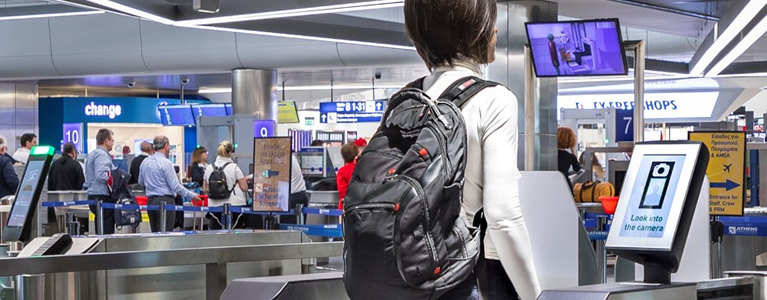
Passengers flying with Aegean Airlines from Athens International Airport are being offered a faster, more efficient journey through the airport by merely scanning their face at check-in and at security points.

Athens Airport has become the first airport in Europe to trial SITA Smart PathTM, a unique solution where passengers can use their facial biometrics to identify themselves at key steps in the journey without having to show their passport or boarding card.

When arriving at Athens Airport to check in, passengers who utilize the trial service, scan their passport and have their photo taken. Once completed, passengers can then proceed to security where they can quickly be verified as a known traveler – without having to show a boarding pass. Passengers simply have their face scanned and then are offered a fast track through security.

Alexandros Ziomas, Acting Director, IT&T Business Unit at Athens International Airport, said: “Passengers really appreciate the ease of using SITA’s Smart Path trial. It has reduced the time taken to check in and verify passenger identity at security to only a few seconds. It will solve a key challenge for us by ensuring a steady flow of passengers to the security area. This is a service we would like to extend to other steps in the journey over time.”

A key benefit of Smart Path is that its technology integrates with the airport’s existing common-use check-in kiosks and boarding gates, making the solution both cost-effective and available to multiple airlines. Smart Path can also be tailored to an airport’s or airline’s specific requirements, allowing Athens Airport to offer this service to other airlines in future, including Aegean’s Star Alliance partners. 

Sergio Colella, SITA President for Europe, said: “As most airports around the world already have self-service infrastructure in place, installing Smart Path is cost-effective and easy to implement. Yet, the improvement to security and the passenger experience is tremendously positive. It explains the growing interest in this solution from both airlines and airports in Europe and around the world.”

Athens International Airport is the latest airport to use SITA’s Smart Path solution, joining Brisbane, Doha, Muscat, Orlando, Miami and Boston airports while numerous other airports in Europe and US are expected to implement the solution in 2019.

source : https://www.sita.aero/pressroom/news-releases/sita-smart-path-allows-passengers-at-athens-airport-to-use-their-faces-as-their-boarding-pass?mkt_tok=eyJpIjoiTVdJMllXUTVNREZoWW1ZMCIsInQiOiJXNVFZM3J5NFZTNTJVTFI0Q3J4RWwySHFOQmxhXC9Fb3ZtVmtEaXUzRHowK1dhMXNKZFwvYlwveG1NWjM1cGZnVWNpR3liREltZzk0Nk03dkdhbGpoWmE0THdXRFZoeDRYY25TWkxGXC9EOFNnZWNyS0xIQTNpZjVLNTNNbzF2Y3UrK1UifQ%3D%3D