Airports embrace biometrics

While travel continues to increase in popularity – with some estimates putting global annual tourism spend at US$1.5 trillion – few would consider airports a particularly enjoyable part of the overall experience. Onerous security measures are just one element that can sap the fun from a trip, before one has even boarded the plan.

However, technology could potentially have the answer, with airports around the world reportedly falling over themselves to invest in smart inventions such as artificial intelligence and biometrics, a trend that could hopefully make the experience of air travel a good deal less stressful for consumers. A new forecast from Acuity Market Intelligence suggests that the number of biometric touchpoints – such as AI-powered facial recognition – throughout airports, from check-in to boarding gates, could increase at a compound annual growth rate (CAGR) of 27 per cent between this year and 2022.

“Smarter, seamless travel is no longer a vision for the future,” said Maxine Most, Principal and Founder of Acuity. “It is happening now, all over the world. In the past month alone, reports from Asia indicate massive uptake. As airport AI-enhanced biometrics become mainstream, so too will consumer comfort and preference for the convenience of the experience. This will change passenger expectations and drive demand for similar solutions within airports and across the entire travel sector, from cruise ships and car rentals to train stations and ferry terminals.”

A number of airports have recently announced the adoption of these technologies. Narita Airport (also known as Tokyo Narita Airport) has talked of its plans to be the first airport in the world to allow all passengers to board flights using facial biometrics alone, with no need to stop for identification; these biometrics will also be used for check-in, bag drop and so on. AirAsia, meanwhile, is piloting facial recognition for passengers boarding flights at Senai Airport in Johor, while Hong Kong Airport plans to launch an identity system based on facial recognition and utilising a single token by early 2020.

Airports in Miami, Orlando and Atlanta in the US are also using variations on facial recognition technology, while Bristol and Dublin Airports in the UK are currently trialling the SelfPass biometric solution from Collins Aerospace, said to be the first solution of its kind that enables a single enrolment that can be used across multiple countries.

While the widespread adoption of facial recognition technology has rightly had some privacy advocates worried – there are undoubtedly numerous ways in which these advancements could be used to unscrupulous ends – it seems inevitable that airports will continue to make use of them. And if they make passengers’ lives easier, as with any such controversial technology, it could well be that the need for convenience ends up steamrollering any concerns over individual liberty.

source : https://www.itij.com/story/115450/airports-embrace-biometrics

17 innovations that can improve the passenger experience

FTE in London: 17 innovations that can improve the passenger experience in the airport terminal

In our efforts to find innovation in every corner of the air transport industry, Future Travel Experience visited last week’s PTE show in London, where we explored some of the solutions that can help to improve the airport terminal.

Defined by a strong focus on new biometric-enabled, self-service and data-driven solutions to enhance operational efficiency and improve the passenger experience, here we present a selection of some of the cutting-edge products and services that have the potential to deliver positive change.

Elenium and Etihad Airways

Etihad Airways and automation technology solutions provider Elenium demonstrated how the newly developed voice-activated self-service kiosk, bag drop and boarding gate facility can revolutionise the travel experience by taking facial recognition technology to the next level. Rico Barandun, Head of Strategy, Elenium Automation, explained that when passengers check-in for their flight they can register their biometric data on their mobile device before arriving at the airport, which means they won’t have to queue at the airport. Using AI, the new baggage-drop terminals scan and memorise each suitcase placed on the belt through a unique camera system, potentially removing the need for tagged luggage. Using biometrics, passengers are identified and offered a personalised duty-free shopping experience through an interactive display with integrated voice technology. The new biometric-enabled boarding gate concept is such that the gates are always open, which welcomes passengers to go through, unless the passenger hasn’t registered his/her biometric data. “The whole concept is about how travel can look in the next two to five years from now. Our aim is to take some pieces of the whole project and deploy them in a live environment in the next six to nine months.” Abe Dev, Head of Technology & Innovation Airline Operations, Etihad Aviation Group, added: “From an Etihad perspective, this partnership fits with our vision to create a seamless and frictionless journey for our passengers. We wanted to go one step further by using Elenium and Amazon Web Services to commercialise the entire process, and also integrating it with Etihad’s technology that we are working on in-house.”

Collins Aerospace

Biometrics has been high on the agenda of most airports, airlines and technology providers over the past few years, and this year has already seen a number of initiatives coming to fruition. FTE was invited to Collins Aerospace’s exclusive press briefing announcing the launch of the SelfPass biometric-based identity management solution. Collins Aerospace’s Tony Chapman, Director of Global Product Management and Strategy, Information Management Services, and Christopher Forrest, Vice President of Global Airport Systems, revealed several new partnerships, including a trial by JetBlue at JFK, as well as trials at Bristol and Dublin airports. “We believe it is one of the world’s first total end-to-end solutions that covers not just one airport but multiple airports, multiple journeys, multiple airlines and multiple countries,” explained Chapman.

Stanley Robotics

Stanley Robotics, whose autonomous parking robots can be found in Lyon-Saint Exupery Airport, has signed a framework contract with Gatwick Airport. The trial will run from the second half of 2019 to early 2020 and passengers will simply leave their car in a parking station close to Gatwick Airport’s South Terminal entrance and, without handing over keys, the driverless robot will gently lift up the car and transport it for storage in a secure car park. The system will also be connected to real-time flight information, so the robot simply returns the vehicle to the parking station at the correct time. The customer then receives an SMS that the vehicle is ready and waiting for their arrival. The trial will see 270 parking spaces being managed by three robots. Stéphane Evanno, COO of Stanley Robotics, outlined the main benefits of the service for airports. The valet robot technology can optimise space to create up to 50% extra parking spaces and its deployment is quick and needs little construction. It also provides a simplified and convenient experience for passengers. “At Lyon we have 500 parking spaces managed by four robots. So, it is really tangible and that’s why the interest from the airport industry is very strong. We are expanding quickly and aiming to hit over 1,000 spaces at Lyon. The end-goal is to operate 20 robots managing 6,500 parking spaces.”

Aurora AI

Aurora AI showed FTE a range of its artificial intelligence (AI) solutions that make use of deep learning technology. Among them was a bag tag recognition solution, which uses optical character recognition (OCR) AI to enable accurate reading of the text on labels. For instance, the letters “BHX” are quickly recognised as meaning Birmingham Airport. As Dr Nick Whitehead, Head of Strategic Partnerships, explained, this solution supports airports in the management of baggage handling either to enhance read rates or to act as a fully functioning back-up when systems that rely on barcode reading are compromised. Among the other solutions offered are Bio-Q face recognition queue measurement and predictive analytics using AI.

bagchain

bagchain showcased its latest products, which help to bring simplicity and convenience to the airport environment. Among the solutions on show was the second generation of the bagchain gate kiosk and a new version of the bagchain print kiosk. The former helps to simplify the gate experience by enabling agents to quickly and easily print and issue bag tags when necessary during the boarding process. bagchain’s products can already be found in various locations, including Amsterdam Airport Schiphol.

Amadeus

Amadeus showcased its latest common use concept, which aims to reduce the complexity of the back-end infrastructure at airports. Iyad Hindiyeh, Amadeus’ Global Head of Strategy, explained: “What we are doing effectively is we are taking the common use infrastructure out of the airport and bringing it into the cloud, which means airlines can connect much faster and the airport can service their customer much faster.” Another benefit he highlighted is that as part of some ACI initiatives a lot of airports are aiming to be green, so that helps airports reduce the footprint of the electricity they use. Another focus on the Amadeus stand was the baggage reconciliation system, which runs in the cloud. This ‘single data source’ ensures that up-to-the-minute information on loading, tracking, baggage, passengers and flights is held centrally and can be updated and accessed on demand. Amadeus also displayed its ready-to-buy biometric solution, which Hindiyeh shared was recently tested in Ljubljana Airport. “We have done the test with approximately five airlines and it was very successful. In the next months we will be announcing the launch of this solution.” Moreover, Amadeus has announced an agreement for the acquisition of ICM Airport Technics. Commenting on this, Hindiyeh said: “Airports are requiring an end-to-end service from vendors, which includes the software, the hardware and the future services. At Amadeus we have a very strong software, which is cloud-based, so by providing the hardware, especially in the self-service bag drop, we believe the story of Amadeus is complete.”

ICM Airport Technics

Following the announcement of the agreed acquisition, FTE also caught up with Richard Dinkelmann, CEO of ICM Airport Technics, to find out what this partnership means for ICM. He explained: “By combining ICM’s market-leading self-service and passenger processing solutions with Amadeus’ global reach and complementary product offering, we are now in a unique position to offer even better technical solutions to our airline and airport customers, and we can do so faster. We are excited about the future, as we share similar values such as strong innovation, reliability, and an uncompromising commitment to improving airport efficiency, as well as passenger safety and security.” ICM also showcased its next-generation check-in kiosks, which feature the same design as its self-service bag drop solutions, creating consistency across the entire check-in and bag-drop process. “What it does differently, is that it puts all of the future features into the machine, including biometric recognition camera for facial recognition, disability access pad and payment,” explained Dinkelmann.

Panasonic

Panasonic also highlighted its vision of how biometrics will transform the passenger experience. As Shusuke Aoki, Head of Business and Industry Solutions at Panasonic demonstrated, the One ID solution for fully automated curb-to-gate airport services is powered by facial recognition technology, which includes check-in and immigration screening, robot assistants to provide directions to boarding gates, digital signage providing personalised flight information, and self-boarding gates. While the automated check-in and security tracking solutions are already in use at airports in Asia and Europe, this was the first time the company showcased the full end-to-end One ID solution.

Vanderlande

At an exclusive press briefing, Koen Evers, Manager FLEET at Vanderlande and Ron Louwerse, Director at Rotterdam The Hague Airport, shared the initial results from the revolutionary baggage handling FLEET project, which was launched last year. Highlighting the benefits of FLEET for Rotterdam The Hague Airport, Louwerse said: “For us it was important to have a system which was flexible, efficient, sustainable that could be scaled up and down as needed. We needed a new baggage system because the current one was very outdated, but we needed it to be flexible enough to manage future growth. FLEET gave us the opportunity to trial a system that was independent of the actual number of bags.” Evers added: “For us it was about proving the system in a live operational environment and learning more about how the users interact with the system, and that is one of the key learnings of the trial that was very positive.” So, what’s next for FLEET? Louwerse revealed that the trial is entering its second stage, and he is already looking beyond the baggage handling capabilities inside the terminal, extending for instance to the tarmac. Vanderlande also announced that before the end of summer, there will be four systems up and running at airports in various locations, including the US and Europe.

SITA

FTE also caught up with SITA’s Product Development Lead Stephen Challis. “Our customers have already got kiosks and e-gates, so what our skills and experience allow us is to add things on top of that to deliver extra value. This idea of leveraging the investment our customers have already made is very important for us.” Challis demonstrated the SITA Smart Path, which uses digital biometric ID management technology to automate the travel journey from secure check-in to on-time boarding. A key benefit of Smart Path is that the technology can be integrated with the airport’s existing common-use check-in kiosks and boarding gates, making the solution both cost-effective and available to multiple airlines. During the event, SITA also announced that Athens Airport has become the first airport in Europe to trial its Smart Path solution, joining Brisbane, Doha, Muscat, Orlando, Miami and Boston airports while numerous other airports in Europe and the US are expected to implement the solution in 2019. Manchester Airports Group (MAG) has also selected the IT provider to implement further passenger self-service across the group’s three main airports – Manchester, London Stansted and East Midlands airports. SITA has also been selected to carry out an upgrade to Manchester Airport’s baggage reconciliation systems, enabling the airport to better track bags at key points throughout the journey.

AOE

To strengthen non-aviation business, digital transactions are becoming increasingly important for airports. In fact, one year ago Heathrow Airport announced the implementation of AOE’s digital marketplace that includes flight information as well as a Reserve and Collect service. Much of the revenue at the airport has been generated by high-end luxury fashion goods. FTE caught up with Kian Gould, CEO and Founder of AOE, who explained that this emphasis on luxury goods is reflected in an average basket value, which is about five times Heathrow’s retail average. So, what’s next? Gould shared: “The next step would be to launch payment, so that the items selected by the consumer could be prepaid and not just reserved. The OM3 platform is also being utilised by Frankfurt and Auckland airports, as well as by Lufthansa, Avianca and Singapore Airlines. Looking ahead, Gould said: “My view of the future is that in five years’ time there will be two kinds of airlines – the ones that will become real e-commerce players, and there will be the ones that will decide that inflight retail is not completely feasible, so they would soon stop offering it. If they do stop it, they would have the potential to become traffic sources for the airport e-commerce platforms, so that when customers want to buy something they are directed to the airport’s e-commerce platform.”

Materna Intelligent Passenger Solutions (IPS)

Materna showcased its portfolio of innovative solutions for check-in, automated bag drop, biometrics and monitoring. One of the main highlights was the hybrid self-service bag drop solution. Suitable for both self-service and agent service baggage drop-off, it gives airports maximum flexibility when deciding how the bag-drop station is used, according to capacity, queues and peak times. FTE met with Holger Kennke, Sales Director, Materna IPS, who took us into a virtual environment where we were presented with various self-bag drop solutions. The virtual tour showcases the entire passenger journey from check-in to boarding and could help airports visualise where best to position the solutions in the terminal.

CrowdVision 

The latest version of CrowdVision’s solution is focused on optimisation. As Fiona Strens, CEO, CrowdVision explained, it provides aviation planners and operators with highly accurate and actionable data to optimise all aspects of the airport in a passenger-centric way. “Our key message is to focus on optimisation and the consequence will be reduced wait times and seamless passenger journeys.” As passenger numbers continue to rise, pressure on ageing infrastructure is a major concern for many airports. According to Strens, CrowdVision’s data can help optimise the constrained terminal space and capital investment. Among some of CrowdVision’s success stories are London City Airport and Chicago O’Hare International Airport.

IER

IER showcased its latest self-service solutions that help airport and airlines provide an enhanced passenger experience. Among some of the solutions on display were the i920 self-service check-in kiosk, the i820 retrofit bag drop and a brand-new e-gate for all airport touchpoints. IER also took the opportunity to unveils its new entity of IER and Automatic Systems Passenger Solutions, called EASIER. As Catherine Kokar, Marketing & Communications Manager, IER, explained, EASIER will leverage the best of the two companies and will provide customers a more comprehensive product range for airports and airlines.

McLaren Deloitte Alliance

FTE also spoke to Martin Bowman, General Manager, Aviation Products, McLaren Deloitte Alliance, who outlined how Deloitte and McLaren are applying Formula 1 thinking to aviation. He said: “At the highest level, the idea is to tap into that approach and understanding as used by McLaren around the role of data and modelling and simulation to support tactical decisions. That is the fundamental idea. There is a culture of not necessarily looking back and learning from the past. Everything has happened before, but yet we take it as a new challenge. So, what we are trying to do is a detailed historical analysis so that we can learn from the past and we can provide a better understanding of what is effective.” Through simulation and mathematical models, and applying them to support airports, airlines and air traffic control (ATC), the company can enhance airports’ and airlines’ operational efficiency. Bowman also shared that McLaren Deloitte is starting a new innovation partnership with Avinor. “It is a very interesting collaboration where we use Avinor, and in particular Oslo Airport, as the testbed for new ideas.” Essentially, the project will use prediction simulator and machine learning tools from Formula 1 applied to the airport’s flight data. The result will generate an Airport Operation Plan (AOP), a concept that is coming to many airports in Europe as part of the SESAR programme.

OneBagTag

E-tags, or permanent electronic bag tags, have been touted as the future of baggage tagging for a number of years already and they are slowly gaining traction as the industry continues to embrace more modern solutions. FTE had a close-up look at OneBagTag, one of the players in this space. As Eli Ostreicher, Founder & CEO, explained, the e-tag includes a global tracker, a built-in weight scale, on demand alert ringer, and a 30-day battery life with USB-C rapid charging. So how does it work? The product has been designed to allow passengers to check-in on their airline’s app as usual, receive a PDF of their luggage tag along with their boarding pass, and then sync this digital tag with the OneBagTag E-Ink display via Bluetooth.

Innovative Travel Solutions, Vancouver Airport Authority

As passenger traffic continues to grow, it is crucial for airports to future-proof their facilities. The automation of passenger processing using border kiosk technology is one way in which progressive airports are doing just that. The BORDERXPRESS technology developed by Innovative Travel Solutions, an independent business unit of Vancouver International Airport (YVR), had, as of the end of 2018, processed almost 250 million passengers at 42 airport and seaport locations around the world. Significantly, the first implementation of BORDERXPRESS in Europe took place at Pafos and Larnaka airports in July 2018, with the installation of 74 kiosks. BORDERXPRESS uses self-service, biometric-enabled kiosks in a two-step process to expedite border clearance, and is said to reduce passenger wait times by more than 60%. “This leads to overall operating efficiency and space savings of more than 50%, because it allows airports to expand passenger traffic without having to add additional space or staffing resources,” explained Chris Gilliland, Director of Innovative Travel Solutions, Vancouver Airport Authority. “The kiosks also allow border officers to focus on maintaining the safety of the border, which is of paramount importance to airports and a condition of governments when considering automation.”

Mark your diary for Future Travel Experience’s 2019 events, where you can demo the latest products and services in the exhibition and learn how to future-proof your organisation and ensure it is ready for the next wave of technologies and trends in the premium conferences. You can find out more on the event websites: FTE EMEA and FTE Ancillary (18-20 June, Istanbul); FTE Global (4-6 September, Las Vegas); and FTE Asia EXPO (12-13 November, Singapore). Contact us here to discuss sponsorship and exhibiting opportunities. 

source : https://www.futuretravelexperience.com/2019/04/17-innovations-improve-passenger-experience-airports/

Airbus’ icephobic coatings to reduce time for de-icing planes

In an interview with International Airport Review, Airbus discuss their new icephobic technology that will reduce de-icing times airside.

Can you briefly explain how the ice-resistant technology works?

Airbus is currently developing and testing improved ice-resistant technologies to support current anti-icing systems. This “new” ice-resistant technology is based on the design and manufacture of special coatings that can be applied to the external surfaces of an aircraft in order to stop or slow down the formation of ice or snow while an aircraft is on ground or in-flight using less energy than solutions in place today.

How were the planes tested?

The so-called “icephobic” coatings are not yet used on commercial aircraft. Airbus is testing them in laboratory situations; in icing wind tunnel tests, and in-flight tests to assess both their durability and their performance. There is still a long way to go before all tests will be complete and certification achieved.

Will aircraft with this technology in place have any drawbacks concerning in-service life?

We expect that aircraft equipped with this technology should have the same – or even an increased – in-service life as compared with current aircraft.

Is this a technology that can be applied to existing planes?

Yes, “icephobic” coatings could also be applied to existing aircraft. We call this process “retro-fitting”, which means applying a newer technology to an existing product. However, the main target for the new “icephobic” coatings will be the next-generation of Airbus products.

Will this technology only be useful in icing conditions?

As our current understanding of the technology is, the same coatings should also allow for a reduction in the accumulation of dirt and of other contaminants onto external aircraft surfaces. This will in turn enable a reduction in drag and therefore fuel consumption – it will also keep the aircraft “cleaner and shiny” for a longer time.

Is this solution cost effective compared to traditional de-icing methods?

We do not expect “icephobic” coatings to totally replace traditional ice protection systems, but instead support them; making them more efficient, reducing the energy required to use them as previously mentioned. Our goal of course being a more eco-friendly air-transportation without compromising on safety. 

source : https://www.internationalairportreview.com/article/81940/airbus-icephobic-planes/?utm_source=Email+marketing&utm_medium=email&utm_campaign=IAR++-+Newsletter+%2313+-+NEC+Japan+-+28+March+2019&utm_term=Airbus%e2%80%99+icephobic+coatings+to+reduce+time+for+de-icing+planes*+plus+all+the+latest+airport+news…&utm_content=http%3a%2f%2femails.internationalairportreview.com%2frussellpublishinglz%2f&gator_td=m745KmN4byC7y8mRHpucUyYBR67kdo4UBx3MKlEFENCxdPmzxM3R3473nXsIgbCVyiwbEP7QV6KEDDCmUV%2f8nKKgN%2fOQ7PCO%2fiTeKaZQkSStAYCViY0wHHdnPuvrP5c%2bwh%2fMuvNdC3mRrygYQ87ykRF%2fOZH3k8cWH384yWNZt2DQgTD7vUS6sOVj%2fH5zuysDcgzd%2fyGGXm2InufP9NJw7X7gUkidAi8f4OkiSfT3sZE%3d

Mobile technology: the answer to better baggage handling

Mobile technology will bring far better baggage handling. This is a crucial focus for the air transport industry as passenger numbers grow, says the SITA 2019 Passenger IT Insights report.

If the air transport industry is going to improve the passenger experience, operational efficiencies and its bottom lines, then better baggage handling is undoubtedly a top agenda item. Some 4.3 billion air passengers traveled around the globe last year. That’s roughly 4.3 billion bags that have to be processed. This number will only grow.

Better baggage handling is central to a better travel experience for air passengers. Bags, after all, are personal. People are understandably attached to them. They don’t want the added stress of not trusting whether their bag will be there at the end of the journey. They just want to pick it up and be on their way.

Transforming to an intelligent baggage experience

In our 2018 SITA Baggage Report we saw how baggage management is changing, with passengers set to see some major differences. I’m pleased to say that this has come to fruition. SITA’s 2019 Passenger IT Insights report highlights enormous potential for using data and intelligence to inform air passengers of the whereabouts of their baggage. Real-time notifications and fast self-service bag drop, for example, are becoming more commonplace.

Airlines are increasingly rolling out apps for air passengers that provide them with tracking updates on their baggage in real-time. The Insights report shows that one in four passengers have used an app to collect information about their baggage, to inform them of which belt their baggage will arrive on, for example.

Tracking – tackling a pinch-point

One of the stand-out points of the SITA 2019 Passenger IT Insights report is that passengers are more satisfied when using technology. This especially applies to baggage tracking. Some 8.6% said they were more satisfied when airlines and airports share information about the whereabouts of their baggage. This is a great improvement as baggage handling is a real pinch-point for air passengers.

At SITA we’re actively working with IATA to deliver tracking to comply with the IATA Resolution 753, designed to encourage airlines to further reduce baggage mishandling by implementing cross-industry tracking for every bag journey. Data harvested at check-in, aircraft loading, transfer and arrival can be shared with stakeholders to enhance operational efficiency by reducing baggage mishandling costs and pushing forward on-time performance.

SITA’s BagJourney, for example, supports a smoother bag journey experience by making sure everyone involved in the baggage process has up-to-date information about the exact location of each bag being handled. Following the deployment of BagJourney, Etihad Airways, which processes approximately 24.5 million bags for its 8,500 scheduled flights now closes more than 90 percent of mishandled baggage cases as a result.

SITA’s BagJourney, for example, supports a smoother bag journey experience by making sure everyone involved in the baggage process has up-to-date information about the exact location of each bag being handled. Following the deployment of Bag Journey, Russia’s S7 Airlines was able to meet the requirements of Resolution 753 very quickly, as 55% of its baggage traffic was already digital thanks to SITA’s baggage services already in place. These services have also allowed the carrier to improve its passenger experience, using the SITA Bag Journey API with real time information of the baggage loading information, S7 passengers are able to track their baggage at Domodedovo Airport via the S7 mobile app.

Passengers want mobile services

SITA research also shows that the vast majority of passengers carry a smartphone, tablet or laptop – with 17% carrying all three devices. This provides an enormous opportunity for airlines and airports to provide mobile services that offer personalized information. There’s no doubt about it: the demand among passengers is definitely there.

In our 2019 Passenger IT Insights report, unsurprisingly, three of the top mobile services on air passengers’ wish lists link directly to tracking the status of their baggage: 65% said they’d definitely report mishandled bags via their mobile devices, 64% said they want to be able to track their bags via an app, and 63% would like baggage collection notifications pushed to their mobile devices on arrival. Only a quarter of air passengers say they can actually do this today.

A mobile future

This year’s Passenger IT Insights is encouraging. It makes clear that airlines and airports are keen to bring in mobile services for baggage tracking, and where such services are available passengers are getting a very positive experience.

This is great news. I believe we’re on the cusp of real change. The analysis of end-to-end baggage tracking has the power to pinpoint exactly where efficiencies can be improved, while enhancing the overall passenger experience and taking us one step closer to seamless travel. 

source: https://www.sita.aero/resources/blog/mobile-technology-the-answer-to-better-baggage-handling?mkt_tok=eyJpIjoiTkRJek5qbGxOakZsTXpCbSIsInQiOiJYT1daUzJKTHY4MGJaVVhseEJkXC9CQTJjMmZOcFZCVk1zYmVrNWJJRm9idHgxZWgxditVT2Q2c2JWellMQ3RraG5KYjVqYnNDMkZLSmdDT3dZMktxSmIrZ00rdXZpb0ZVXC9qOVQ5aWQxblA0MDJPWG1aSXNRVmFSZ0h4aWp5RU9sIn0=

Incheon Int’l Airport marks 18-year anniversary, milestone as world’s 5th busiest airport

Incheon International Airport is celebrating its 18th anniversary this week,… and its status as the fifth-busiest airport in the world. The airport says the number of travellers passing through its gates has been growing every year at an average of seven-point-seven percent. 2018 saw an all-time annual high of 67-point-six million passengers,… an on-year jump of ten percent. That was the world’s fifth-highest number of international travellers. Dubai was busiest with nearly 89 million, followed by London Heathrow, Hong Kong and Amsterdam’s Schiphol airport.

How technology is simplifying, personalizing travel

(Unsplash)

Technology for travelers is shaping expectations and changing the way people travel. Mobile apps like AtYourGate and App in the Air are coming on the market in response to changing guest expectations when it comes to convenience and tailored services, and providing solutions to help enhance travelers’ lives and making things easier.

The At YourGate dining app, launched last year in San Diego, allows users to place an order from a participating airport restaurant and have it delivered right to their gate or other location.

“AtYourGate takes away the stresses of travel by delivering food and travel essentials no matter where you’re located in the airport,” said company President David Henninger. “Whether it’s a flight delay, short layover, or just hard to leave your gate, using the AtYourGate app saves you time, allows you to relax, and lets you choose what you want versus having to settle for choices nearby.”

In January, AtYourGate rolled out at New York’s John F. Kennedy International, Newark Liberty International and LaGuardia airports, garnering thousands of orders.

“We are continually exploring service innovations and new technologies in order to make traveling easier for our customers,” said Port Authority Executive Director Rick Cotton in a press release. “Partnering with innovative companies such as AtYourGate helps us effectively meet passenger needs in an increasingly digital world.”

App in the Air is another piece of mobile technology that is making things easier for travelers. The app has been credited with simplifying the flight experience from booking to landing by helping travelers manage various aspects of travel including multiple itineraries and boarding passes as well as loyalty programs associated with airlines, rental cars and hotels. In addition, the app contains airport information, including security line wait times, airport maps and flight delays.

App in the Air founder and CEO Bayram Annakov described it as “the premier personal travel assistant for frequent fliers. We cover the pre-trip, day-of travel and post-trip travel stages through the app’s various streamlined features, to make flying seamless and more efficient for the user.”

App in the Air is not forgetting the human element with its “nearby” feature, which helps travelers connect with one another via simple conversation starters within the app, allowing users to share tips like “hidden” power outlets and connect with each other about travel delays or even to share a cab or meet up. Annakov said App in the Air is “grounded in the major trend of customization” in travel.

The Baarb hotel search assistant is an example of the tailored travel technology, connecting people to the right hotel based on their personal taste. Baarb was part of the recent Future of Travel Tech Summit in Miami. 

Making travel easier

There is a growing body of solutions that use technology to make travel easier. The Neatebox app, for example allows air passengers to enlist specific assistance at the airport. Edinburgh Airport has adopted this technology.  Munich Airport’s Josie Pepper robot, meanwhile, assists passengers as they pass through the terminal.

Transportation apps such as Rome2Rio and Car2Go make it easy to get around foreign cities. Rome2Rio provides information on navigating public transit and other travel options worldwide. Car2Go enables car rentals by the hour. 

Google Translate and Pocketalk help travelers use technology to cross language barriers. The Pocketalk device that provides audible translations from English to other languages.

Future enhancements

Artificial intelligence, speech recognition and high-speed internet connections while in flight are among the upcoming technologies that will shape the travel experience.

Henninger of AtYourGate says a key to the company’s success is its “talented and motivated team of brand ambassadors that follow a proven approach to hospitality and passenger service.” The app facilitates 20,000-plus orders last year.

App in the Air is planning to roll out a new flight booking feature, completing its all-in-one functionality. The app will match fliers with itineraries with the highest number of rewards points based on which loyalty programs they participate in.

“With these new features, we continue to make the travel process more personalized, because we recognize that air travel is an experience of the masses and individualizing it is key,” Annakov said.

__________________________________________________

If you enjoyed this article, sign up for National Restaurant Association, ILHA SmartBrief, ISPA Smartbrief or SmartBrief for the Travel Professional to get news like this in your inbox, or check out all of SmartBrief’s food and travel newsletters as we offer more than 30 newsletters covering the food and travel industries from restaurants, food retail and food manufacturing to business travel, the airline and hotel industries and gaming.

source: https://www.smartbrief.com/original/2019/04/how-technology-simplifying-personalizing-travel

The latest 2019 World Airport Star Ratings are announced

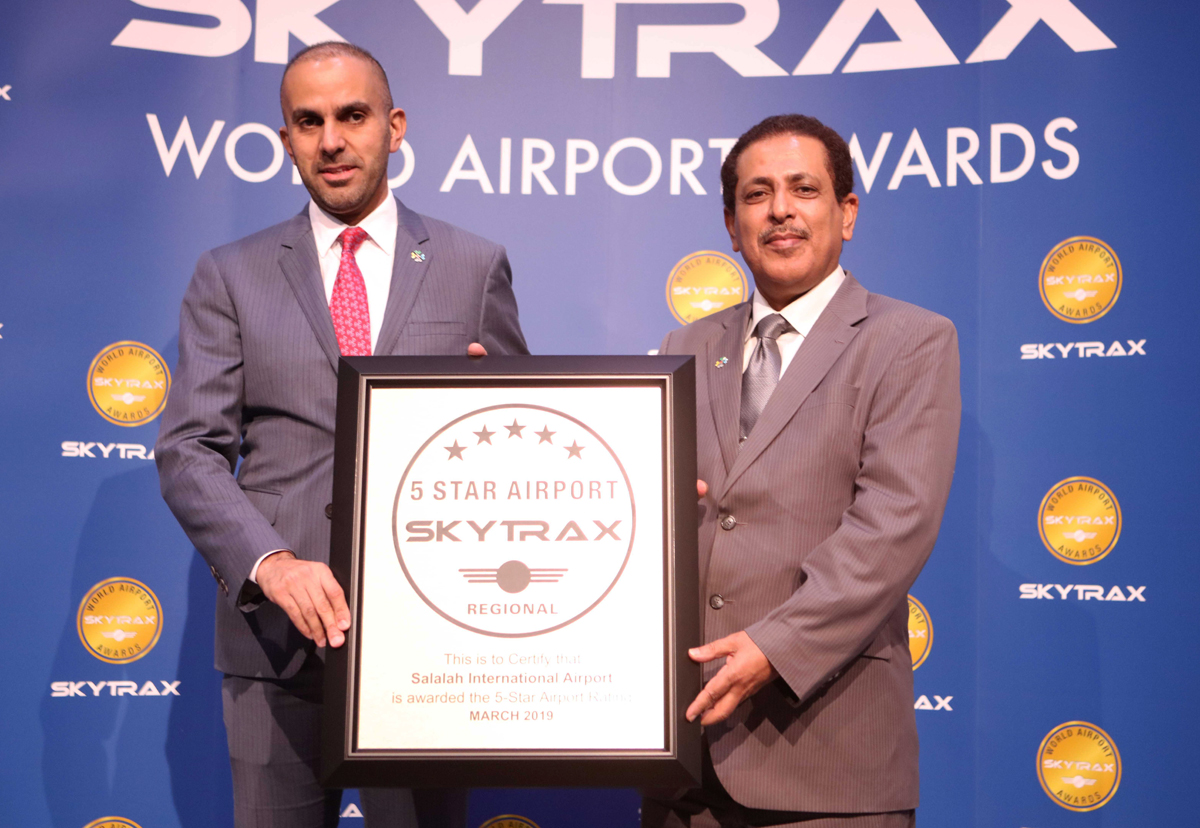
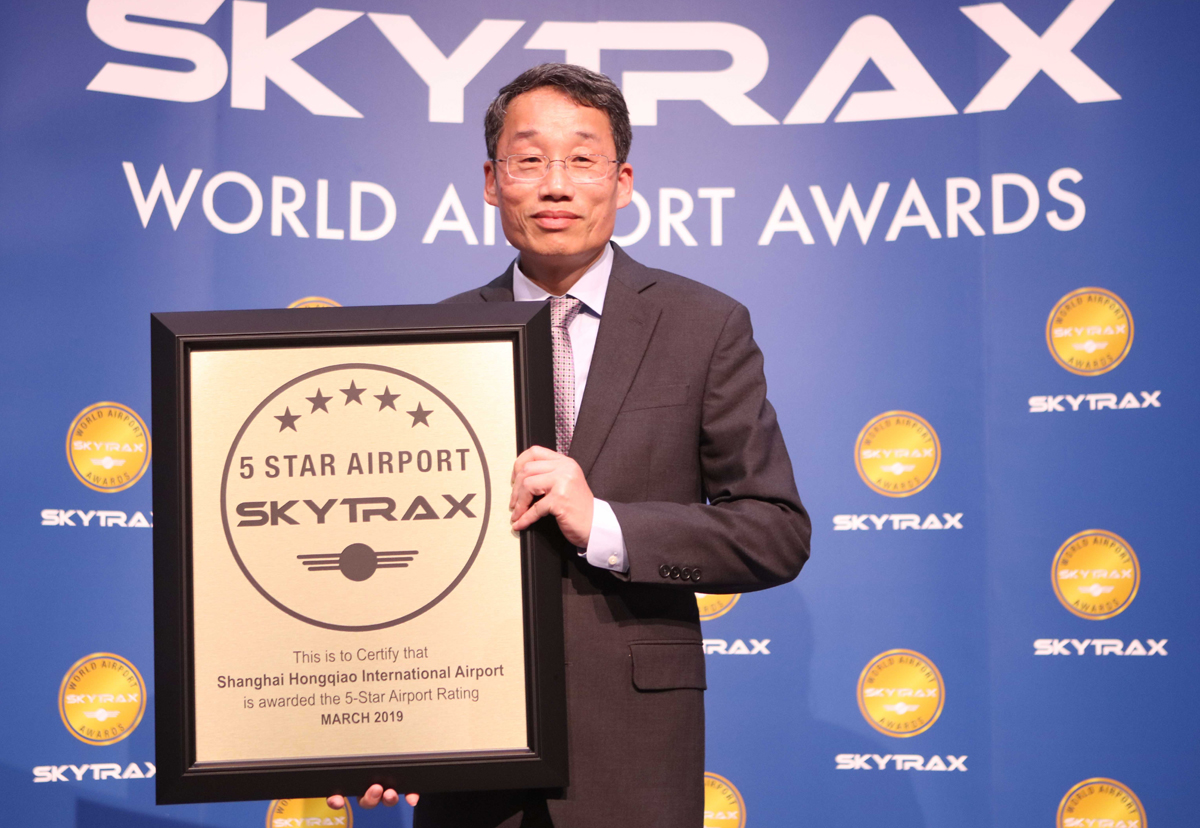
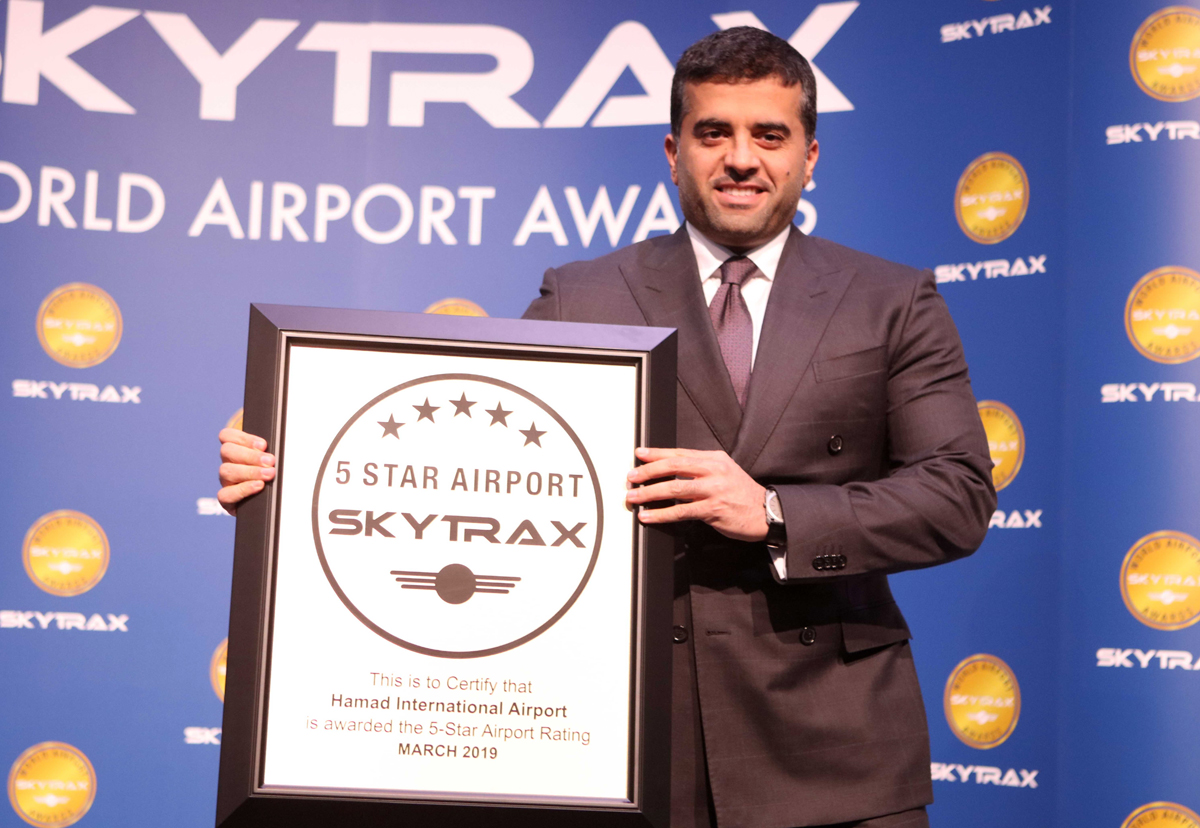
The latest World Airport Star Ratings were announced during the World Airport Awards ceremony in London on 27th March 2019, with Certification presented to Salalah International Airport, Shanghai Hongqiao International Airport, Hamad International Airport, Platov International Airport, Delhi International Airport, Moscow Sheremetyevo Airport, Haikou Meilan International Airport and Milan Malpensa Airport.

Salalah International Airport

Salalah International Airport in Oman was confirmed as a 5-Star Regional Airport. As the primary entry point to the Indian Ocean resort on the Omani south coast, the airport’s key appeal is the excellent efficiency of passenger processes from aircraft to arrival and check-in to gate. For an airport in this particular market are is abundant passenger comforts and facilities serving the needs of families and other leisure travellers, while also making strong consideration for business travellers making the journey between the capital Muscat and the countries second city.


Sheikh Aimen Al Hosni (left) , CEO of Oman Airports received the 5-Star Certification


Shanghai Hongqiao International Airport

Primarily a domestic airport handling more than 42 million passengers, Shanghai Hongqiao International Airport was  announced as a full 5-Star Airport. The upgrade to 5-Star Rating was facilitated by the recent complete renovation and re-modelling of its international terminal 1, with the airport now provide a seamless level of high quality service and product across all customer terminal facilities.

Mr Jiang Yunqiang, the President of Shanghai Hongqiao International Airport


Hamad International Airport

Hamad International Airport, Doha has successfully maintained its quality status and was again Certified as a 5-Star Airport for 2019. In their own publicity, they invite customers to “step inside, to a new standard in airport comfort, convenience and choice”, and following the detailed audit review SKYTRAX were pleased to note that this is a bye line statement that Hamad International Airport lives up to well.

Eng. Badr Al Meer, COO of Hamad International Airport


Platov International Airport

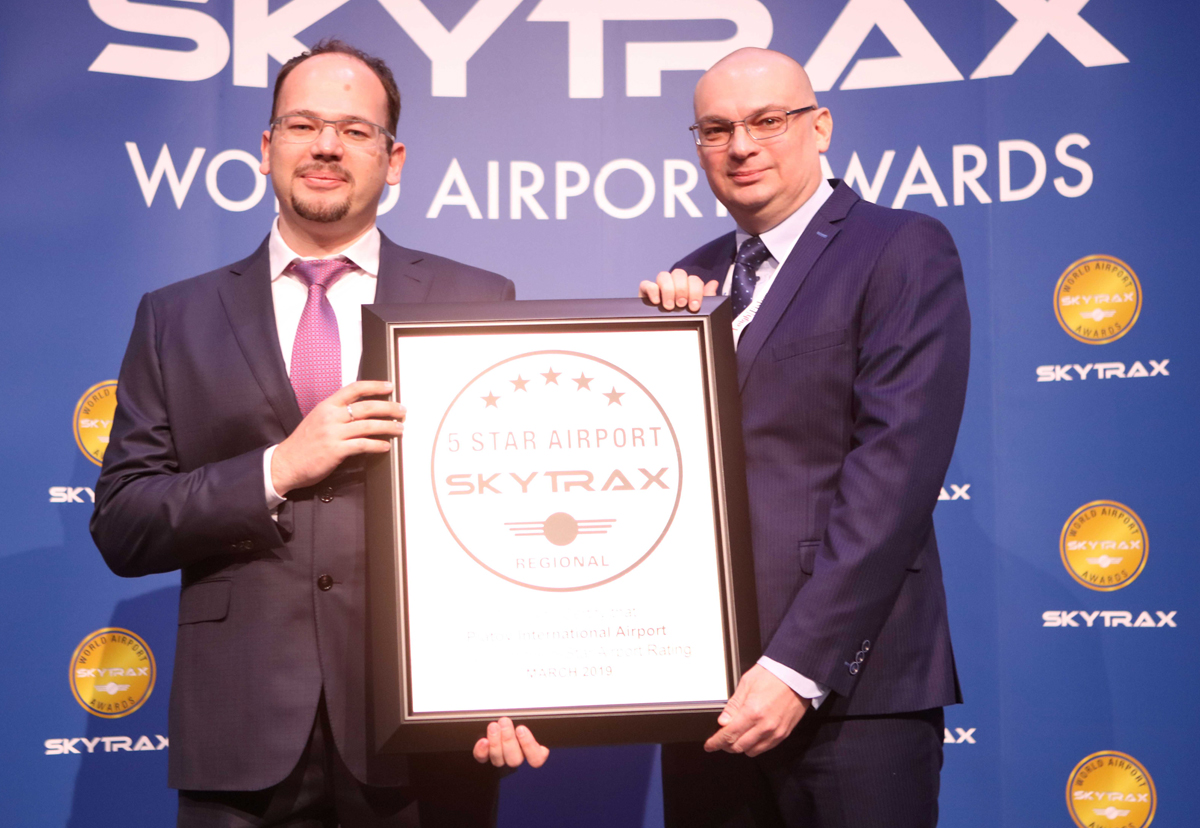
Platov International Airport in Rostov on Don received the 5-Star Regional airport status, just over 1 year since welcoming its first passengers. The airport is the primary gateway to the city of Rostov-on-Don and serves 3 million domestic and short-haul International leisure passengers. The terminal has been designed with excellent processes and efficiency for departure and arrival. Wayfinding, transportation and service procedures for security, immigration and passenger movement all meet 5-star requirments, with many elements of enhanced décor, furnishings and architecture that captures the beauty of the River Don.

Mr Evgeniy Chudnovski, CEO Airports of Regions and Alexander Serov, CEO of Platov Airport


Delhi International Airport

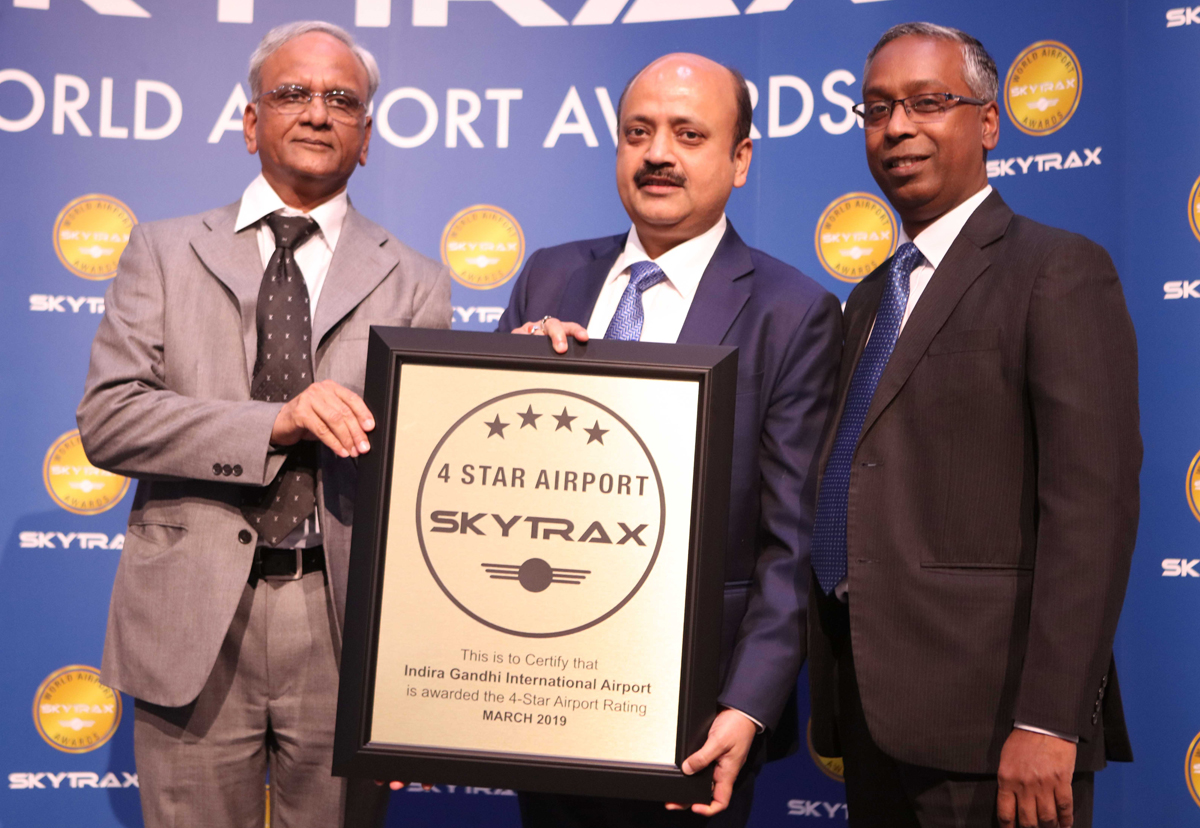
Indira Gandhi International Airport, Delhi is certified as a 4-Star Airport. As a major International and domestic facility Delhi caters well to a wide range of passenger types, across full-service, leisure and low-cost markets. It’s flagship Terminal 3 continues to be improved in terms of customer comfort and facilities, and this includes many exceptional artworks and design features. With significant plans for expansion and terminal renovations passengers should hope to see more quality change and enhancements in the future.

CEO of Indira Gandhi International Airport, Mr. Videh Kumar Jaipuriar 


Haikou Meilan International Airport

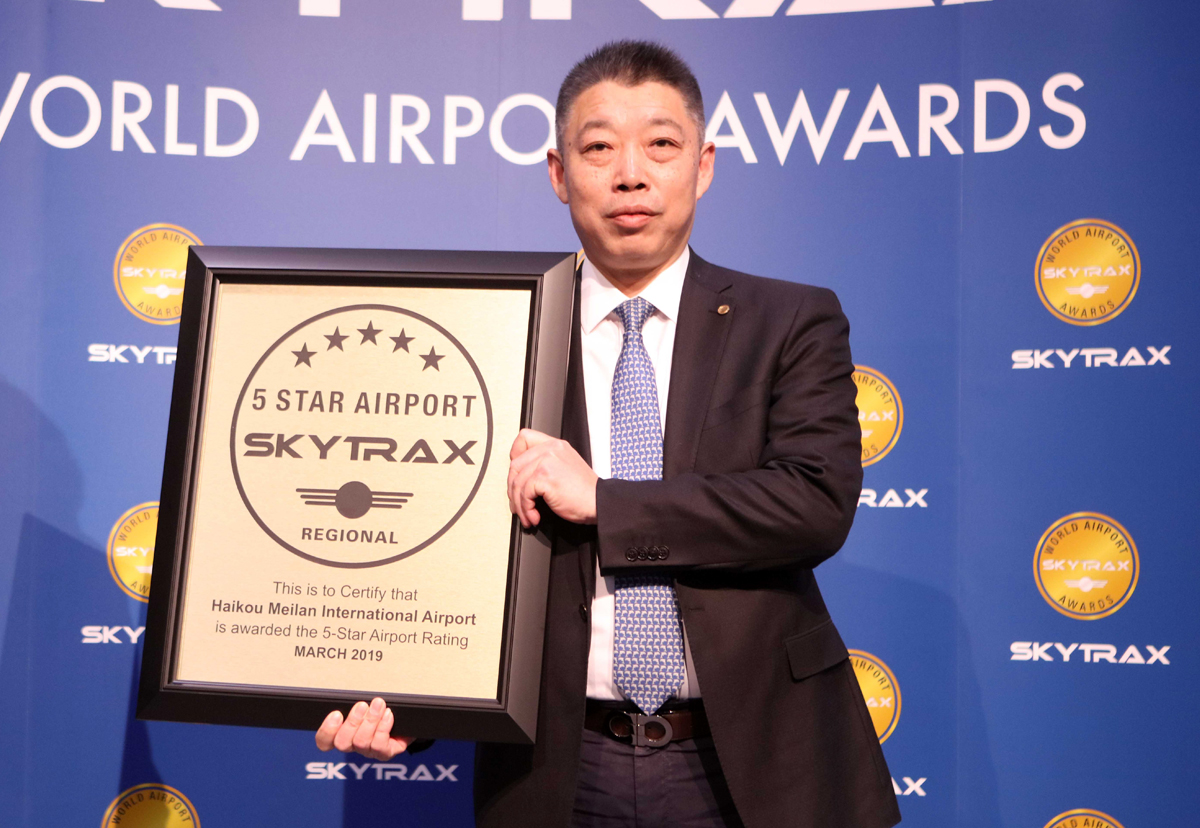
Two years since Haikou Meilan International Airport became the first 5-Star Regional Airport in mainland China, they have again been Certified for 2019 as a 5-Star Regional Airport. With a massive, new Terminal 2 due to go into operation later in 2019, SKYTRAX expect Haikou Meilan International Airport to firmly establish its long term future as a 5-Star Regional Airport.

Mr Wang Hong, President of Haikou Meilan International Airport


Sheremetyevo International Airport, Moscow – Terminal B

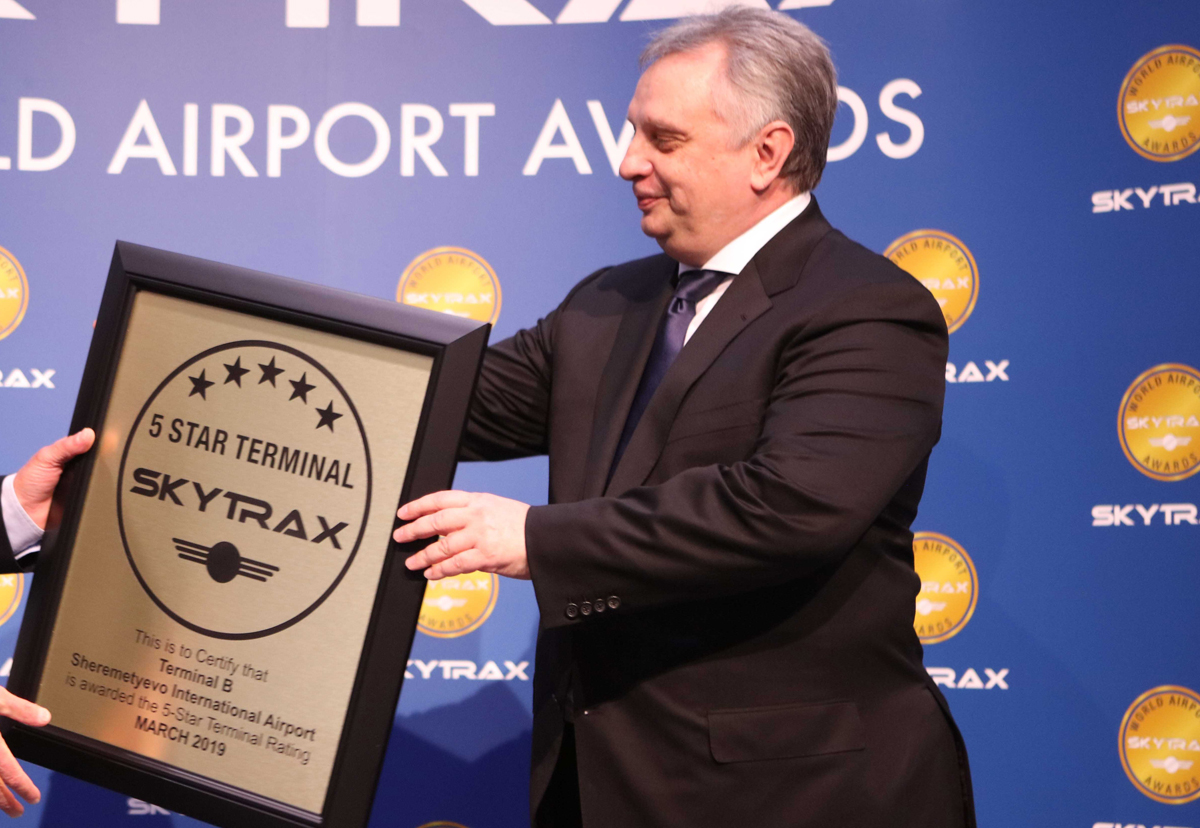
After an intensive programme of construction and quality refinement, Terminal B at Sheremetyevo International Airport, Moscow is being certified as a 5-Star Terminal for 2019. A striking piece of architecture built with a strong Russian constructivist theme running throughout passenger facing areas. Aside from easy movement for departure and arrival, the facilities have been well considered and for example, customers will never find themselves more than 30 metres from the nearest washroom. With further extensions under development to serve International flights in 2020, passengers can expect more exciting upgrades which should deliver a truly World-Class experience.

Mr Michael Vasilenko, CEO of Sheremetyevo International Airport


Milan Malpensa Airport – Terminal 2

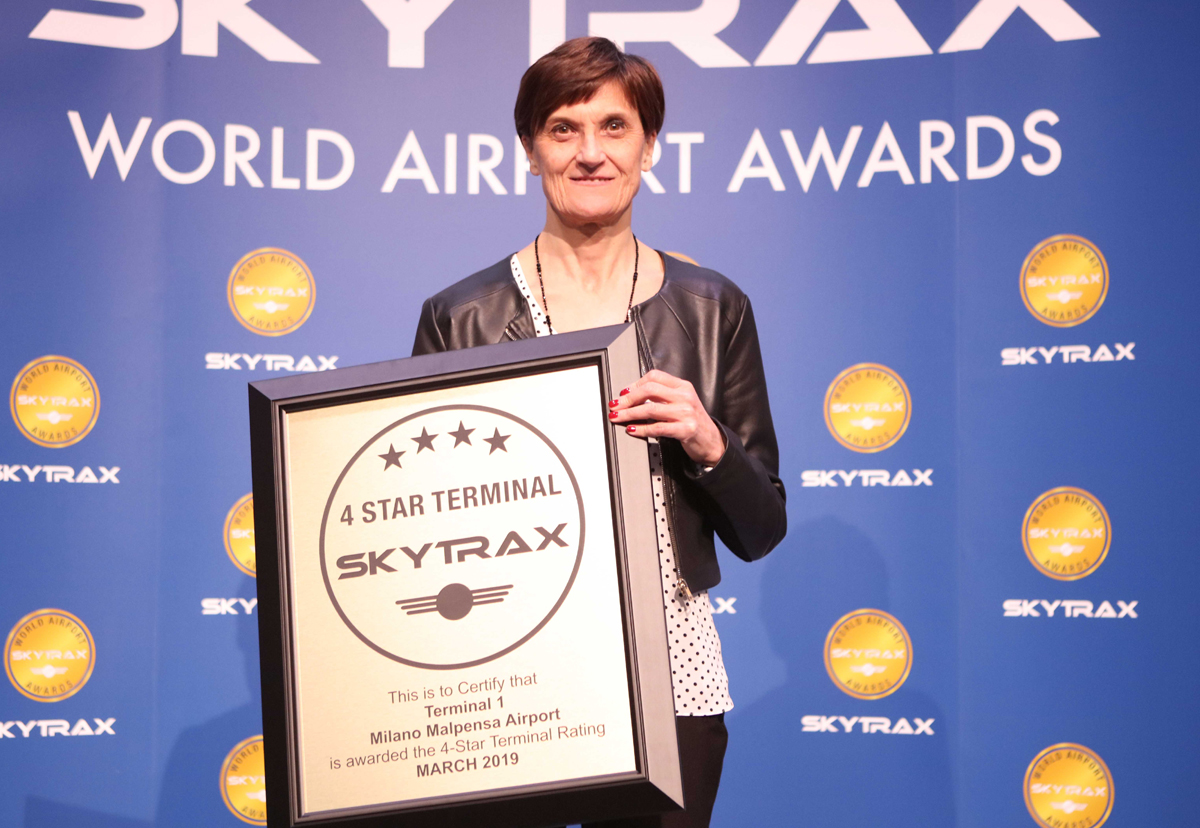
Skytrax announced the 4-Star Terminal Rating for Milan Malpensa Terminal 2. This terminal has undergone extensive redevelopment in recent years to deliver a high standard of shopping and dining facilities – which captures the glamour of Italian design and fashion, while integrating facilities to suit the everyday needs of mainstream customers.

Ms Anna Francinelli of Aeroporto Milano Linate


World Airport Star Rating

Airport Ratings are based on a comprehensive study of over 500 airport product and service items (+/- subject to airport size). The criteria includes key items of process efficiency, terminal comfort and cleanliness, passenger facilities and staff service. Product assessment includes features such as seating, power options, WiFi, washrooms, food and beverages and all front-line facilities. Service ratings cover both official staff (eg. immigration, police, security and customs), as well as more general airport staff (shops, restaurants and cafes, help counters etc.)

Airports do not have to be large hub facilities to achieve the 5-Star and 4-Star Airport ratings. The rating assesses each airports target market and customer base, to determine it’s Quality success in that area. For example, a small regional airport serving point-to-point to routes is not expected the offer the same facilities as a global hub airport, but both airport types are eligible to meet the top tier, 5-Star Airport rating.  In 2016, Regional Airport Ratings were introduced with many regional airports being added to the global rating.

source: https://www.airlinequality.com/news/the-latest-2019-world-airport-star-ratings-are-announced/

How Technology Can Pave The Future Of Our Roadways

Tweet This
uncaptioned image

Photo credit: Getty Getty

By most reports, by 2020 there will be 10 million semi and fully autonomous cars on the road. And according to Stanford Magazine, by 2030, passenger vehicles will drop to 44 million down from 247 million in 2020. 

Dr. Andrew Dubner, Business Leader, 3M Connected Roads says that with an anticipated fleet change that could take decades, roads will need to accommodate both human and machine navigated vehicles. 

“Existing safety materials on roadways today in the form of lane markings and traffic signs help safely guide drivers through visual cues such as shape, color and retroreflective properties for nighttime driving,” said Dubner. “But these same materials can be optimized for machine navigation, as well.”

Dubner says that having the right technology on the road surface is critical for the effective and efficient performance of machine vision systems, especially in challenging weather and light conditions such as rain at night. 

Many vehicles on the road today are equipped with advanced driver assistance (ADAS) technology, such as lane-keep assist or lane departure warning. In 2016, 5,281,385 cars (30%) had blind spot detection. These safety features use machine vision or cameras to ‘see’ the roadway, similar to how the human eye sees the road.

source : https://www.forbes.com/sites/jenniferhicks/2019/03/29/how-technology-can-pave-the-future-of-our-roadways/#36d61a6a7399

Kyushu Saga International Airport to become proving ground for latest technologies

All Nippon Airways (ANA) has partnered with Saga Prefecture in Japan, to transform Kyushu Saga International Airport into one of the world’s smartest, best-connected airports.

The move is designed to make Saga Airport a proving ground for the latest connected technologies, turning it into a hotbed of innovation and a premier logistics hub in the region.

As a prominent testing ground, Saga Airport will collect data on the effectiveness of new technology featured at the site, acting as a template for future “Simple & Smart” airports.

“We seek to innovate and reimagine how the travel experience can be improved by harnessing the potential of technological innovation,” said Shinzo Shimizu, Senior Executive Vice President of ANA. “The on-the-ground tests that ANA will be conducting at Saga Airport will lead to important breakthroughs that streamline and improve service on the ground. This will allow us to complement our exceptional in-flight service with a similar level of logistical support.”

New technology to be featured in the first round of trials at Saga Airport include a wearable robotic exoskeleton, remote-controlled aircraft pushbacks, automatic baggage loaders and automated towing tractors

 The robotic exoskeletons for heavy duty loaders entered service in February, while the first autonomous towing tractors are set to roll out between late March and early April.

 The latest pushbacks will start the trial in mid-April, with the automated baggage loaders being the last of the first batch to undergo testing sometime in the FY 2019.

“We aim to set the standard for modernization at Kyushu Saga International Airport through our partnership with ANA,” said Yoshinori Yamaguchi, Governor of Saga Prefecture. “Saga has a history of innovation, serving as the base of Japan’s industrial revolution, and has leveraged its creativity to build a strong legacy of global leadership in manufacturing. I hope to continue building on these achievements and making Saga a transmission point for the fourth industrial revolution: AI and IoT.”

Officials at Saga Airport and ANA will monitor the performance of these devices closely, using the data gained from these trials to improve efficiency across the airport. This information will also be instrumental in the implementation of other innovations at Saga Airport in the future. © Asia Travel Tips

source : https://japantoday.com/category/tech/kyushu-saga-international-airport-to-become-proving-ground-for-latest-technologies

Panasonic Exhibits Automated Airport Terminal Powered by Facial Recognition

Panasonic demonstrated an automated airport passenger terminal, powered by facial recognition technology, for the first time in London.


London, United Kingdom – Visitors to Passenger Terminal EXPO at ExCel London, from 26-28 March 2019, were introduced to Panasonic’s vision of the ‘One ID’ solution which enables passengers to check-in, pass through immigration, receive directions to the boarding gate from a robot assistant, check personalised flight details using digital signage, and self-board at the gate, without manual ID verification.
The One ID platform is designed to enhance passenger throughput and customer satisfaction by decreasing waiting times, while drastically improving airport operational efficiency. Demonstrating the company’s market-leading security systems, facial recognition technology and artificial intelligence applications, Panasonic provided visitors with hands-on access to the company’s unique version of the solution for the first time.
Simulating a passenger’s journey through an airport, visitors to the Panasonic stand were first able to use the automated check-in counter, which uses facial recognition and an intuitive user experience designed to speed up processing. They were then able to experience the smooth and speedy operation of the facial recognition gates at border control. As they pass through the airport, the facial recognition capabilities of Panasonic’s One ID solution are integrated in to customer service robots and digital signage that directs passengers to their gate and provides personalised flight information.
In addition, automated personal mobility units can be activated via facial recognition and used by passengers requiring assisted transport to their boarding gate. Panasonic’s FacePRO security system, named the industry’s most accurate in independent testing, can also track the whereabouts of passengers on their way to the boarding gate, enabling airport staff to quickly locate passengers who may be lost or delayed within the terminal.
“Visitors to the expo were able to experience the airport journeys of the future and see just how much time and resource can be saved by using technology solutions already available today,” said Shusuke Aoki, Director of the Business & Industry Sector at Panasonic System Communications Company Europe. “Elements of the solution, such as the automated facial recognition gate and security tracking solutions are already in use in major international airports in Asia and Europe, but this was the first time the company’s unique automated end-to-end One ID solution were demonstrated to the public. We see this technology not only revolutionising the way we travel but also bringing about efficiency to sectors such as entertainment and hospitality, with similar applications being used within theme parks, concert venues and sporting events.”
For further information about the Passenger Terminal Expo click here, or visit Panasonic B2B here.

https://news.panasonic.com/global/topics/2019/67181.html