Brussels Airport pilots self-driving shuttle

A self-driving mini-shuttle took its first trial drive on Monday at Brussels Airport, covering a distance of a few meters and stopping or slowing down autonomously. The electric shuttle is the result of a jointly-led project by Brussels Airport and transport company De Lijn, as part of their ambition to increase investments in “intelligent mobility.

Monday’s trial run signals the start of a pilot-phase, currently under development, which will consist of further test drives in the course of 2020, with no passengers but with a steward on board, according to a statement released by De Lijn.

The objective of the test drives is to ensure that the shuttle can transport passengers safely in different types of weather and, most importantly, autonomously —with no steward on board.

If the trial goes as planned, the shuttle, manufactured by Dutch company 2GetThere, is expected to transport its first passengers in 2021.

The shuttle would drive at an average speed of 20 km/h, transporting staff and travellers between the terminal, the air cargo zones and the parking

source : http://brusselstimes.com/brussels/15565/brussels-airport-pilots-self-driving-shuttle

Baggage tracking investment pays off in short time

Published on  09 May by Timos Korosis , DCS Administrator, Aegean Airlines

Like many carriers, we at AEGEAN Airlines have been addressing baggage tracking in response to IATA’s Resolution 753. We are already seeing positive returns on our technology investment in this area.

For us, one major element in offering best services to those who travel with AEGEAN, is punctuality. Punctuality in departure times and punctuality in delivering the luggage immediately upon the arrival of our passengers at their destination. Hence, 12 months ago, we mapped and looked at improving factors that cause failures in a bag’s journey, as part of a drive in AEGEAN to achieve Resolution 753 compliance.

A 2.3% further reduction in total mishandled bags … and more positive results

Last year, our airline carried 13.9 million passengers and handled 9.5 million bags. Thanks to the introduction of new technologies and processes, we saw a 2.3% reduction in total mishandled bags in 2018, compared to 2017.

But this considerable improvement was not the only positive result we achieved by implementing Resolution 753. There were more positive returns ahead. Focusing on factors that our airline could control internally, we reduced the figure for mishandled bags by a further 32%. In addition, 80% of our mishandled bag cases were solved within 24 hours.

We are delighted with the progress we have made so far, but this is just the beginning. We were pleased, therefore, to feature in the SITA Baggage IT Insights 2019 report, which shows that implementation of bag tracking is helping to significantly reduce baggage mishandling in regions all across the world.

The Resolution has driven change

There can be no doubt that implementing Resolution 753 was good motivation for us to dig deeper into the baggage challenge. It led to our close analysis of the issues, along with our mapping exercise to improve and control those factors that disrupt a bag’s journey.

In keeping with Resolution 753, which many will know came into effect in June 2018, we needed to look at baggage tracking at four key points:

  • Passenger handover to the airline
  • Loading onto the aircraft
  • Delivery to the transfer area
  • Return to the passenger

A new philosophy for evaluating baggage mishandling

To improve our baggage mishandling rates at AEGEAN, we adopted a new philosophy for baggage mishandling evaluation. We analyzed codes in different data sets, including mishandling due to transfer, sorting and so forth.

This helped us to get a better understanding of the causes of baggage mishandling. As a result, we have been able to focus on areas where we can influence and eliminate mishandling.

Over the past two years, we have been actively working with IATA and partners to implement Resolution 753. This includes creating an in-house application for processing baggage data from multiple sources, including SITA BagJourney, Star Alliance Baggage Hub and local connections, together with upgrading our error correcting logic.

Enhancing data sources and passenger satisfaction

We have also advanced our Central Baggage Tracing and Lost and Found procedures. This includes enhancing data sources and focusing on improving passenger satisfaction. In addition, AEGEAN has deployed a centralized reporting baggage tool which processes data from various sources and provides advanced monitoring capabilities.

Added to this, we have rolled out Resolution 753-compliant scanning across AEGEAN Airlines’ network. It includes our hub in Athens, Greek state-owned airports and regional airports owned by Fraport within the country. This numbers 96 airports in total. I am proud to say that we are seen as the driving force behind this implementation.

Our airline has also developed new tools allowing us to carry out extensive analysis of performance and processes. These tools enable us to identify bottlenecks within our operation and at the same time ensure that we are always within our SLA and KPI targets.

Next step – real-time tracking app

We are now busily enhancing our app with real-time tracking features, which are scheduled to go live this year. Our app will use the Star Alliance Digital Services Platform (DSP), which covers flights operated by both AEGEAN and Olympic, and flights operated by its Star Alliance partners.

Passengers into our hub airport in Athens already receive automated notifications via a mobile app or SMS, highlighting which baggage belt they should pick their bags up from. And we are improving AEGEAN’s self-baggage drop-off service at our hub by installing additional self-service bag drop processes.

It demands good cooperation across stakeholders

So, there is a lot happening to tackle the baggage journey at AEGEAN. If I were asked to provide two pieces of advice about the processes we have been through, I would say focus on collaboration and clear targets.

Good collaboration is essential among all the stakeholders across this journey. In addition, we believe that by setting realistic and measurable KPIs and SLA targets – between our airline, and our ground handling, airline and airport partners – we can achieve effective tracking as part of a focus on the entire baggage experience for passengers, in line with the high standards we promise to our customers.

source : https://www.sita.aero/resources/blog/baggage-tracking-investment-pays-off-in-short-time?mkt_tok=eyJpIjoiTUdObVlUUTJaamN3TkRNeSIsInQiOiJWTmw2aENJZzNCQlZcL0l4NnJYdHZxUHZlV2htWG81Ynh4Mmw2THZGeFZnZEFDNmx5VkJHMUc3Y09oc2ZQeEI0K1cyM1FMb2Zrd2FiSFZJUUVUeldPcU5wK0o4NGhsU2hiWTdnUStRZTJFWDFCZGhMMmVDNzNCNG5McllMd0hEUzEifQ%3D%3D

DTI backs Taiwanese firm’s plan to bring robot assistants to PH airports

Trade Secretary Ramon Lopez has committed to connect the New Kinpo Group with the Department of Transportation and the Department of Tourism ‘to facilitate its planned installation of airport robot assistants,’ says the DTI

EXPANSION PLANS. Taiwanese company New Kinpo Group wants to expand its presence in the Philippines, its planned regional hub for Southeast Asia

EXPANSION PLANS. Taiwanese company New Kinpo Group wants to expand its presence in the Philippines, its planned regional hub for Southeast Asia

MANILA, Philippines – The Department of Trade and Industry (DTI) supports the plan of Taiwanese firm the New Kinpo Group (NKG) to bring robot assistants to Philippine airports.

The DTI said in a statement on Friday, May 10, that Trade Secretary Ramon Lopez “committed” to help NKG with its plan by connecting it with the proper government agencies.

“Sec Lopez committed to connect NKG with the Departments of Transportation (DOTr) and Tourism (DOT) to facilitate its planned installation of airport robot assistants. Once in place, the robot concierge will guide passengers to their respective terminals by scanning their boarding passes,” DTI said.

Lopez welcomed the prospect of having robot assistants in Philippine airpots.

“These robots can be a great feature in some of our newer airports. These technologies also help bring public awareness to the benefits of artificial intelligence (AI),” the trade chief said.

“As the Philippines has its eyes on being an AI Center of Excellence by 2025, we look forward to seeing more of these and manufacturing them here in the country,” he added.

The DTI said that in 2018, NKG began talks with SM Supermalls to supply them with customer service robot assistants.

The DTI also said that through the Board of investments (BOI), it will support NKG’s expansion plan in the country.

NKG will build a 24,000-square-meter facility in Lipa, Batangas, NKG CEO Simon Shen told DTI officials led by Lopez on May 2. This is also part of the company’s bid to position the Philippines as its hub in Southeast Asia.

DTI said NKG will also develop its manufacturing plant at the First Philippine Industrial Park, Incorporated in Sto Tomas, Batangas, and that the expansion plans will increase its workforce from 11,000 to 18,000 in the next two to 3 years.

NKG’s local subsidiary, Cal-Comp Technology (Philippines), Incorporated, will conduct an initial public offering in 2019 to fund the company’s expansion. – Rappler.com

source : https://www.rappler.com/business/230208-dti-backs-taiwanese-firm-plan-bring-robot-assistants-philippine-airports

Ireland developing as a hub for robot car development

Drive west: Ireland developing as a hub for robot car development

Jaguar Land Rover and Valeo plan west of Ireland expansion for autonomous vehicle tech

Neil Briscoe

‘It’s easy to do autonomous cars in California or Arizona, where the roads are big, the lane markings are clear, and you have great weather,’ says Cormican

It’s easy to do autonomous cars in California or Arizona, where the roads are big, the lane markings are clear, and you have great weather,’ says Cormican

Jaguar Land Rover (JLR) and Valeo, the French vehicle technology supplier, are building up a major hub in the west of Ireland for autonomous vehicle research and development. CAV Ireland (Connected and Autonomous Vehicles) is backed by the IDA and Enterprise Ireland, as well as Science Foundation Ireland, the Department of Transport, and the Lero research institute. There are plans to build up an interlinked group of companies and research centres, around Valeo’s existing operations in Tuam, Co Galway, and JLR’s new autonomous vehicle development centre at Shannon.

I would challenge any car maker to come down here, to Co Kerry, and take a vehicle from Killarney, around the Ring of Kerry

There are even proposals to build a major test track and proving ground facility, directly adjacent to Shannon Airport, which would allow car makers to test and develop their robotic cars before unleashing them on the roads. JLR has even earmarked a circuit of roads in Co Clare (running from Kinvarra down to Kilrush and back around).

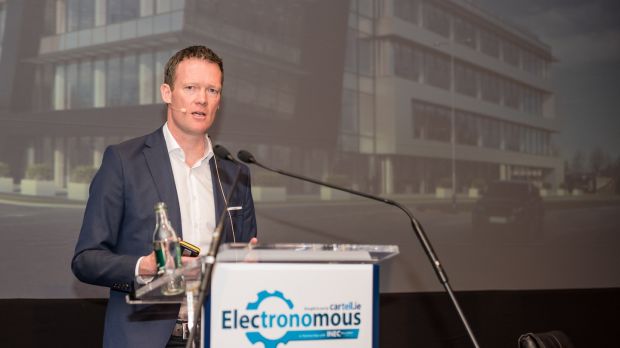
Such development could mean a boost to employment in the area. Speaking to The Irish Times at the Electronomous car technology conference in Killarney, JLR’s John Cormican said: “We started with 12 people, we’re now up to 250. And we intend to keep expanding into the future. It’s been a great journey so far.”

John Cormican of Jaguar Land Rover:

John Cormican of Jaguar Land Rover


Meanwhile, Valeo, the giant French vehicle technology and components supplier, confirmed at Electronomous that it intends “double-digit” hiring of artificial intelligence engineers and developers for its site in Tuam.

Pipeline of talent

Why is the west of Ireland suddenly such a hive of autonomous vehicle technology development? “We’re close to Limerick, Cork, and Galway where we’re based, and in those three cities you have three world-class universities, and three world-class technical colleges, so we have a great pipeline of talent for engineering and software. For the past 30-40 years, we’ve been exporting that talent all over the world which in some ways is great, it’s part of our DNA as a nation. But now hopefully a lot of folks will be staying home and working on tech like this here,” said Cormican. “The amount of tech companies in this country already is mind-boggling. The Dublin tech scene is pretty well known, but out west it’s really growing now. You have ourselves, General Motors, Valeo, Analogue Devices, Cisco, Ericsson, Johnson Controls and more.”

source : https://www.irishtimes.com/business/innovation/drive-west-ireland-developing-as-a-hub-for-robot-car-development-1.3882627

Digitizing travel: Say goodbye to long queues at UAE airports

  • Mark Anthony Karam May 08, 2019

UAE airports are implementing new technological innovations to streamline the passenger’s journey, cutting queues and getting you on your way in minutes, if not seconds.

  • According to the CEO of Dubai Airports, operator of DXB and DWC, the company wants to eliminate physical check-ins
  • Through the adoption of new tech like AI and biometrics, the digital transformation of UAE airports is being made possible
  • Soon, passengers might not need their passports to travel anymore

From hours to 15 seconds: time’s up for long queues at the airport. Soon, you might not even need your passport to travel. 

This will be possible because the UAE is implementing new technology that will allow travelers to enjoy a seamless airport experience. Some of this tech has already been put in place. 

What kind of tech is going into these new digitized airports?

Physical check-in desks will be a thing of the past

As we approach the deadline for Smart Dubai 2021, Dubai continues to undergo digital transformation on all levels of business and infrastructure. 

Naturally, the operator of Dubai International Airport (DXB) and Dubai World Central (DWC), Dubai Airports, will want to follow suite with a similar transition at their airports. 

The company’s CEO, Paul Griffiths, told Aviation Business that Dubai Airports wants to phase out physical check-in desks.  

“What we want is to eliminate them altogether,” Griffiths said. “Soon, I don’t think you’ll need to check-in using any physical token of booking. Most of it will be done at the time of booking in the office or home. We just need to find a way of dealing with baggage and I think technology is moving towards that area too.” 

He explained that the airports they manage “don’t have the space to build a huge amount of new aviation infrastructure, to create additional capacity.” As such, they’ve decided to invest in processes and technology, to streamline the passenger journey. 

“That’s a combination of consolidation and elimination — putting processes together that are currently operated in discrete silos, such as check-in, immigration, security, and boarding,” he added. “All of those at the moment are discrete processes.”

What tech are we talking about here? 

While Griffiths did not go into details regarding the technologies that they seek to implement, we have a general idea of what to expect. 

Across the world, we are already seeing the large-scale digitization of airports. Last year in Uruguay, Carrasco International Airport introduced self-service biometric boarding for LATAM Airlines, allowing passengers to board the plane without having to show their passport or boarding pass at the gate.

In Turkey, the world’s largest, fully-digitized airport is being built – the Istanbul Grand Airport, which began limited operations in late 2018. 

Locally, UAE airports are already making the transition, investing in new tech. In March, Etihad announced that it has partnered with automation tech firm Elenium to bring Abu Dhabi International Airport a slew of new innovations. The partnership will implement voice-recognition technology at self-service kiosks, bag drop and the boarding gate facility.

This will be made possible by utilizing cloud technology, artificial intelligence (AI), computer vision and natural human interfacing. 

“Passengers check-in to their flight and register their biometric data on their mobile device before arriving at the airport,” a press release by Etihad said. This mirrors what Griffiths is aiming for in terms of DXB and DWC.

As for Dubai Airports, they have begun implementing similar new-generation technology, such as smart gates, which were rolled out in 2017. According to the Dubai Media Office (DMO), the number of passengers passing through smart gates at Dubai Airports in 2018 reached 10.7 million – 22.3% of the total number of passengers who travelled through the airports that year. These smart gates can only be used by UAE residents, however. 

source : https://www.ameinfo.com/industry/travel/airport-travel-digitization-passport-control-uae-airports

Exploring India’s ambitious growth plans: AIR Issue 43

In this issue: India’s plans to build 200 new airports by 2040, examining European aviation growth in 2018, and more.

India’s civil aviation ministry recently released its ‘Vision 2040’ document, which sets out plans to have 200 airports serving the country by 2040. But just how will such capacity be achieved? We look into India’s grand plans for air travel.

Elsewhere, robotics are again taking centre stage: a brand new maintenance robot has been undertaking work on a Boeing 737 by moving all around the exterior of the aircraft, in a bid to revolutionise complex structural inspection tasks.

In the Netherlands, local authorities are struggling with a decision whether or not to expand Amsterdam’s Schiphol Airport as it pushes the limits of capacity, and finally, we discuss the security landscape in more detail with Stephen Cooper OBE, the director of operational solutions at Apstec Systems.

Read the issue in full here.

In this issue

Countering drones at airports: what technology options are out there?

A recent spate of incidents involving drones at airports in the UK, the US and the UAE has focused public and media attention on the threat they pose to critical airspace. Julian Turner talks to Adam Lisberg of Chinese company DJI about advancements in drone detection systems.

Read the article here.

Europe’s airports in 2018: talking points from a year of massive growth

Last year saw 136.6 million additional passengers at Europe’s airports, with the top five alone welcoming an additional 16.5 million passengers. Using data provided by ACI Europe, Patrick Kingsland takes a look at the main talking points from an epic year of air travel in Europe.

Read the article here.

Snowed under: mapping US airports’ winter woes

Late January 2019 brought an icy polar vortex to the US, sweeping across the Midwest and Northeast and crippling flight schedules across the region. How did this frigid weather pattern – and the so-called ‘bomb cyclone’ that followed – affect operations at some of the US’s major air hubs? Chris Lo finds out.

Read the article here.

Future tech: robotic repair on the runway

A team of researchers has successfully trialled a four-wheel robot capable of carrying out structural inspections on aircraft. The robot, which was tested at Cranfield University, can stick to and move around the sides and underbelly of an aircraft, as it hopes to revolutionise and automate aircraft maintenance. Adele Berti reviews the technology.

Read the article here.

Skyway vision: an analysis of India’s airport ambitions

India’s civil aviation ministry recently revealed its intention to build 200 new airports by 2040 in a bid to serve the country’s growing air passenger traffic numbers. But with its perennially underperforming domestic airlines and airports, should such plans be taken with a grain of salt? Ross Davies reports.

Read the article here.

Do not disturb: airports helping passengers find some peace and quiet

The number of sleep pods or capsule hotels at airports is increasing as the business travel market continues to grow. Could that mean business travel having a negative effect on our health? And how do these sleep pods work? Frances Marcellin takes a closer look.

Read the article here.

Amsterdam Schiphol Airport: finding the right way to grow

As Amsterdam Schiphol Airport pushes towards its limit of 500,000 flight movements a year, the Dutch Government and local authorities have a dilemma: should the airport be expanded or should a new facility be built? Heidi Vella investigates.

Read the article here.

Discussing airport security with Stephen Cooper OBE

With thousands of passengers passing through their doors on a daily basis, international airports require the utmost security. Could a new high-footfall screening system, developed by APSTEC Systems, soon become a mainstay in departure halls? Ross Davies meets Stephen Cooper, the group’s director of operational solutions and integration, to find out more.

Read the article here.

Next issue | June 2019

In our June edition, we analyse the special privileges national air carriers receive on the regular, and ask whether some of these benefits are being passed down to their passengers.

We also take on a big quest: following IATA’s recent boasts that aviation helps lift entire communities out of poverty, we set out to find if this is really true, and if so – how?

In a special photo feature, we take of tour of the otherworldly Jewel Changi Airport, a mixed-use development which includes a canopy park, sky nets, discovery slides and much more.

Finally, we round up the top lessons learned from ACI’s Combating Human Trafficking handbook and report from this year’s Passenger Terminal Expo.

RECOMMENDED COMPANIES

Learn more

Hover over the logos to learn more about the companies who made this project possible.Show meClose

Most Read

  1. Exploring India’s ambitious growth plans: AIR Issue 43
  2. Future tech: robotic repair on the runway
  3. Amsterdam Schiphol Airport: finding the right way to grow
  4. Skyway vision: an analysis of India’s airport ambitions
  5. Do not disturb: airports helping passengers find some peace and quiet

source : https://www.airport-technology.com/features/exploring-indias-ambitious-growth-plans-air-issue-43/

Advanced Drone Technology Spreads Its Wings in Ohio

A new high-tech radar system called SkyVision, developed by Ohio’s Department of Transportation and the Air Force Research Laboratory, will allow drones to fly beyond the visual line of sight. by Skip Descant / May 7, 2019

A mobile unit houses SkyVision, a radar system designed specifically for drones, at the Ohio Unmanned Aircraft Systems Center at the Springfield-Beckley Municipal Airport in Springfield, Ohio.

Ohio’s Department of Transportation wants to allow drones to fly beyond what the eye can see.

A partnership between DriveOhio — a division of the Ohio DOT — and the Air Force Research Laboratory (AFRL) at Wright Patterson Air Force Base, located near Dayton, has developed SkyVision, a radar system designed specifically for drones. The technology allows unmanned planes to fly “beyond the visual line of sight,” known in aerospace parlance as BVLOS.

“When we look at the development of the technology, whether it’s unmanned traffic management systems or delivery of packages and goods, none of those capabilities are possible without beyond visual line of sight in flight,” said Luke Stedke, managing director of communications at DriveOhio. “What this does is allow that type of testing to occur for commercial, academic and other institutions in the state of Ohio.”

SkyVision allows drones to see and avoid other aircraft — whether they are fellow drones or conventional aircraft — while in flight. The system has also been called an “aircraft control system for drones.”

The Federal Aviation Administration recently granted a Certificate of Authorization to AFRL to operate drones beyond the visual line of sight for the Ohio Unmanned Aircraft Systems Center at the Springfield-Beckley Municipal Airport. Drones will be allowed to fly within a 200-square-mile section of unrestricted airspace near the Springfield airport.

“This also opens the door for commercial companies to work with Ohio, AFRL and the FAA to test their own UAS-related technology using our SkyVision detection system,” said Gov. Mike DeWine, in a statement. “This is a major step in revolutionizing the transportation industry, with Ohio leading the way in aerospace, defense and aviation innovation.”

The move by the FAA follows a similar authorization to allow the Chula Vista Police Department in Southern California to operate drones beyond the visual line of sight. The unmanned aircraft are used as first responders, replying to 911 calls.

Advancing the development of drone technology in Ohio is one piece of the state’s vision to serve as a destination for companies wanting to develop next generation transportation, whether it’s connected autonomous autos or new forms of aviation, said Stedke.

“All of this technology — unmanned aircraft, autonomous vehicles — there are no models for this. These are new systems. These are new companies. These are new companies trying to operate in an old system of transportation. So it’s really going to take partnerships, not only with companies and the government, but intergovernmental partnerships,” said Stedke. “We want to be the one-stop-shop for connected and autonomous vehicles in the state of Ohio.”

VyrtX, a Dayton, Ohio, technology company exploring the use of using drones for medical transport involving human organs, will be one of the first companies to test at the Ohio UAS Center. Test flights are allowed at altitudes of 1,000 to 10,000 feet. The SkyVision system is operated in a large RV-like vehicle to ensure its close positioning near drone aircraft that are in flight.

source : https://www.govtech.com/fs/automation/Advanced-Drone-Technology-Spreads-Its-Wings-in-Ohio.html

Collision-Detecting Suitcase, Wayfinding App Help Blind People Navigate Airports

By Byron Spice

May 07, 2019

Researchers, Pittsburgh International Airport seek to increase independence of travelers with vision impairments

AddThis Sharing ButtonsShare to FacebookShare to TwitterShare to LinkedInShare to PrintShare to Email

By Byron Spice Email Media Inquiries

Carnegie Mellon University researchers say a smart suitcase that warns blind users of impending collisions and a wayfinding smartphone app can help people with visual disabilities navigate airport terminals safely and independently.

The rolling suitcase sounds alarms when users are headed for a collision with a pedestrian, and the navigation app provides turn-by-turn audio instructions to users on how to reach a departure gate — or a restroom or a restaurant. Both proved effective in a pair of user studies conducted at Pittsburgh International Airport.

The researchers will present their findings at CHI 2019, the Association for Computing Machinery’s Conference on Human Factors in Computing Systems, May 4–9 in Glasgow, Scotland.

Carnegie Mellon University and Japanese researchers have created a rolling suitcase, which sounds alarms when visually impaired users are headed for a collision with a pedestrian. They say the smart suitcase, named BBeep, can help people navigate airport terminals safely and independently.

CMU and Pittsburgh International Airport are partners in developing new systems and technologies for enhancing traveler experiences and airport operations.

“Despite recent efforts to improve accessibility, airport terminals remain challenging for people with visual impairments to navigate independently,” said Chieko Asakawa, IBM Distinguished Service Professor in CMU’s Robotics Institute and an IBM Fellow at IBM Research. Airport and airline personnel are available to help them get to departure gates, but they usually can’t explore and use the terminal amenities as sighted people can.

“When you get a five- or six-hour layover and you need to get something to eat or use the restrooms, that is a major hassle,” said one legally blind traveler who participated in a focus group as part of the research. “It would be lovely to be able to get up and move around and do things that you need to do and maybe want to do.”

An increasing number of airports have been installing Bluetooth beacons, which can be used for indoor navigation, but often they are deployed to enhance services for sighted travelers, not to help blind people, said Kris Kitani, assistant research professor in the Robotics Institute.

He and his colleagues deployed NavCog, a smartphone-based app that employs Bluetooth beacons, at Pittsburgh International Airport. The app, developed by CMU and IBM to help blind people navigate independently, previously has been deployed on campuses, including CMU, and in shopping malls. They modified it for use at the airport, where extremely wide corridors make users vulnerable to veering, and for use with moving walkways. As part of the project, the airport installed hundreds of Bluetooth beacons throughout the facility.

“Part of our commitment to the public includes making sure our airport works for everyone, particularly as we modernize our facility for the future,” said Pittsburgh International Airport CEO Christina Cassotis. “We’re proud to partner with such great researchers through Carnegie Mellon University. Having that world-class ingenuity reflected at our airport is emblematic of Pittsburgh’s transformation.”

The app gives audio directions to users. It relies on a map of the terminal that has been annotated with the locations of restrooms, restaurants, gates, entrances and ticketing counters.

Ten legally blind people tested the app using an iPhone 8 with good results, traversing the terminal’s large open spaces, escalators and moving walkways with few errors. Most users were able to reach the ticketing counter in three minutes, traverse the terminal in about six minutes, go from the gate to a restroom in a minute and go from the gate to a restaurant in about four minutes.

The NavCog app for iPhone is available for free from the App Store and can be used at Pittsburgh International in the ticketing area of the landside terminal and in the concourses and center core of the airside terminal.

Another team, including researchers from the University of Tokyo and Waseda University in Tokyo, developed the smart suitcase, called BBeep, to help with another problem encountered in airports — navigating through crowds. The assistive system has a camera for tracking pedestrians in the user’s path and can calculate when there is a potential for collision.

“Sighted people will usually clear a path if they are aware of a blind person,” said Asakawa, who has been blind since age 14. “This is not always the case, as sighted people may be looking at their smartphone, talking with others or facing another direction. That’s when collisions occur.”

BBeep helps clear a path. A rolling suitcase itself can help clear the way and can serve as an extended sensing mechanism for identifying changes in floor texture. BBeep, however, can also sound an alarm when collisions are imminent — both warning the user and alerting people in the area, enabling them to make room. A series of beeps begins five seconds before collision. The frequency of the beeps increases at 2.5 seconds. When collision is imminent, BBeep issues a stop sound, prompting the blind user to halt immediately.

In tests at the airport, six blind participants each wheeled BBeep with one hand and used a white cane in the other as they maneuvered through crowded areas. They were asked to walk five similar routes in three modes — one where the suitcase gave no warnings, another in which the warnings could only be heard by the user through a headset and another in which warnings were played through a speaker. A researcher followed each participant to make sure no one was injured.

The researchers said the speaker mode proved most effective, both in reducing the number of pedestrians at risk of imminent collision and in reducing the number of pedestrians in the user’s path.

“People were noticing that I was approaching and people were moving away … giving me a path,” one user observed.

In addition to Kitani and Asakawa, the authors of the BBeep report are Seita Kayukawa and Shigeo Morishima of Waseda University, Keita Higuchi and Yoichi Sato of the University of Tokyo, and João Guerreiro, project scientist in the Robotics Institute. Guerreiro, Asakawa and Kitani are joined in the NavCog report by Daiskuke Sato, a CMU project scientist, and Dragan Ahmetovic of the University of Turin.

The National Science Foundation; the National Institute on Disability, Independent Living and Rehabilitation Research; the Allegheny County Airport Authority; and Shimizu Corp. sponsored both studies. The Japan Science and Technology Agency and Uptake provided additional support for BBeep.

source : https://www.cmu.edu/news/stories/archives/2019/may/suitcase-helps-navigate-airports.html

Using tech to overhaul one of the most troublesome parts of the travel experience

By Mitra Sorrells | May 8, 2019

More than 22 million passengers and 13 million bags passed through Dubai International Airport in the first quarter of 2019, making it one of the busiest hubs in the world.

In addition to ongoing physical renovation and expansion projects to manage this volume, the airport is continually investing in new technology to improve and expedite the customer experience.

To learn more about this, we asked Dubai Airports’ executive vice president of technology and infrastructure, Michael Ibbitson, to share details about the facility’s technology strategy. Dubai Airports owns and manages the operation and development of both of Dubai’s airports – Dubai International (DXB) and Dubai World Central (DWC).

Dubai International Airport is the world’s busiest airport for international travel – and getting busier year after year ‐ and yet you managed to reduce wait times by 28% in 2018. How did you do that? Can you share some additional examples of how technology is improving the traveler experience at the airport?

There were three significant factors involved: implementing smart technology, leveraging big data and intensifying collaboration.

Over the past two years we have worked with the local immigration authority to improve performance, enhance wayfinding and encourage the passengers to use Smart Gates. This boosted usage, dropped queue times and created additional airport capacity by lowering overall transaction times per passenger.

Today the passenger queues at immigration desks are monitored through real-time dashboards with sensors published to the airport stakeholder through a mobile application to improve performance and passenger experience.

DXB has over 23 billion data points, collected every six months in our real-time analytics platform. Enter the airport community app – a shared platform that made an immediate and dramatic impact on Dubai Airports’ operational managers as well as the thousands of operational staff in stakeholder organizations.

The platform, for the first time, extended real-time, relevant data on customer touch points across the airport’s operational community. Suddenly data was transparent and shared, driving greater accountability and leading to more predictive approaches to problem resolution. The community app has grown to over 20,000 users, with new features added all the time.

The platform relied on a number of other technological implementations. For example, Xovis technology, which leverages a network of sensors across DXB, monitors passenger movement and reports queues in real time. Not only does this lead to day-of responses, it identifies patterns and trends and proactive plans to avoid or limit repeat occurrences. 

Another critical implementation was Splunk for baggage. Real-time dashboards have been rolled out to improve baggage delivery times, transfer bag performance and automated analysis.

The most dramatic implementation and evidence of the airport management company’s commitment to data management was the opening of its Airport Operations Control Centre in 2018. It’s also one of the best examples of close collaboration where hundreds of staff from across the airport work closely together every day. The AOCC is a key element in our strategy to implement collaborative decision making and, ultimately, total airport management.

Arguably the biggest and most sophisticated of its kind, the new AOCC is a 24/7, co-located control room for all airport service partners (Dubai Airports, Dnata, Dubai Police, Road & Transport Authority, DCAS, Dubai Customs, Dubai Immigration/General Directorate of Residency & Foreigners Affairs, etc.). It provides real-time data feeds from across the airport (airfield, aircraft stands, baggage, terminals, touch points, queuing, flight information display screens, security, etc.), tapping into over 90 applications and feeding it to up to 120-plus staff via 96 work stations and 12 video wall screens.

It is a fully resilient, mission-critical facility across all services (power and network). It was also enabled by implementation of new systems, such as Dubai Airports’ Airport Operations System and Real-Time DXB that provides a digital clone of the airfield to all stakeholders, keeping them aware of aircraft movements, stand capacity, on-time performance, passenger transfer matrix and many others from a single source of truth.

All of this tech has made a massive contribution to enhancing the customer experience.

What are the challenges in using technology to expedite and improve the guest experience while also needing to ensure security?

We believe both can and should be achieved simultaneously. The biggest challenge, and the biggest opportunity, involves the definition and adoption of global industry standard for a single biometric footprint, which will transform the customer experience by enabling a one-time capture of data that can then be used at multiple points in the customer journey in a seamless and non-intrusive way.

We are working locally and globally, with organizations including IATA and the World Travel and Tourism Council, to further the case for a common single biometric identity. This would unleash a new world of convenience while heightening security.

Imagine an airport with no check-in, no immigration and discrete, non-intrusive security, all enabled by a single identity database, securely held in the cloud and available to those who currently need physical evidence of our identity as we travel.

The possibility then emerges to reorder the entire travel process around customer service rather than around the convenience of everyone else in the supply chain. And if we extend our thinking around making the links between ground and air more efficient, then maybe we don’t need an airport terminal at all.

What if that journey could start at multiple points of convenience near where people live or work? What if the airport terminal and building could be disaggregated into multiple smaller, convenient entry points into an airport transit system that can take customers from their homes or places of work directly to their plane? What if we could bypass all the changes of mode, baggage issues, queues, multiple documentation and security checks and long walking distances – all the things we hate when we travel?

In announcing the new DXB brand, you said, “The new brand represents the ways in which we connect the world, not only by physically facilitating access to over 220 destinations around the world, but by transporting our customers through their experience of different cultures, food, music and art.” Can you tell us more about some of these experiential features?

The new DXB brand embodies the unique values of our home city, Dubai. Our intention is to transform DXB into a destination in itself by creating exciting, immersive experiences that bring the iconic parts of Dubai into the airport as well as music, art and even fashion exhibitions that showcase local culture and celebrate diversity.

MusicDXB and ArtDXB are long-standing examples of those experiential features that continue to mature and add value. We first introduced the concept of live music concerts in the airport four years ago. This year we upped our ante with an in-house resident DJ and a regular program of curated performances from local and global artists demonstrating a culture of vibrant imagination, openness to fresh ideas.

Dining is a very important part of a traveler’s journey through the airport, so we have introduced a range of interesting and different options to choose from. Exclusive to DXB are the traditional flavors of the S34 Gahwa Mezza Bar and an Americana-style diner with an Arabic twist, Tranzeet DXB.

Understanding the needs of our truly global audience, we have also opened in the past year the licensed Hard Rock Café, joining more than 100 other food and beverage outlets.

Combined, the experiences support the creation of a destination that celebrates Arabian culture showcasing to a truly global audience local heritage and tradition.

Looking ahead, what technologies do you think hold the most potential to improve the air travel experience?

As mentioned earlier, we need global standards to unlock the value of existing and future technologies such as biometrics. Going forward, advancements in autonomous vehicles and ground transportation systems will improve the access to and interface with aviation. 3D printing presents some interesting possibilities for creating dynamic airport environments and managing things like spare parts.

Security screening technologies are developing at a terrific pace recently. They could provide a better experience from the basics of not removing liquids and gels and laptops from bags to not even separating passengers and their hand luggage, as the whole process becomes passive.

However, the regulatory challenges to such massive change to the way industry works will require some brave and disruptive support from governments and regulators.

What are Dubai Airports’ priorities for the next five years?

Our primary focus, beyond the essential provision of a safe and secure operation and environment, is providing our customers with efficient and convenient passage through our airports, top flight products and services and experiences that transcend the norm and make DXB a destination in and of itself.

DXB is already the world’s number-one airport for international passenger numbers; our next goal is to make it number one for service. Ultimately, Dubai is counting on us to provide the capacity, innovation and levels of service that align with the city’s global reputation and continue to significantly contribute to the emirate’s social and economic development.

We also have a large focus on energy efficiency and carbon footprint. We have started a number of initiatives in the last two years that will see our energy consumption decline by over 20% by 2023. This is paired with a switch to zero-emissions vehicles used airside, that will take five to 10 years to fully come to fruition due to the lack of supporting products in the market place.

What factors have enabled Dubai Airports to emerge as one of the most innovative airport companies in the world?

First and foremost, it is absolutely embedded in the city and country that we call home. Dubai’s relentless pursuit of innovation, excellence and willingness to understand, embrace and prepare for the future is second to none. That spirit is contagious, and we have embedded it in our corporate culture and do our best to convey it in everything we do.

We also have staff from around 60 countries providing our services to passengers from all nations. This provides us with a very diverse and multicultural environment that mirrors the society we live in.

source : https://www.phocuswire.com/Dubai-Airports-technology-innovation-strategy

Future tech: robotic repair on the runway

A team of researchers has successfully trialled a four-wheel robot capable of carrying out structural inspections on aircrafts. The robot, which was tested at Cranfield University, can stick to and move around the sides and underbelly of an aircraft, as it hopes to revolutionise and automate aircraft maintenance.

Aircraft maintenance is a time-consuming procedure that takes up about 20% of total operating costs and, being usually done manually, is subject to human error.

Yet repair and inspection operations may soon become automated, thanks to the latest work carried under the CompInnova project, a European scheme that focuses on emerging technologies.

Promoted by the European Commission, the CompInnova initiative is funded by the EU’s H2020 Framework Programme and coordinated by UK-based Cranfield University in collaboration with four other partners.

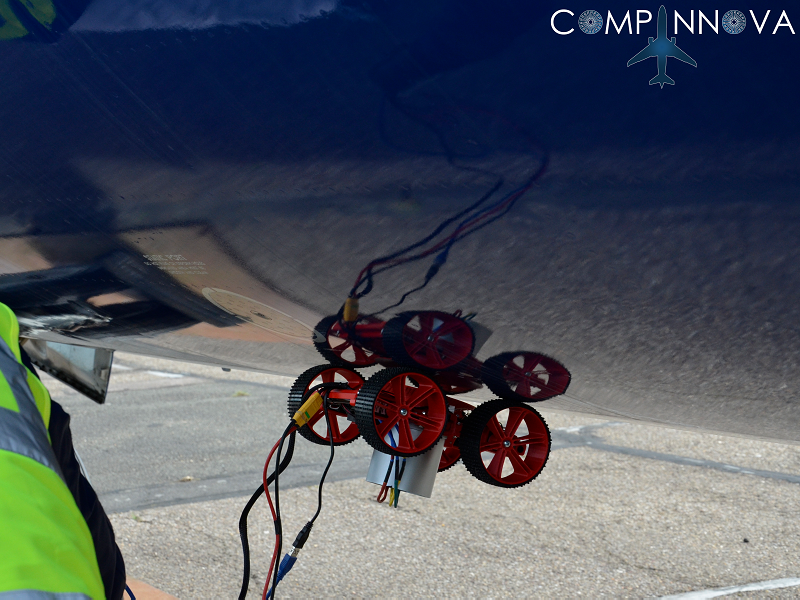
Within this framework, experts participating to the initiative have recently developed a four-wheel robot capable of moving around the surface of a plane carrying structural inspection.

With a little more than a year left before its official release, the prototype robot, called Vortex Robot, was successfully trialled on Cranfield University’s Boeing 737 aircraft in February.

Automating aircraft inspection

According to Joao Raposo, international project manager at Cranfield University, the concept of the project is to develop a comparative strategy for inspecting and repairing composite materials in aircrafts. “The goal is to automate as much as possible the parts (of maintenance procedures) that require the least technical skills”, he says.

The Vortex Robot does just that. Equipped with force sensors that can measure adhesion and controlled motorised wheels, the machine uses intense suction to climb the outside of the aircraft to detect damaged composites.

The platform also features a number of inspecting technologies that allow it to gather information on the state of the aircraft while moving around it.

Developers have also equipped it with an ultrasonic sensor – allowing in-depth characterisation of the types of damage the aircraft has – and an infrared thermography. “The goal is to automate as much as possible the parts that require the least technical skills.”

“The idea is to have a first high-level inspection of the aircraft using the infrared thermography,” says Cranfield lecturer Luca Zanotti Fragonara, “and then we will use the robot again to inspect it in detail with the ultrasonic sensor.”

The technology will then allow to create a digital twin version of the aircraft registered in a database through which staff will be able to find and sort the damages.

Next steps: damage repair and optimised laser removal

Having successfully tested the inspection robot, the CompInnova team is now working to complete the development of an autonomous version of the robot, called a ‘manipulator’, with integrated repair capabilities.

Designed to inspect planes undergoing long-term periodic checks, the manipulator is connected to the aircraft fuselage through suction caps, instead of wheels, that help reduce its power consumption.

Over the next few months, Cranfield’s partner University of Patras will be working to optimise a laser removal procedure to install on the robot, which, Zanotti Fragonara explains, will remove the damaged composite material layer by layer. “In the long term, we are hoping that the robots will fully replace the need for human intervention.”

“It’s almost like a surgical operation on the aircraft,” he says. “It will allow the robot to isolate the materials from the composite parts that are damaged and apply a patch to fix the damage.”

According to the researchers, the ultimate goal is for the different robots to work together and make maintenance and inspection more efficient and quicker.

“Overall, you will have a digitalised model of the aircraft where you can either continuously monitor the evolution of damage or, when necessary, operate and repair the damage.”

At this stage, human intervention is still quite important when it comes to repairing damaged composites, but, as Raposo puts it, “in the long term, we are hoping that the robots will fully replace the need for human intervention.”

source :https://www.airport-technology.com/features/future-of-aircraft-inspection/