SITA provides Viggo with more efficient operations from check-in to departure at Eindhoven Airport

With flights arriving and departing every few minutes, a real-time overview of resources is vital.

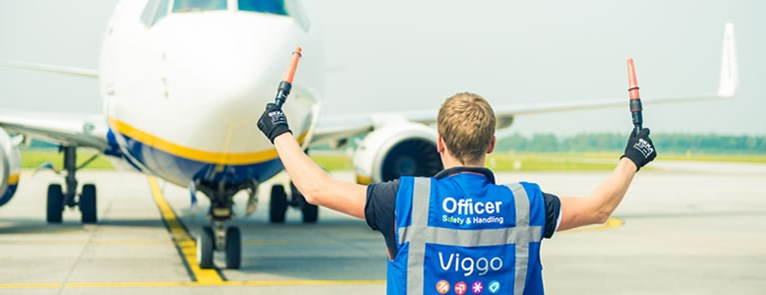
Viggo, the sole ground handler at Eindhoven Airport, has implemented SITA’s latest Airport Management System to manage one of Europe’s fastest-growing regional airports, ensuring timely aircraft turnaround times and a more efficient passenger journey.

With flights arriving and departing every few minutes, SITA’s AirportResource Manager allows Viggo to co-ordinate and monitor tasks of the more than 500 employees working across the airport. SITA’s technology also supports all airside ramp activities during the turnaround of low-cost carriers at Eindhoven.

Martijn Limburg, Managing Director of Viggo said: “SITA’s Airport Management System has brought new capabilities and efficiency to Viggo Eindhoven Airport by providing an integrated, real-time view of our operations in both the terminal and airside. It has helped us secure our on-time performance by improving the effective use of all our resources by setting uniform target times. This has contributed to a better customer journey while at the same time maintaining staff efficiency at the highest level.”

Starting from 2020, SITA’s technology is planned to support operations at Lelystad Airport, the Netherland’s newest regional airport, by offering a scalable management solution which supports Viggo’s multi-skilled resource model.

SITA and Viggo have worked together for many years with Viggo becoming the first licensed Airport Management System delivery consultant for other SITA customers. This means that SITA’s innovative solution can now be combined with Viggo’s operational knowledge and hands-on experience to ensure a successful implementation that provides customers real control and insight over their daily operations.

Sergio Colella, SITA President, Europe said: “For any airport and ground-handler to operate at their maximum efficiency, it is important to have a full picture of what is happening across their operation at all times. Our Airport Management System provides that big picture and it is gratifying to see our technology supporting one of the most efficient airports in Europe.”

Last year Viggo welcomed roughly 6.3 million passengers on almost 40,000 flights at Eindhoven Airport.

source : https://www.sita.aero/pressroom/news-releases/sita-provides-viggo-with-more-efficient-operations-from-check-in-to-departure-at-eindhoven-airport?mkt_tok=eyJpIjoiTVdKaFl6QmhORGhqWVRBeiIsInQiOiJHc2RCMGV0aGhBclJMZ1d6WUlsV3RwTDFuMXpqVGhpY0ZjTkdrVUdvOHZISEo0SEcrVlVLNFwvWlJyamhxUjU2QVZ6UzhmSXpFRUt3ckNha2NhQnJiXC81RVdFM29DNFVrZHliTmJwNUZhUTNMcHc1T2pkSXRuQ1JlaU5zS2ROenBZIn0%3D

A robot showed me around the airport in Seoul

The network is already governed by algorithms, but in the real world robots are still an unusual sight. At the airport in Seoul, I could not miss the opportunity to exchange with a few courtesies.

Last week I spent in South Korea, where I looked closely at various LG brand equipment. In addition to factories (which unfortunately I could not take pictures) and the LG Best Shop brand store, I had the opportunity to visit numerous showrooms in which the company flexed electronic muscles.

The number of categories in which LG is present today is impressive.

When I think about this brand, smartphones are in front of my eyes … because this category of devices awakens the biggest emotions today. Immediately afterwards, I remember that LG’s phenomenal OLED TV sets perform better. However, how to think about it, however , the Korean company prizes, however, primarily in the segment of household appliances .

lg best shop 0

This can be seen after delving into the structure of the company’s revenues. The electronics department, which consists of several entities, as a whole is responsible for the lion’s share of them. And if you look closer at this category, the sale of household goods brings the most money to LG.

No wonder the producer wants to pay attention to it. In the show rooms, which were located in the many LG offices that I had the opportunity to visit, so swarmed with microwaves, stoves, double drum machines, refrigerators with their own operating system and numerous other devices.

lg cloi robots

A lot of space was also devoted to the robots from the LG CLOi series.

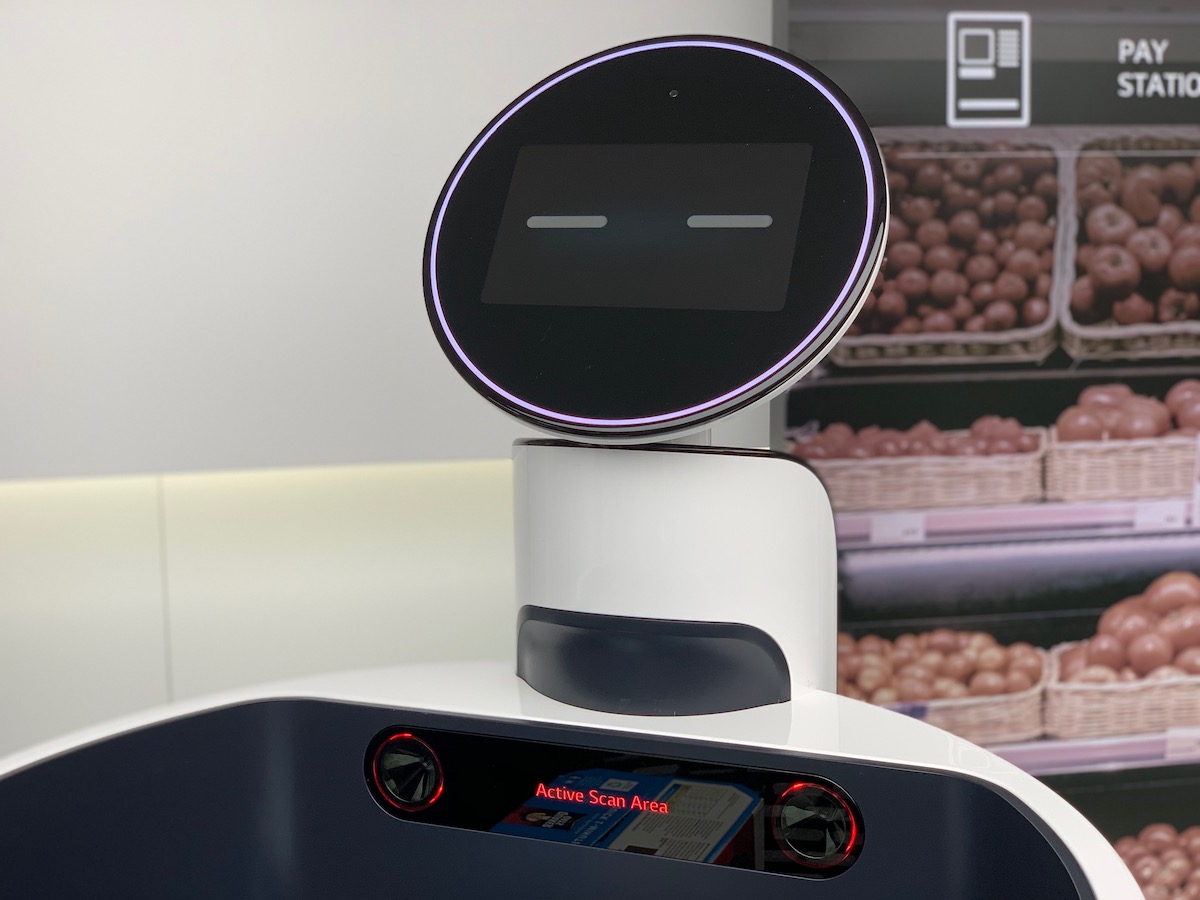
At the exhibition I was able to see a lot of different types of robots from the LG CLOi family and equipment using technologies based on artificial intelligence and machine learning. From tiny autonomous vacuum cleaners and lawn mowers, to anthropomorphic assistants.

Of course, at this moment, the rebellion of machines from the series of films “Terminator” does not threaten us. LG CLOi robots are unaware. The multitude of possibilities of their interaction with the surroundings, however, makes an impression and even a bit worries. The Korean company sees in robotics the future and even … the present.

lg cloi robot seoul korea airport

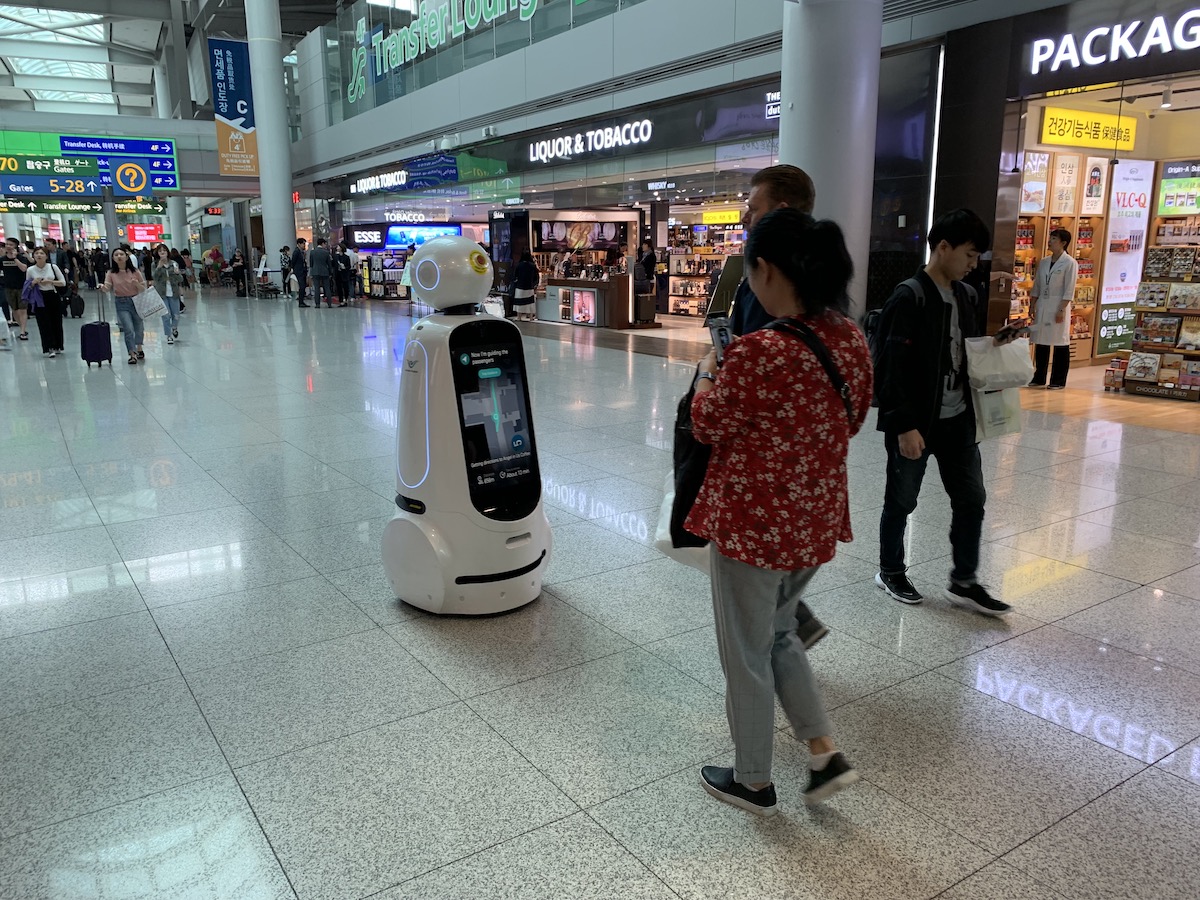
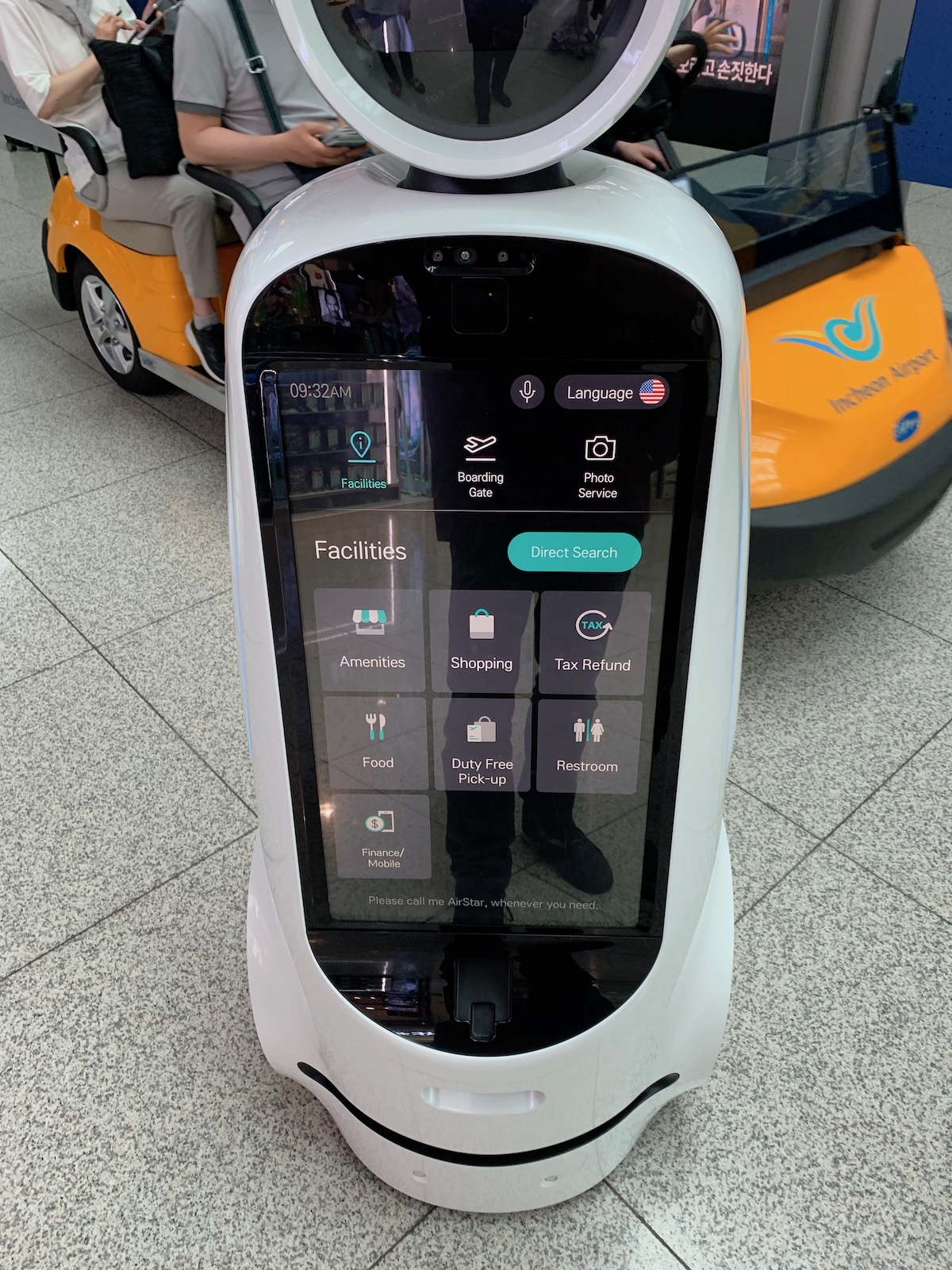
On the robot LG CLOi I came across the way back at the airport.

Watching machines even in a sterile room is impressive, but at the exhibition they still look like something unreal, straight from the future. Returning from my trip home, at the airport in Seoul I came across a representative of the series C-3PO LG CLOi in its natural environment.

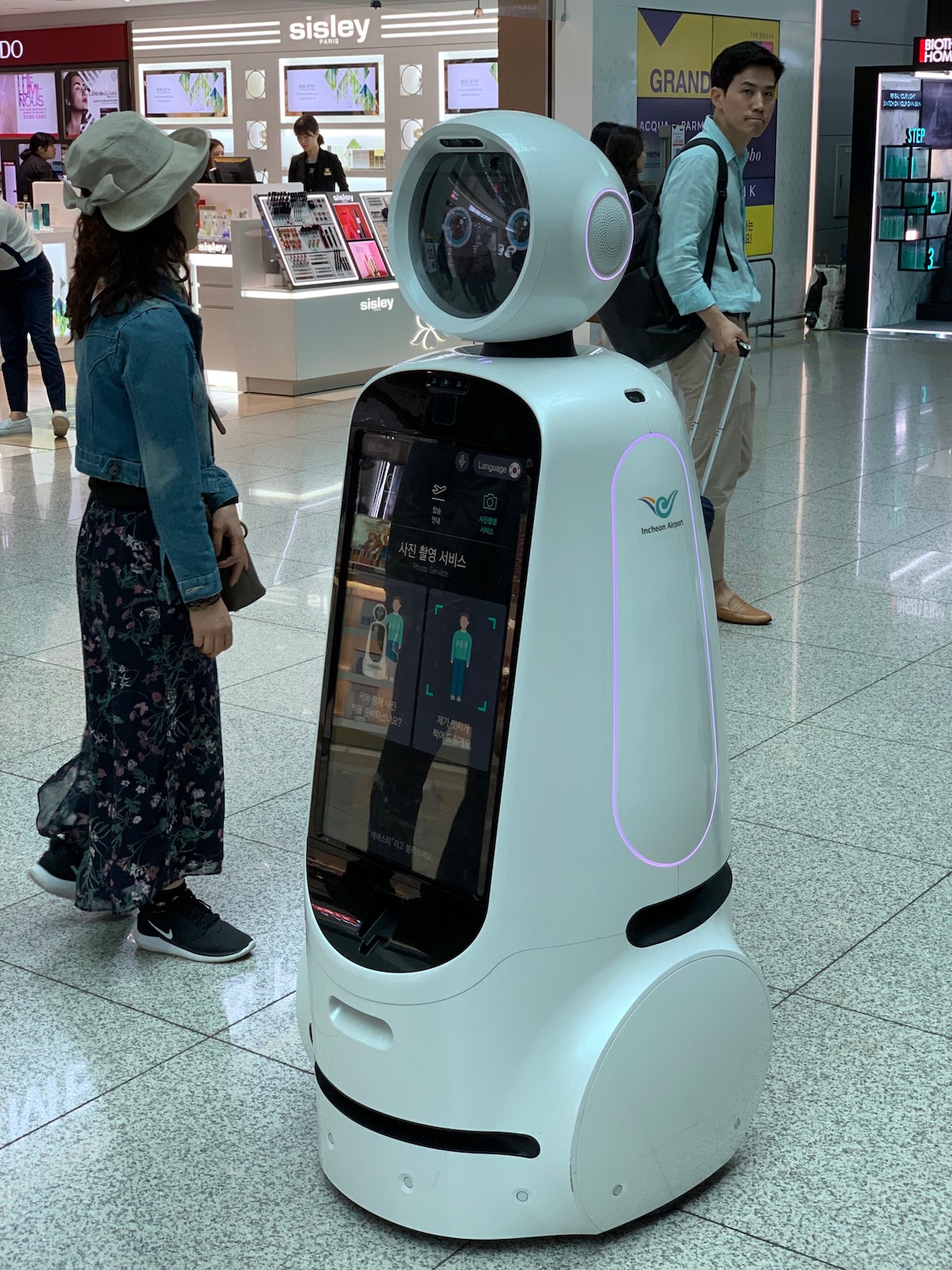
Although the robots prepared for the airports do not have a logo – its removal from the housing requires, as I managed to determine, a contract with the authorities of the Seoul airport – but the characteristic “eyes” can not be confused with anything else. I missed the opportunity and approached him warily.

lg cloi robots

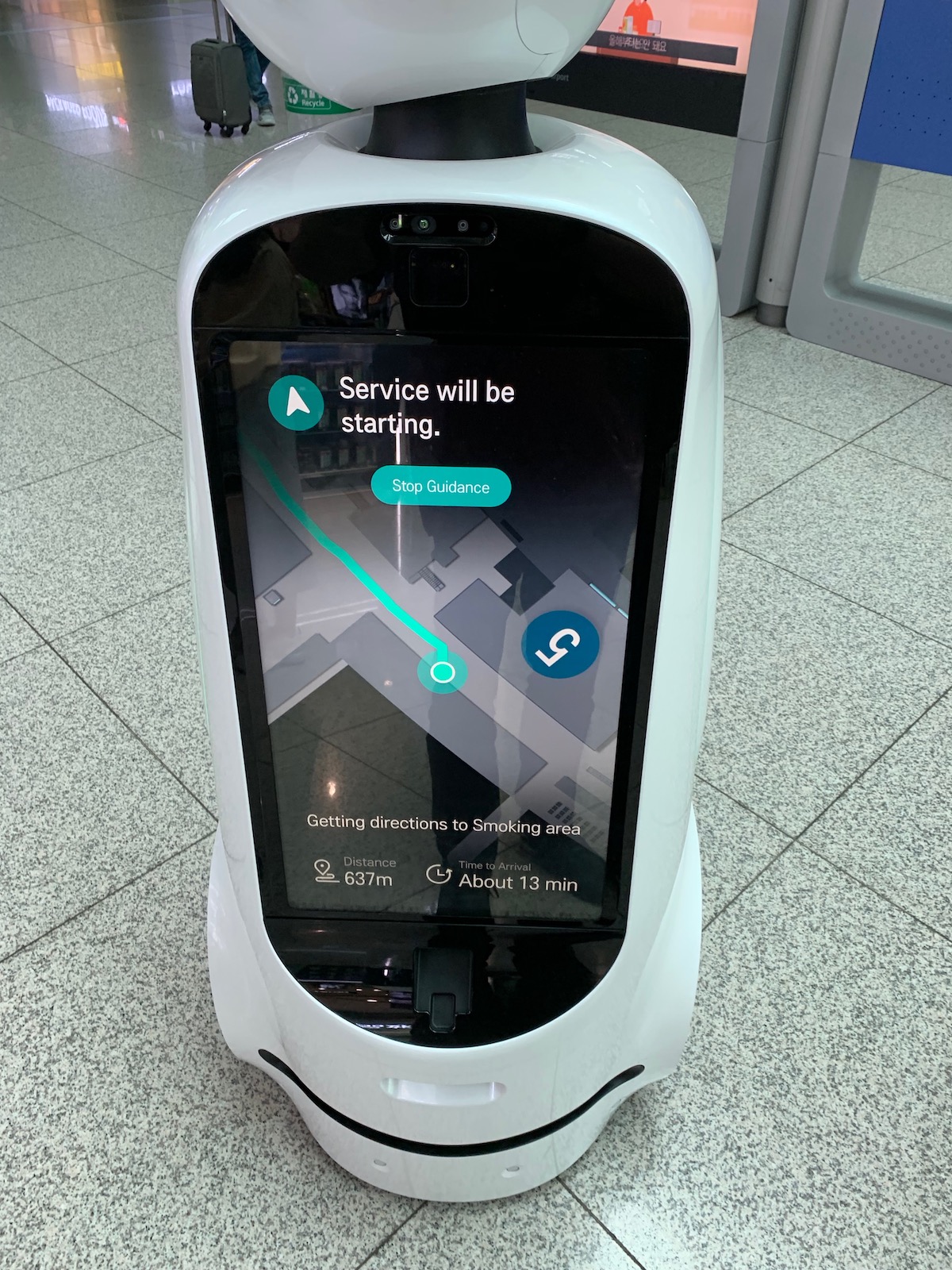
The robot hesitantly showed me where my goal is.

It was enough to go to the robot and touch the screen located on his chest . I changed the language to English, and the first test was to check whether the robot would be able to convey where my gate is. The test was passed, but let us not kid ourselves – just to the goal it will be everywhere without help.

From the experience (fortunately of a former fireman) I know, however, that finding a roaster at the airport, especially one that is visited for the first time in a lifetime, is often a journey of torment. So I checked out of curiosity whether the robot would show me the way to the place where you can catch the balloon .

lg cloi robots

Also, it was not a challenge for LG CLOi.

However, it was not particularly spectacular – setting the route, even those inside buildings, I saw earlier. In order to do this, I can use the smartphone. However, the airport robot has an additional function, which is the ability to guide the passenger to the destination.

This is the future that we can taste today. A standalone assistant who, thanks to the software, sensors and mechanisms that allow him to move, helps the real world in a real world, I’ve seen science fiction movies before.

lg cloi robots

I am familiar with new technologies, and I have happily spent a few moments at LG CLO.

The moment when the robot starts to glide along the floor after setting the route and suggests that the human master should start before he or she follows, it impresses. It is also not surprising that a friendly robot woke up at the airport with interest, and equally adults and children approached it.

I will not be surprised if such works will become more and more popular. Just remember, after meeting such robots, to thank them in the end. Maybe they are not planning to close us in the Matrix now, but if one day Skynet’s cousin actually gains consciousness, then you will have extra points!

PS I hope that next time I will go to another robot from this series, who can carry bags after the passenger …

source : https://www.xiaomist.com/2019/05/a-robot-showed-me-around-airport-in.html

FAA Adds More Airports To Automated Drone Flight Authorization System

Aaron Boyd

By Aaron Boyd,
Senior Editor, Nextgov

More than 100 more airports have joined the beta test of a program that authorizes drone flights in controlled airspace in near-real time.

cinema99/Shutterestock.com

The Federal Aviation Administration expects to see more drones flying around airports in the near future, but that’s OK.

The FAA announced a 20 percent expansion in the number of airports using the Low Altitude Authorization and Capability, or LAANC, an experimental system for managing and authorizing drone traffic in near-real time. The LAANC system is currently in beta, being tested at some 600 airports, with the addition of 109 locations announced Thursday.

The LAANC system is the first public-private partnership under FAA’s Unmanned Aerial System Data Exchange. The project creates an automated system for drone pilots to obtain authorization to fly in controlled airspaces, namely at low altitudes around airports.

“When a drone pilot submits a request through a LAANC USS, the request is checked against multiple airspace data sources in the FAA UAS Data Exchange,” including flight restrictions, important notices and other planned drone flights, according to the FAA. “If approved, pilots receive their authorization in near-real time.”

In turn, air traffic control gains a reliable view of when and where drones will be operating in their airspace.

Authorizations through this system are only valid for 12 hours and cannot be combined with other authorizations, such as a waiver to fly at night or out of line-of-sight. Those authorizations can be obtained through another FAA program called DroneZone.

At this time, the automated registration system is only available to drone operators with a remote pilot certificate registered with the FAA. The agency plans to expand the LAANC program to include recreational flyers in the near future.

source : https://www.nextgov.com/emerging-tech/2019/05/faa-adds-more-airports-automated-drone-flight-authorization-system/157253/

San Francisco Bans Facial Recognition Technology

Nicole Lindsey On May 24, 2019

Amidst growing concerns about the privacy issues raised by facial recognition technology, San Francisco became the first major U.S. city to prohibit the technology. As part of a broader anti-surveillance ordinance (“Stop Secret Surveillance Ordinance”) introduced by Supervisor Aaron Peskin and approved overwhelmingly by the city’s Board of Supervisors, the facial recognition technology ban will apply to all of the city’s 53 different departments, including the San Francisco Police Department.

Details of the facial recognition technology ban

The new ordinance is expected to go into effect in less than 30 days, meaning that it will have a direct and tangible impact on how San Francisco deals with surveillance technology. The city – known as one of the most tech-savvy and tech-friendly in the world – is now at the forefront of issues like privacy and the responsible use of technology. As the Board of Supervisors noted, there is a fine line between “good policing” and becoming a “police state”, and the recent rapid improvements in facial recognition technology (which now enable near real-time tracking of individuals, even in large crowds) have raised many concerns that the technology was advancing too far, too fast. By the city slapping a total ban on the technology, it would help to prevent the proverbial genie from escaping out of the bottle.

It is important to note, however, that the ban on facial recognition technology for city agencies does not apply to private individuals or private businesses. Individuals, for example, are still able to use their home security cameras. And they will still be able to use the facial recognition technology built into digital mobile devices like the iPhone. Private businesses in the city – such as the local supermarket – would still be able to use surveillance technologies in order to prevent or deter crime from happening on their premises.

Michael Magrath, Director of Global Regulations & Standards at OneSpan, commented on the scope of the new ordinance: “The intent of the law is to ban the use of biometrics for surveillance activities primarily by law enforcement. The ban targets those entities using facial recognition without permission, and is limited to business conducted for the City of San Francisco either by law enforcement or city agencies.”

“Banks, e-commerce and other entities using biometrics in their interactions with customers are covered by their End User License Agreement (EULA), so this particular legislation won’t impact them by and large, although there could be some BYOD implications, but is certainly interesting in terms of consumer sentiment and in particular, the emotions some groups have surrounding new technologies,” says Magrath.

And, even though the San Francisco Police Department is no longer able to authorize the use of new facial recognition technology without first getting the approval of the city government’s Board of Supervisors, it will still be able to use existing surveillance technology that is already in place, such as police body cameras and license plate readers. Moreover, if needed in a criminal investigation, the San Francisco Police Department would be able to request that footage from surveillance cameras be used to help solve the case. Finally, federally controlled facilities at both the San Francisco International Airport and the Port of San Francisco – two entry points into California from possibly dangerous foreign destinations – would still be able to use face recognition technology.

Controversy surrounding facial recognition technology

There are several major issues that still need to be worked out for facial recognition technology in order to make it more palatable for city leaders. One major issue, for example, is the perceived notion that facial recognition technology comes with its share of biases and inaccuracies that could lead to a disproportionately negative effect on certain demographic groups. A recent MIT and Georgetown study found that, since facial recognition technology is almost always “trained” using datasets featuring faces of white males, that it is not as accurate in finding matches for women and people of color. If used by a police department, for example, it might lead to a lot of false positives and the wrongful arrest of people of color.

On a related note, another fear is that facial recognition technology will be deployed in a way that will disproportionately impact certain neighborhoods in the city. In the name of cracking down on crime in notoriously high-crime neighborhoods, for example, police officers might deploy facial recognition technology primarily in parts of the city that are known to have large African-American or Hispanic-American populations.

Given these issues and the overall controversy swirling around facial recognition technology in general, it is perhaps no surprise that civil liberties and privacy advocates – such as the ACLU and the Electronic Frontier Foundation (EFF) – have wholeheartedly supported the new ordinance. As Matt Cagle, a technology and civil liberties attorney with the ACLU of Northern California, points out, a total ban on facial recognition technology is needed for the smooth functioning of a “healthy democracy.” There is a reasonable expectation that, if you are walking around the city, that someone is not tracking your every move.

However, not everyone is supportive of the surveillance tech ban. Some tech lobbying groups, for example, have said that a more practical step would have been a “moratorium” on the use of the technology, rather than an outright ban. And one anti-crime group known as Stop Crime SF has said that the ban would remove a possible deterrent to specific sorts of crime, such as property crime. Tech companies that make the facial recognition systems, though, have been notably absent from the debate. In general, they support “safeguards” on the use of the technology, but as might be expected, do not support a total and outright ban on facial recognition software.

Possible implications of the San Francisco facial recognition technology ban

So will other cities follow suit, now that San Francisco has decided to move ahead with its facial recognition tech ban? Two other cities – Oakland, California and Somerville, Massachusetts – could be next up on the list of municipalities to ban facial recognition technology. And, overall, there seems to be growing momentum for cutting back on surveillance technology and protecting consumer privacy. At least seven different California municipalities are working on surveillance ordinances of their own, and there is even mounting speculation that some type of action might be taken at the federal level. In March, for example, the U.S. Senate introduced a new bill that would have placed new safeguards around the use of facial recognition technology.

Going forward, it will be interesting to see if legislation at both the local level and the federal level can keep pace with the remarkable amount of innovation happening in the technology space. As various forms of artificial intelligence (AI) become more and more powerful, it is perhaps only a matter of time before more cities and states take a step back to consider what the impact might be on personal privacy.

source : https://www.cpomagazine.com/data-privacy/san-francisco-bans-facial-recognition-technology/

Dublin Airport: Shaping the customer experience

Visitors to Day 1 of Passenger Terminal Conference 2019, held in London on March 26-28, listened as Jan Richards, head of insights and planning at Dublin Airport, described airports as a microcosm of society. PTW speaks exclusively to Richards to find out more

What is your role at Dublin Airport?
I am head of insights and planning, which is a new role that was formed about five years ago in response to increasing customer-focused services at the airport. I focus on improving the passenger research we carry out and then using that research to undertake work around the passenger experience, journey mapping and understanding how the passenger feels. I work cross functionally across the airport to improve the whole experience. My role ultimately covers passenger experience, brand planning and research. We’ve started measuring the voices of the employee as well as the customer, and we try to connect things to form a dashboard with some kind of correlation between the feedback.

How do you get the insights?
We have a research program which has two main quantitative trackers – one is passenger tracking. We’re interviewing passengers face-to-face on an almost 24/7 basis – we speak to more than 20,000 a year. It’s a seven- to eight-minute interview but we get an awful lot out of that: we know who they are, their age, reason for travel, destination, what services they’re using, and so on, which helps us understand the changing demographic, how people’s purpose of travel is changing, and the different services they’re using.

We then have the customer satisfaction monitor and that’s upward of 8,000 face-to-face interviews a year that tell us about passenger satisfaction levels for services along most of the journey. We also do a lot of qualitative focus groups as well.

How important is an independent airport brand?
We know from our research that the most important thing for airports is destination and price. Price is something that we’re not in control of – that’s an airline decision – but the business-to-business marketing of an airport is definitely an important department because an airport is capable of bringing in airlines and helping build destinations.

One important part of our research is onward connections, so we know where passengers are connecting to and we can highlight for our sales department when people are regularly connecting onward to a particular destination, so we can start offering a direct service.

Many airports are focusing on the transfer market as more people are flying and are happy to transfer to get somewhere – it doesn’t put people off like it used to. The transfer market is a market in its own right – people will transfer via somewhere and remember it’s a great airport to transfer via, so they’ll chose it again. If you’re a monopoly airport, branding might be less important, but in London, for example, there are Heathrow, Gatwick and City, and I could choose any of those – the experience and the brand is important in making me choose that airport again.

At Dublin, our reputation is crucial, as we’re the flagship airport for Ireland. We’re the first point of welcome so we have to be a great brand and offer a great experience – we’re representing the island of Ireland. I think a brand is crucial for an airport, but it depends on which market you’re targeting and how important you are to the business of the country you’re in.

What are the main things that Dublin’s brand encompasses?
We represent Ireland, but if you’re a transfer passenger you need to be able to see Ireland without leaving the airport. Our people and our service at the airport also have to express the welcome that the Irish are known for. That makes the whole human side of the experience even more important for us – ‘Irishness’ is very important but defining that is a deep well that isn’t worth jumping into!

So, we’ve tried to define what we think the airport can do to represent Irishness – warmth and ingenuity. We make sure our staff understand the warm welcome and importance of customer service, and we have really high scores on courtesy and helpfulness.

What are some of the challenges faced by Dublin Airport?
Speed of growth – we were the fastest growing airport in Europe for several years. Another challenge is capacity; we’ve had to quite quickly add capacity – stands, buildings, and so on – which is difficult. Trying to maintain high levels of customer satisfaction while you have all the building work going on is also a challenge.

For the first time, I’ve been involved in capital planning at the airport so that there is somebody thinking about the passenger and their experience. We’ve used a passenger experience agency for the first time as part of the infrastructure planning process, which has been really good.

We’re adding remote stands, remote boarding gates, etc, which presents challenges that can make the passenger experience more difficult. We monitor our ease score, our reputation and our brand score. The ACI ASQ score is really important to us, and throughout all the developments in the past three years we’ve managed to retain our Top 5 ASQ score in our competitive group (15m+ group) and Top 10 in European airports.

How have you used passenger insights to influence services or technologies introduced into the airport?
Another part of my job is looking at passenger trends and one of the big things we’ve seen is the move toward comfort. We know that one of the most important areas of an airport is departure gates and people spend a fair amount of time here, so one of the key things is the comfort of the seating. We worked with Asset Care to make sure all of the seats at gates have soft cushioning as opposed to metal seats and our customer satisfaction scores went through the roof. We’ve also introduced water fountains and reusable cups as passengers no longer want to buy single-use plastic bottles.

We started direct routes to China and, following research from Chinese passengers, have begun offering hot water and Chinese signage in line with their needs. The increase in solo passengers means we’ve started making sure there are more two-seater areas rather than the normal four-seater tables.

Shopping is becoming less important at airports but what is becoming important is airports as a place for entertainment rather than just for passing through, so we’re examining the whole F&B offer to make sure we are providing somewhere people can get a great quality and range of food in line with their needs. We’ve found we need a mix of local and international food and beverage, and we try and balance that mix carefully.

We’ve just started making our own honey as part of our sustainability projects – we’ve got an apiary and have just produced a batch. We had a competition among staff to give it a name and it is called Nect-Air. We use that in our lounges, it’s a tiny thing but it is important.

What will the airport of the future look like?
I think it will segment more – there are the bits people don’t want to be bothered with like check-in and security, and they have to become seamless and effortless and offer an easy passenger experience. And they don’t necessarily need to have staff at them unless there is a problem.

But then there’s the other side of things where there are passengers who are less used to traveling that need more help and a human face. Ever greater service will be expected. I think that airports could fall into the trap of throwing technology at stuff when actually there will always be that balance needed between the human face and technology.

And then there’s the question of what an airport is – is it just somewhere for people to travel through quickly or will it become a place where we can meet and enjoy entertainment? I think airports will be one or the other – either fast-track lanes or places for people to spend time.

What advice would you give to other airports looking to stand out from the crowd?
I think it isn’t just about travel trends, you have to understand trends and the way that people’s behavior is changing. You need to understand the differences in generations, and in the medium term it is about service and the human touch.

My one piece of advice would be understanding the way the environment and world events are affecting the way we travel. The second thing would be knowing what your airport is trying to do – you need a very clear brand strategy. Knowing your identity and what you’re giving to your passengers is key.

New Istanbul Airport Launches Video Kiosks to Transform Travel Experience

23 May 2019, Moscow — Passengers of Istanbul New Airport can experience a new level of real-time customer service and get immediate help in a matter of seconds with the help of information video kiosk system powered by TrueConf SDK. Self-service kiosks create personalized air travel experience, significantly reduce waiting times, and lower costs for the Istanbul New Airport.

Istanbul Airport, the city’s new international hub, which is expected to be the the largest airport in the world, officially opened in April 2019. With an area of 818 million square feet, Istanbul Airport is planning to serve 200 million passengers a year and handling more than 200 flights on a daily basis.

The sheer size of Istanbul New Airport and the enormous number of passengers that it serves required a new reimagined approach to customer service. To digitize airport processes, facilitate customer service and provide assistance to clients with special needs, the management decided to implement self-service video kiosks and information panels across the building. The new system had to be designed for the passengers who required immediate assistance in purchasing tickets, viewing flight schedule, or simply finding their way around the airport.

To ensure flawless audio and video communication and a truly engaging travel experience, Istanbul Airport utilized TrueConf SDK for Windows. The click-to-call solution was integrated into Artech self-service interactive kiosks manufactured by Cizgi, a leading Turkish IT systems provider.

TrueConf ’s solution supports a complex queueing algorithm that directs calls to an available call agent, reducing wait time and keeping customer happy. Operators can offer immediate video assistance to their customers and improve the user experience by providing visual cues thanks to content sharing support. With TrueConf, airport travellers enjoy video calls and conferences in Full HD resolution, while all communication sessions run in local network and are safely recorded on the server for further reference and operator assessment.

Self-service kiosks powered by TrueConf dramatically lowered the cost basis for the Istanbul Airport versus traditional customer service model while maintaining excellent quality of experience. Video chat kiosks drives ROI, cut waiting time and increase customer satisfaction.

“The greatest thing about TrueConf is that it worked perfectly right off-the-shelf,” says Mehmet Berk, Sales Marketing and Operations Director at Cizgi, interactive kiosk system provider. “Their products proved both reliable and user-friendly”.

“TrueConf is proud to bring personalized customer journeys for the passengers of the world’s biggest airport”, says Dmitry Odintsov, Chief Executive Officer at TrueConf. “Video conferencing technology helps eliminate common client service problems, boosts customer satisfaction and drives business value”.

source : https://www.digitalsignageconnection.com/new-istanbul-airport-launches-video-kiosks-to-transform-travel-experience

Developing autonomous baggage handling tech

Dutch logistics automation specialist Vanderlande has signed a partnership to trial autonomous baggage handling vehicles at Hong Kong Airport. How does the technology work and how could real-world experience help shape the automated baggage handling systems of the future?

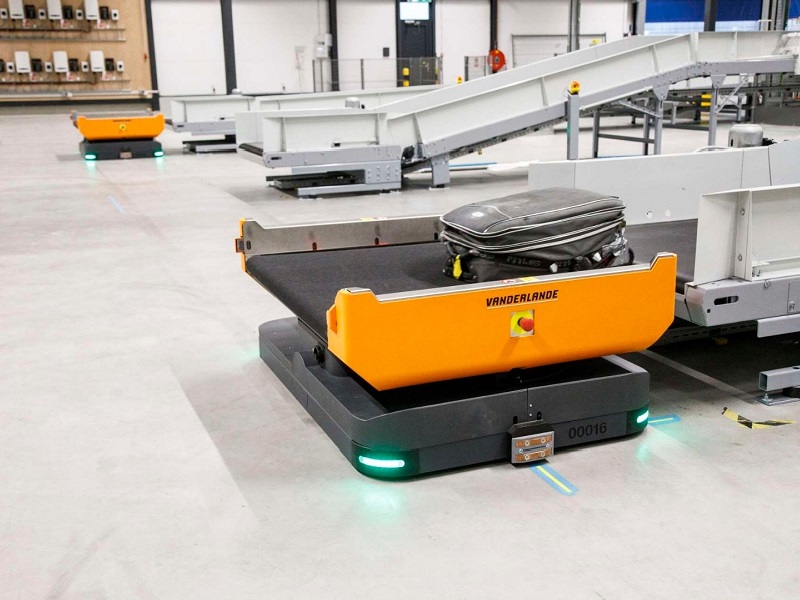
Dozens of small robotic vehicles carrying suitcases criss-cross a vast, airy warehouse – plucking baggage from conveyor belts before darting off towards X-ray security scanners and then on to the aircraft hold.

The scene – shown in a promotional video from the Dutch logistics automation specialist Vanderlande – looks like something out of a science fiction movie. But it is in fact an already operational automated baggage handling system that could transform how airports work in the future.

Known as FLEET, the Vanderlande system seeks to replace the need for fixed conveyors and sorting systems – a process that is buckling at the seams as more than 4 billion passengers take to the sky each year and new hold baggage screening regulations prove challenging and costly for some airports.

According to the most recent statistics from SITE – an aviation communications and technology company – roughly 22 million bags were lost in 2016, affecting around six in every 1,000 passengers. While this number is half the rate of 2007, it is still a sizeable percentage that airports are keen to bring down as passenger numbers soar.

Airports must adapt rapidly and cope with a shortage of personnel, while maintaining seamless operations within a limited footprint,” says Vanderlande spokesperson Diane van der Sanden.

“Fixed infrastructure and fragmented IT architecture are no longer the preferred solutions in an ever-evolving environment in which process fluctuations (and corresponding volume changes) must be accommodated.”

“Flexible and cost-effective”

With the FLEET system, intelligent autonomous vehicles carry single bags through the airport, determining the most optimal route for a given time and passenger. The technology is based on real-time data, with route planning continuously updated and optimised to obtain the highest possible throughput.

According to Vanderlande, the system is able to withstand “fluctuations in baggage flow characteristics, such as airline volume distribution or hot bag percentages”, as well as changing security and screening regulations.

If certain parts of an airport’s operations move to another area, for example, the vehicles can be shifted to where they are needed most. FLEET can also act as a temporary baggage solution for peak periods or during phased construction projects.

“Due to FLEET’s configuration, adding vehicles or changing routes is easy, resulting in a scalable and flexible solution,” says van der Sanden. “It has been designed to seamlessly grow alongside an airport, match its operations and peak flows, and allow it to adapt to changing security and screening regulations without interrupting operations.”

The flexibility of the system means it is also cost-effective. Because airports can adapt the number of vehicles and routes to their specific capacity needs, having unused assets on their balance sheets “is a problem that can be consigned to history,” says van der Sanden.

“When the needs of an airport or security regulations change, FLEET can adapt to the new situation,” she says. In this way, it contributes strongly to improved asset utilisation.”

From Rotterdam to Hong Kong

The FLEET system was first introduced to the market in 2017 at inter airport – an international exhibition for airport equipment, technology, design and services. The vehicles were then built and tested in-house at Veghel, Vanderlande’s headquarters in The Netherlands, before being put into use at Rotterdam The Hague Airport (RTHA).

According to van der Sanden the first installation was relatively straightforward, with the vehicles driving around their new home almost immediately. A few months after the project began, the CEO of RTHA, Ron Louwerse certainly appeared satisfied.

“For us, it was important to have a flexible, efficient and sustainable system that could be scaled up and down as required,” he said at a press conference in March.

“We needed a new baggage system because the current one was outdated, but we needed it to be flexible enough to manage future growth. FLEET gave us the opportunity to trial a system that was independent of the actual number of bags.”

Real-world experience

The installation at RTHA, alongside projects at Lelystad Airport in the Netherlands and another airport in the USA, have produced invaluable insights that have helped shape the FLEET system, van der Sanden says.

“Our Value Centre uses global insights gained from our cross-site activities to make daily improvements,” she says. “Through these, system, maintenance and operational improvements can be made daily, as well as reductions to the total cost of ownership (TCO). By using central intelligence and a standard platform, every FLEET user is connected and benefits from continuous improvement.”

A new partnership agreement signed with Airport Authority Hong Kong will soon test the system in an even more strenuous setting: Hong Kong International Airport (HKIA), one of the fastest growing airports in the world.

The partnership will allow Vanderlande to further modify and adapt FLEET, while HKIA will be able to see how autonomous vehicles could help improve the efficiency of its baggage handling processes as well as the working conditions for its ground staff.

“We are delighted to join forces on this programme that will help us to realise our aspiration of being a leader in technology and innovation among international airports,” said Steven Yiu, deputy director of service delivery at AAHK.

Vanderlande’s executive vice president of airports Andrew Manship added: “Ultimately, our aim is to enhance the passenger experience, while improving efficiency and we have full confidence in FLEET’s capacity to deliver impressive results at one of the fastest growing airports in the world. This cooperation agreement with HKIA will be another important step in its further development.”

source : https://www.airport-technology.com/features/autonomous-baggage-handling-vehicles/

DJI’s awesome new feature will stop drones taking down airports

The majority of DJI’s drones will include aeroplane and helicopter detectors to stop them intruding on flight paths from 2020.

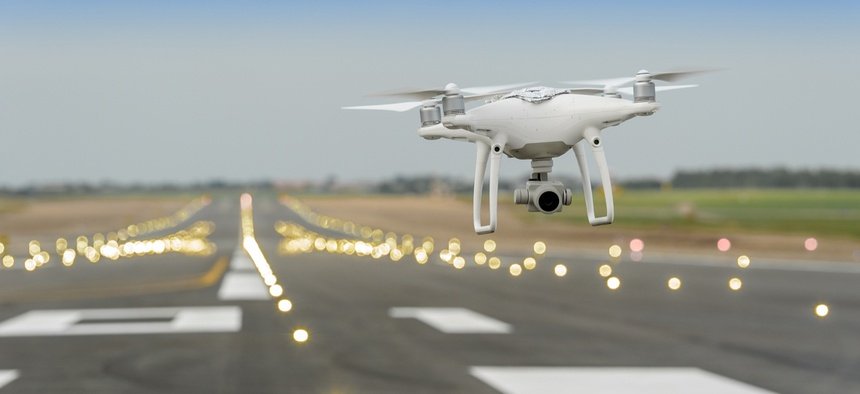
Airport drone incidents drew widespread attention when a drone shut down Gatwick Airport in late 2018. The safety measure is called AirSense and will be rolled out on all new DJI drones weighing more than 250g .

AirSense can reportedly detect aeroplanes and helicopters from miles away. The location of detected aircraft will be shown on the remote controller of the drone user. The measure still requires action by the user as it simply notifies them of nearby aircraft.

AirSense technology uses ADS-B sensors. ADS-B sensors are currently used by aircraft and air traffic control towers. The sensors are what will enable new DJI drones to detect aeroplanes and helicopters that the drone user may not yet be able to see.  The feature is not completely new – having been available on professional-grade DJI drones for some time.

Related: Best drones

Prior to these new measures, the company did implement a significant safety update which would prevent users from flying near airports – rather than just warning them. The update added more effective geo-fencing – barring users from flying within airport space. The new Geospatial Environment Online (GEO) came to 32 countries and uses GPS and navigational satellite data to create no-fly zones.

DJI’s new detection sensors are part of a 10 point plan proposed by the company to be implemented industry-wide. The “Elevating Safety” plan includes standards like governments requiring knowledge tests for new drone pilots, increasing the enforcement of drone laws and mandatory geo-fencing for all drones.

Following the Gatwick drone incident in 2018, the UK government brought in new regulations to crack down on errant drone users. The laws made it illegal to fly a drone within a 3-mile radius of any UK airports. The changes implemented additional restrictions to the current set of UK drone laws.

source : https://www.trustedreviews.com/news/3773803-3773803

FAA issues new rules for hobbyist drone pilots Haye Kesteloo –

Last Thursday, the Federal Aviation Administration (FAA) issued new rules for hobbyist drone pilots in an effort to keep the national airspace safe and available for both manned and unmanned aircraft. Hobbyist or recreational drone pilots are no longer exempt under Section 336 and are now required to follow these new FAA rules and regulations. Unfortunately, for the time being, this means that hobbyist or recreational drone pilots are no longer able to fly in controlled airspace at all, with the exception of these designated areas.

Later this summer, when the Low Altitude Authorization and Notification Capability (LAANC) system will be made available to hobbyist drone pilots, they will be required to obtain approval for their flights in controlled airspace through the LAANC system. If this sounds to you like the FAA is putting the horse behind the wagon, then I would agree. However, this is the situation that we are dealing with for now. Keep in mind it will only be temporary until the FAA makes LAANC available to all pilots.

However, this is not all. The FAA will also require all hobbyist drone pilots to take an electronic aeronautical knowledge and safety test. And, you will be required to show proof of you successfully passing the exam to any FAA official or police officer upon request.

Keep reading for all the details of these new rules and what it means to you. If you prefer to watch a 12-minute video instead of reading, I suggest you watch the one below from 51drones.

New rules for hobbyist drone pilots issues by the FAA

As of May 17th, the FAA has put in place the following new rules for all hobbyist or recreational drone pilots in an effort to keep the national airspace safe for both manned an unmanned aircraft.

The new rules are the result of the regulations outlined in the FAA Reauthorization Act of 2018, signed into law by President Trump. The act included the appeal of Section 336, also known as the Special Rule for Model Aircraft, which exempted hobbyist drone pilots from the FAA rules.

Even though the new FAA rules are not legally binding, the agency does have the authority to take enforcement action to guarantee the safety of the national airspace.

Last Thursday, the FAA said in a statement:

“While recreational flyers may continue to fly below 400 feet in uncontrolled airspace without specific certification or operating authority from the FAA, they are now required to obtain prior authorization from the FAA before flying in controlled airspace around airports. Furthermore, they must comply with all airspace restrictions and prohibitions when flying in controlled and uncontrolled airspace.”

Previously, hobbyist drone pilots only had to notify the Air Traffic Control Center (ATC) before flying their drone within five miles of an airport. Now, they will have to request authorization thru the not yet available LAANC system. The FAA expects LAANC to become available sometime this summer. For now, this means that recreational drone pilots can only fly in uncontrolled airspace or at any of the fixed sites, shown on this map here.

Jay Merkle, the FAA’s Executive Director for UAS Integration, explained the situation as follows:

“We view this as a very positive step forward for the safe integration of UAS. Including everyone under the same rules really does move everything forward.”

We would agree with that statement, with the caveat that the FAA should make LAANC available to hobbyist drone pilots as soon as possible as the current situation will likely lead to many drone pilots knowingly or unknowingly breaking the new rules.

As far as the new electronic aeronautical knowledge and safety test that will be required for all hobbyist drone pilots, that should become available in an online form before November 18, 2019.

The new FAA rules have been published on the website of the Federal Register here.

Video explains the new rules

If you prefer to watch a short video instead of reading through all the text, I would suggest you watch this excellent video from 51drone in which Russ explains the new rules for hobbyist drone pilots.

On the FAA website, you will find a summary of the new rules

Recreational Flyers & Modeler Community-Based Organizations

You are considered a recreational user if you fly your drone for fun. It is important to know when and where you can fly and how to register your drone.

New Changes to Recreational Drone Flying in the United States

There’s a new law (PDF) that describes how, when, and where you can fly drones for recreational purposes. Following these rules will keep you and your drone safe and will help keep the airspace available to everyone.

Here’s what you need to do:

  1. Register your drone, mark it on the outside with the registration number (PDF), and carry proof of registration with you.
  2. Fly only for recreational purposes.
  3. Follow the safety guidelines of a community based organization.
  4. Fly your drone at or below 400 feet when in uncontrolled or “Class G” airspace. This is airspace where the FAA is not controlling manned air traffic. To determine what type of airspace you are in, refer to the mobile application that operates your drone (if so equipped) and/or use other drone-related mobile applications. Knowing your location and what airspace you’re in will also help you avoid interfering with other aircraft.
  5. Do NOT fly in controlled airspace (around and above many airports) unless:You are flying at a recreational flyer fixed site that has an agreement with the FAA. The FAA has posted a list of approved sites (MS Excel) and has depicted them as blue dots on a map. Each fixed site is limited to the altitude shown on this map, which varies by location.NOTE: Flight in controlled airspace is temporarily limited to these fixed fields. The FAA is upgrading the online system, known as LAANC (the Low Altitude Authorization and Notification Capability), so that recreational operations can get automated airspace authorizations to fly in controlled airspace. This system is currently only available for certified Part 107 drone pilots.NOTE: If your organization is interested in establishing a letter of agreement for a fixed flying site, please contact us at ajt-9-uas-integration@faa.gov.
  6. Keep your drone within your line of sight, or within the visual line-of-sight of a visual observer who is co-located and in direct communication with you.
  7. Do NOT fly in airspace where flight is prohibited. Airspace restrictions can be found on our interactive map, and temporary flight restrictions can be found here. Drone operators are responsible for ensuring they comply with all airspace restrictions.
  8. Never fly near other aircraft, especially near airports.
  9. Never fly over groups of people, public events, or stadiums full of people.
  10. Never fly near emergencies such as any type of accident response, law enforcement activities, firefighting, or hurricane recovery efforts.
  11. Never fly under the influence of drugs or alcohol.

Recreational flyers should know that if they intentionally violate any of these safety requirements, and/or operate in a careless and reckless manner, they could be liable for criminal and/or civil penalties.

Read the Authorization for limited recreational operations as described in section 44809 (PDF). All limited recreational operations should be conducted in accordance with this authorization.

Changes Coming in the Future

The FAA is upgrading the online system, known as LAANC (the Low Altitude Authorization and Notification Capability), so that recreational operations can get automated airspace authorizations to fly in controlled airspace.

The new law also requires:

  1. Drone operators to pass an online aeronautical knowledge and safety test and carry proof of test passage.
  2. The FAA to issue guidance for how it will recognize community based organizations.

The FAA plans to have all of these features and requirements fully implemented by the summer of 2019.

Check our website for the latest updates or follow us on social media for the latest news.

More detailed information about the FAA’s plan to fully implement the requirements of Section 349 of the FAA Reauthorization Act of 2018 may be found on the Federal Register.

What do you think about these new FAA rules for hobbyist drone pilots? Let us know in the comments below.

Stay in touch!

If you’d like to stay up to date with all the latest drone news, scoops, rumors and reviews, then follow us on TwitterFacebookYouTube, Instagram or sign up for our daily email newsletter, that goes out every weekday at 6 pm.

Buy your next drone through directly from manufacturers, such as DJIParrotYuneec or retailers like Amazon, B&H, BestBuy or eBay. By using our links, we will make a small commission, but it will not cost you anything extra. Thank you for helping DroneDJ grow!

source : https://dronedj.com/2019/05/20/faa-new-rules-hobbyist-drone-pilots/